On eBird ↗
Checker-throated Stipplethroat
Live sightings near you, the range map, bar charts of when it is seen, and Macaulay Library photos and recordings.
Checker-throated Stipplethroat
Epinecrophylla fulviventris
The checker-throated antwren or fulvous-bellied antwren (Epinecrophylla fulviventris) is a small passerine bird in the antbird family. It has traditionally been placed in the genus Myrmotherula, but is, together with other members of the so-called "stipple-throated group", now placed in the new genus Epinecrophylla. This is supported by molecular work, behavior, voice and morphology. Now treated as monotypic, it includes the former subspecies E. f. costaricensis and E. f. salmoni.
From the article Checker-throated stipplethroat on Wikipedia (CC BY-SA), quoted section by section
Description
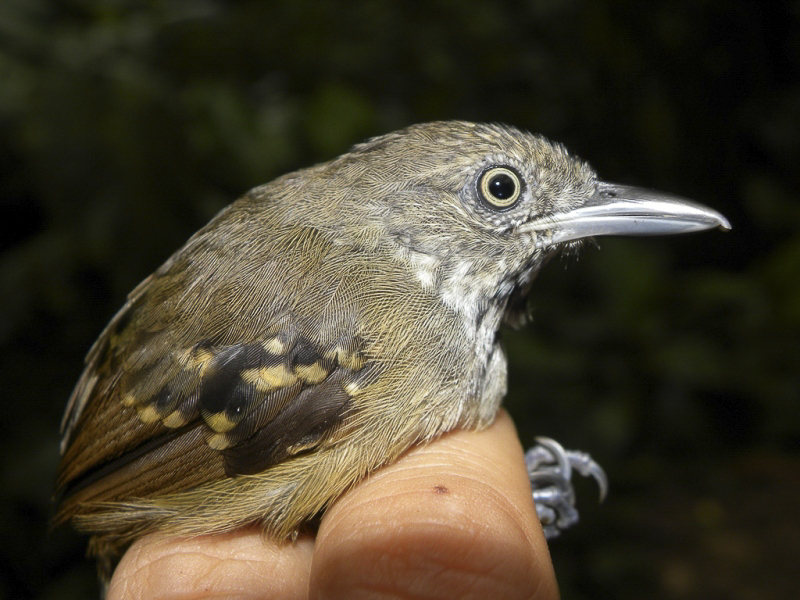
The checker-throated stipplethroat is 10 to 11 cm (3.9 to 4.3 in) long and weighs 8.5 to 11.5 g (0.30 to 0.41 oz). The sexes have nearly identical plumage. Males have a mostly gray face and a black throat with large white spots. Females have a mostly brownish buff face and throat. Adults of both sexes have a gray-brown crown and upperparts and a reddish tail. Their wing coverts are blackish brown to olive-brown with yellow-ochre tips and their flight feathers are reddish. Their breast is gray and the rest of their underparts are brownish buff that is darker towards the vent area. Their iris is golden that darkens with age. Juveniles have a gray iris that yellows as they mature.
Range & habitat
The checker-throated stipplethroat is found on the Caribbean slope from far southeastern Honduras through Nicaragua and Costa Rica into western Panama, on both the Caribbean and Pacific slopes from western Panama into Colombia, east in Colombia into the Magdalena River valley, and south through western Colombia and Ecuador nearly to Peru. It inhabits evergreen forest in the lowlands and foothills and adjacent mature secondary forest. It favors areas with dense vine tangles that collect debris. In elevation it mostly ranges up to about 750 m (2,500 ft) in Central America, to 1,200 m (3,900 ft) in Colombia, and to 900 m (3,000 ft) in Ecuador. It does reach 900 m (3,000 ft) in Costa Rica and 2,000 m (6,600 ft) in Colombia.
Wikipedia: “Distribution and habitat”
What it does
The checker-throated stipplethroat feeds on arthropods, especially cockroaches (Blattidae), crickets (Gryllidae), katydids (Tettigoniidae), and spiders. It typically forages in pairs or in small family groups and less often by itself, and usually as part of a mixed-species feeding flock. It occasionally, and for short periods, attends army ant swarms. It mostly forages in the forest understory to mid-story; some studies found that it seldom exceeds 10 m (30 ft) above the ground, but others have noted it feeding as high as 25 m (80 ft). It forages mostly in vine tangles, on their foliage and in dead leaves and other debris trapped in them. It also forages by hitching along thin branches and capturing prey from their live leaves, in clumps of moss, and from epiphytes.
Wikipedia: “Feeding”
Listen
Looking for field recordings…
Where it lives
Recorded sightings
—
geo-referenced records in GBIF, from museums, herbaria and field observers.
Drag the globe to turn it. Dots are where records exist, not a range map; darker means more records.
In the stacks
Searching the stacks…
Every page naming Epinecrophylla fulviventris in the Biodiversity Heritage Library →
This page is assembled live from iNaturalist, GBIF, Wikipedia, the Source Library and the Internet Archive. It is not yet part of the hand-edited codex. iNaturalist taxon 72833.