On eBird ↗
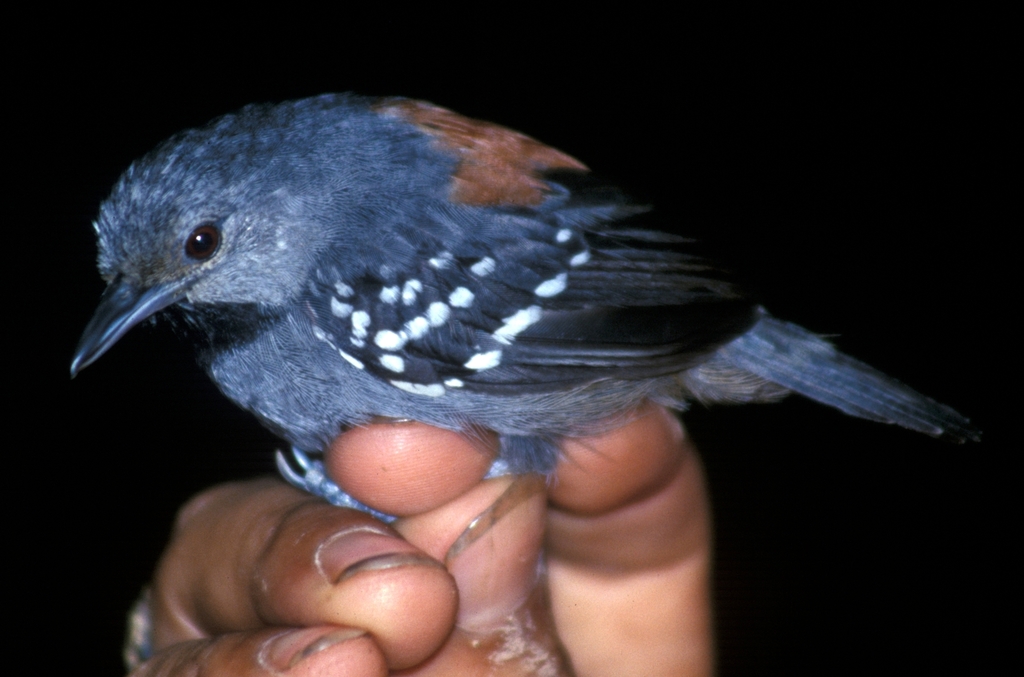
Ornate Stipplethroat
Live sightings near you, the range map, bar charts of when it is seen, and Macaulay Library photos and recordings.
Ornate Stipplethroat
Epinecrophylla ornata
The ornate antwren (Epinecrophylla ornata) is a species of bird in the family Thamnophilidae. It was formerly placed in the genus Myrmotherula but the new genus Epinecrophylla was created in 2006. It is found in Bolivia, Brazil, Colombia, Ecuador, and Peru. Its natural habitats are subtropical or tropical moist lowland forests and subtropical or tropical swamps.
From the article Ornate stipplethroat on Wikipedia (CC BY-SA), quoted section by section
Description
The ornate stipplethroat is 9 to 11 cm (3.5 to 4.3 in) long and weighs 8.5 to 11 g (0.30 to 0.39 oz). Adult males of the nominate subspecies E. o. ornata have a gray head, neck, and upper back. Their lower back and rump are rufous chestnut. Their tail is blackish gray with thin white edges to the feathers. Their wings are blackish gray with white tips on the coverts. They have a solid black throat. Their underparts are mostly pale gray with a brown tinge to the flanks and undertail coverts. Adult females have a mostly olive-tinged cinnamon face. Their crown, neck, and upper back are grayish olive-brown. Their throat is black with white streaks. Their underparts are olive-tinged cinnamon that is darker on the flanks and undertail coverts. Males of subspecies E. o. saturata are darker and more richly colored than the nominate, and females are slightly darker. Males of subspecies E. o. atrogularis are like saturata males; females have grayer upperparts than saturata with no cinnamon on their underparts. Males of E. o. meridionalis have entirely gray upperparts (no rufous chestnut) and pale gray underparts. Females have gray to grayish olive-brown upperparts and cinnamon-rufous tinged buff underparts. Males of E. o. hoffmannsi have less extensive rufous chestnut on their upperparts than the nominate. Females' throats are the same olive-tinged cinnamon as their underparts. …
Range & habitat
The subspecies of the ornate stipplethroat are found thus:
E. o. ornata: Colombia's Meta Department E. o. saturata: south-central Colombia south through eastern Ecuador into northeastern Peru to the Marañón River E. o. atrogularis: from east-central Peru between San Martín and Ayacucho departments east into the western parts of Brazil's Amazonas and Acre states E. o. meridionalis: southeastern Peru, northwestern Bolivia, and adjoining western Brazil E. o. hoffmannsi: Amazonian Brazil in Rondônia, Mato Grosso, and Tocantins states The ornate stipplethroat primarily inhabits evergreen forest including terra firme, transitional forest, and várzea. In some areas it favors stands of Guadua bamboo and in others areas with many vine tangles. In elevation it reaches 1,500 m (4,900 ft) in Colombia but only 900 m (3,000 ft) in Brazil and 1,200 m (3,900 ft) in Ecuador.
Wikipedia: “Distribution and habitat”
What it does
The ornate stipplethroat feeds on arthropods, especially insects and spiders. It typically forages singly, in pairs, or in small family groups, and usually as part of a mixed-species feeding flock. It mostly forages in the forest understory to mid-storey between about 4 and 9 m (13 and 30 ft) above the ground but occasionally as low as 1 m (3 ft) and as high as 20 m (65 ft). It takes its prey almost entirely by gleaning from dead leaves on trees but also from dead leaves caught in vine tangles and small palms.
Wikipedia: “Feeding”
Listen
Looking for field recordings…
Where it lives
Recorded sightings
—
geo-referenced records in GBIF, from museums, herbaria and field observers.
Drag the globe to turn it. Dots are where records exist, not a range map; darker means more records.
In the stacks
Searching the stacks…
Every page naming Epinecrophylla ornata in the Biodiversity Heritage Library →
This page is assembled live from iNaturalist, GBIF, Wikipedia, the Source Library and the Internet Archive. It is not yet part of the hand-edited codex. iNaturalist taxon 72837.