On eBird ↗
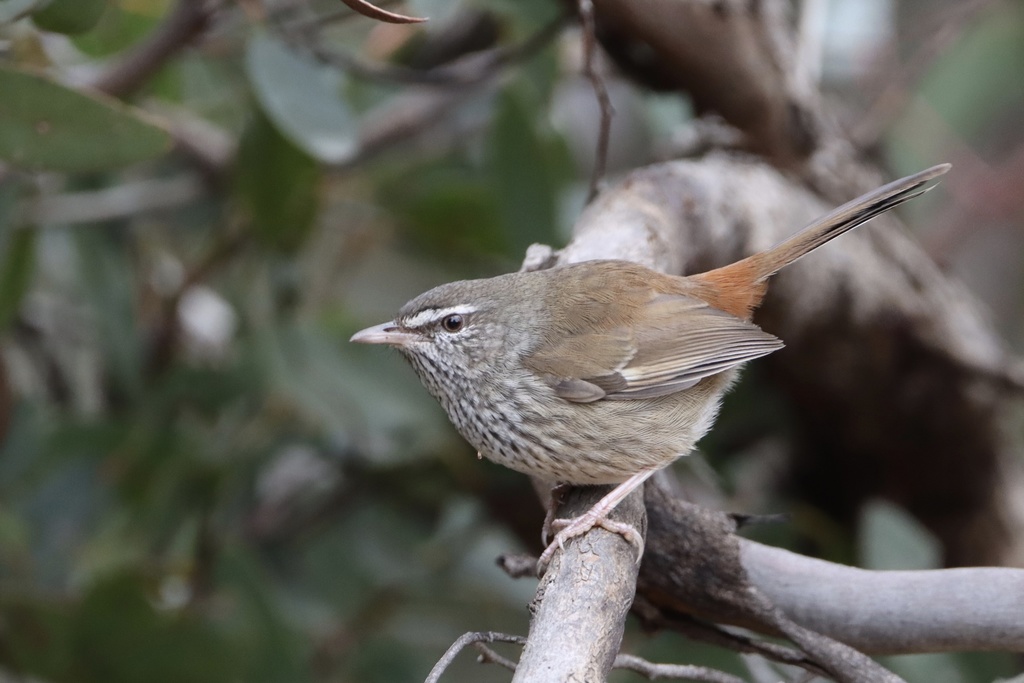
Chestnut-rumped Heathwren
Live sightings near you, the range map, bar charts of when it is seen, and Macaulay Library photos and recordings.
Chestnut-rumped Heathwren
Hylacola pyrrhopygia
The chestnut-rumped heathwren (Hylacola pyrrhopygia) is a species of bird in the family Acanthizidae.
It is endemic to temperate and subtropical forests and heathlands of Australia.
From the article Chestnut-rumped heathwren on Wikipedia (CC BY-SA), quoted section by section
Description
The chestnut-rumped heathwren is a small bushland bird with an olive-brown back with conspicuous reddish-brown rump and tail coverts. It has a streaked brown-on-white chest and the belly and rear flanks are grey-buff. There is a dark subterminal band with a white tip on the usually erect tail. Both sexes have a dull white eyebrow; eyes are yellow, while bill, legs, and feet are grey. There are only small differences between the subspecies that are not easily recognised in the field. It measures 14 cm (5.5 in) in length.
Range & habitat
The chestnut-rumped heathwren occurs in southeastern Australia from the Granite Belt of southeast Queensland through eastern New South Wales, Victoria, and southeast South Australia. In Victoria, it ranges inland to the Grampians and Bendigo region, but is more usual in coastal parts. In New South Wales, it occurs inland as far as the Warrumbungles and Temora. Scattered populations occur in the Flinders and Mt Lofty Ranges, and the Fleurieu Peninsula of South Australia. Its preferred habitats are heaths of coastal, mountain and hinterland areas, and the dense undergrowth of forests and woodland. It is sedentary and uncommon within its range.
Wikipedia: “Distribution and habitat”
What it does
The chestnut-rumped heathwren is usually shy and secretive until the breeding season from July to November, when both sexes will sing from a perch on a bush, though still staying partly concealed. Its song is a rich, melodious warbling chi-chi-tu-weet, kwe-reep, and suchlike notes in great variety, blended with mimicry of other birds. It also makes a harsh or scolding zeet on contact or alarm. The chestnut-rumped heathwren builds a domed or globular nest on or near the ground in tussocks or dense shrubs. The nest is composed of dry grass stems, bark fibre and rootlets, often appearing untidy. A clutch of three or four eggs is laid and usually incubated by the female for 14-16 days. The eggs, measuring 20 by 15 mm (0.79 by 0.59 in), are salmon-pink, freckled with light chocolate-brown, more so at the larger end.
Wikipedia: “Behaviour and breeding”
Listen
Looking for field recordings…
Where it lives
Recorded sightings
—
geo-referenced records in GBIF, from museums, herbaria and field observers.
Drag the globe to turn it. Dots are where records exist, not a range map; darker means more records.
In the stacks
Searching the stacks…
Every page naming Hylacola pyrrhopygia in the Biodiversity Heritage Library →
This page is assembled live from iNaturalist, GBIF, Wikipedia, the Source Library and the Internet Archive. It is not yet part of the hand-edited codex. iNaturalist taxon 72929.