On eBird ↗
Blue Duck
Live sightings near you, the range map, bar charts of when it is seen, and Macaulay Library photos and recordings.
Blue Duck
Hymenolaimus malacorhynchos
The blue duck (Hymenolaimus malacorhynchos) or whio is a member of the duck, goose and swan family, Anatidae and is endemic to New Zealand. It is the only individual species belonging to the genus Hymenolaimus. Its closest relatives are the ducks in the genus Sarkidiornis.
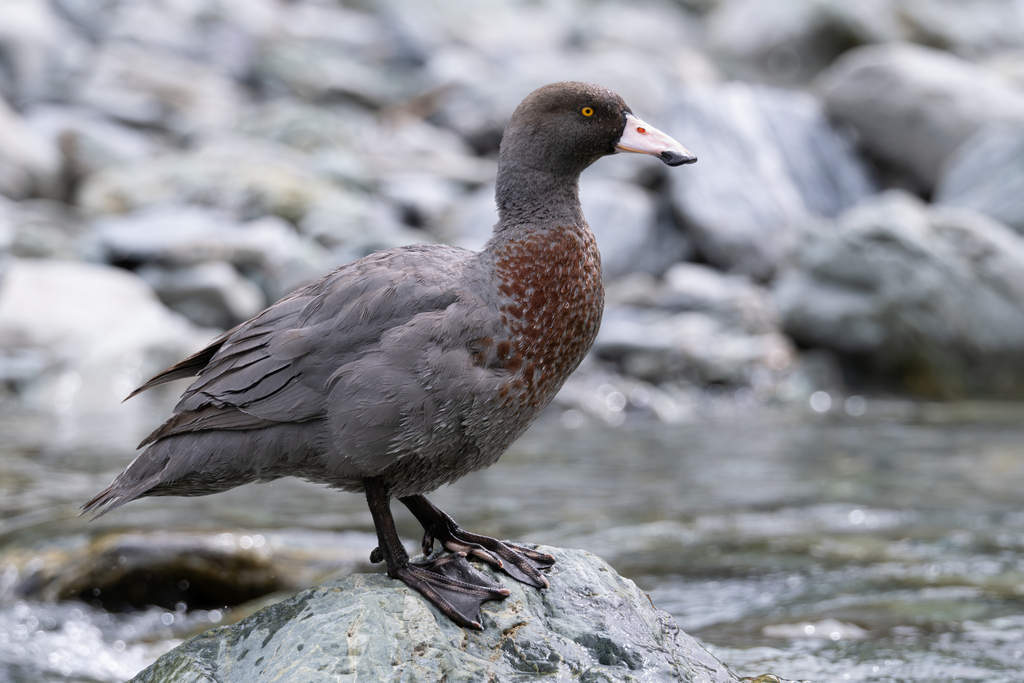
First seen and recorded by the British explorer, James Cook in his second voyage to New Zealand, its scientific name was given by the German naturalist, Johann Friedrich Gmelin in 1789 and later George Robert Gray in 1843. There are two subspecies of the blue duck, one in North Island and the other in South Island. Common to both gender, its physical characteristics include yellow iris, a pale grey beak with semicircular flaps and lamellae, dark-slate grey plumage, chestnut flecked breast, dark grey webbed feet, and well developed claws. The male blue duck has a high-pitched whistle, which gave its Māori name Whio, while the female has a low-pitched rattle.
From the article Blue duck on Wikipedia (CC BY-SA), quoted section by section
Description
The blue duck is 50–55 cm (20–22 in) long and varies in weight by sex. Females are smaller than males, weighing 680–870 g (24–31 oz), whereas the males weigh 820–970 grams (29–34 oz). The plumage is a dark slate-grey with a greenish sheen on the head, a chestnut-flecked breast. The outer secondaries are tipped with white and the inner ones have black margins. The plumage of the two sexes are mostly the same, although the female has slightly less chestnut in the chest. It has webbed feet which gives it power to swim in fast-flowing current, and well-developed claws which are suited for rough terrain. Juvenile blue ducks have an oversized feet and legs that helps it to similarly swim in fast currents, and jump onto large rocks and logs. The legs and feet are both dark grey in colour. The upper bill in blue duck has a semicircular soft flap that protects it from abrasion while it engages in dabbling. The tiny comb like structures (or lamellae) around the edge of the bill helps it to feed by diving. During aggressive confrontations or when frightened, the blue duck's bill changes its pale grey color to a distinct pink. The bill is green at hatching and develops its final colour eight hours later. The juvenile blue ducks have a grey iris while the adults possess a yellow one. Their life expectancy is upto 12 years which gets reduced due to predation. …
Range & habitat
In the 18th century when the European voyages to New Zealand became significant, the Blue duck was widespread and abundant in the country. After the human settlement when the forests were being cleared, its population started to decline. Charlie Douglas in 1891 surprised on the blue duck's quick disappearances during an exploration of Waiatoto River remarked that:
The ferrets have not got among the birds on this river evidently, as kakapos are squealing about in hundreds. Will have to tie up the dog if I don’t want the camp full of corpses in the morning. But what is up with the blue ducks? When up here before they were in hundreds, now I have only seen one, and he travelled as if Old Nick was after him. It was last commonly seen in New Zealand in the 1950s following which its population dwindled because of stoats predating on it. Historical evidence suggests that it once inhabited the offshore islands of New Zealand and not just the North Island and South Island. The blue duck heavily relies on clean, stable rivers and stream catchments. They are currently located in medium to steep gradient rivers with partial forest cover overhead and vegetation to the riverside. Roosting (or resting) spots are close to the stable undercut of river bank formed by the root system of trees or in log accumulations. …
Wikipedia: “Distribution and habitat”
What it does
Blue ducks are found year-round as territorial pairs along a river. Single males occasionally try to take space between separated pairs as new territory. Once the territory is established, it is held by the single male for life. Juvenile or young ducks try to establish their territories near to their natal catchment which leads to high levels of genetic similarity between ducks in a territory. It rarely settles beyond its natal catchment.
Diet. The blue duck feeds almost entirely on aquatic invertebrate larvae. A study of blue ducks on the Manganuioteao River in the central North Island found the most common prey items were Chironomidae (midge) and cased caddisfly larvae, although cased caddisfly were less preferred and were only consumed so much because of their abundance. Hydrobiosidae (free-living caddisfly) and Aphrophila neozelandica (crane fly) larvae were also frequently eaten. Other prey included mayfly, Aoteapysche (net-building caddis) and stonefly larvae. In addition to these insects, it also consumes silt, periphyton and berries from riverside plants.
Foraging. Blue duck forages by dabbling on aquatic invertebrates in cold, fast, well oxygenated and clean mountain streams. It dabbles more by scouring rocks than dabbling at the water's surface. Studies have shown that adult territorial blue ducks dabble more than juvenile ones. …
Wikipedia: “Behaviour”
Listen
Looking for field recordings…
Where it lives
Recorded sightings
—
geo-referenced records in GBIF, from museums, herbaria and field observers.
Drag the globe to turn it. Dots are where records exist, not a range map; darker means more records.
In the stacks
Searching the stacks…
Every page naming Hymenolaimus malacorhynchos in the Biodiversity Heritage Library →
This page is assembled live from iNaturalist, GBIF, Wikipedia, the Source Library and the Internet Archive. It is not yet part of the hand-edited codex. iNaturalist taxon 72936.