On eBird ↗
Imeri Warbling-Antbird
Live sightings near you, the range map, bar charts of when it is seen, and Macaulay Library photos and recordings.
Imeri Warbling-Antbird
Hypocnemis flavescens
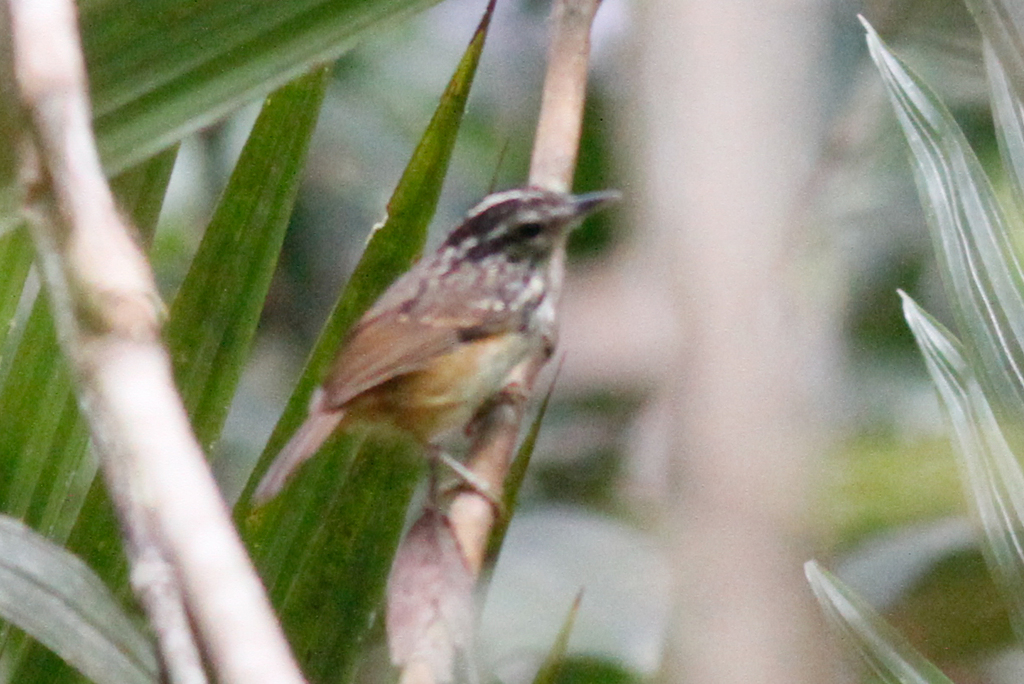
The Imeri warbling antbird (Hypocnemis flavescens) is a species of bird in the family Thamnophilidae. Until recently, it was considered a subspecies of Hypocnemis cantator, but based on vocal differences and to a lesser degree differences in plumages it has been recommended treating them as separate species. As presently defined, the Imeri warbling antbird includes a single subspecies, perflava.
From the article Imeri warbling antbird on Wikipedia (CC BY-SA), quoted section by section
Description
The Imeri warbling antbird is 11 to 12 cm (4.3 to 4.7 in) long and weighs 11 to 15 g (0.39 to 0.53 oz). Adult males have a black crown with a white central streak and a white supercilium on an otherwise black and white speckled face. Their upperparts are olive-gray with a white patch between the scapulars; the center of the patch has black and white speckles. Their rump is rufous. Their flight feathers are brown with yellowish olive-brown edges and their wing coverts black with white tips. Their tail is brown with pale buff tips to the feathers. Their throat and breast are pale gray with a yellow tinge. Their breast and sides have sparse dark streaks and their belly, flanks, and undertail coverts are deep rufous. Females have the same pattern but different colors than males. Their crown is streaked with pale buff, the interscapular patch is small or absent, and their wing coverts are olive-brown with pale buff tips.
Range & habitat
The nominate subspecies of the Imeri warbling antbird is found in southern Venezuela's Bolívar and Amazonas states, in Colombia from eastern Caquetá Department east through Vaupés and Guainía departments, and in extreme northwestern Brazil in the upper basin of the Rio Negro. Subspecies H. f. perflava is found northern and central Roraima in northwestern Brazil. The species inhabits the edges of terra firme and várzea evergreen forest, mature secondary woodland, and shrubby borders of savanna woodland. It also occurs within the forest along watercourses and at gaps caused by fallen trees. In elevation it occurs mostly below about 600 m (2,000 ft), though it reaches only 200 m (700 ft) in Colombia and is found as high as 1,200 m (3,900 ft) in a few locations.
Wikipedia: “Distribution and habitat”
What it does
The Imeri warbling antbird's diet and foraging behavior are not known in detail, but it feeds primarily on insects and spiders. It typically forages by itself, in pairs, or in family groups and only occasionally joins mixed-species feeding flocks. It forages mostly in dense vegetation such as vine tangles, understorey shrubs, bamboo thickets, and among epiphyte cluster on tree trunks and branches. It takes most of its prey by reaching or lunging from a perch and also makes short sallies to overhanging vegetation. It regularly follows army ant swarms, though it defers to obligate ant followers.
Wikipedia: “Feeding”
Listen
Looking for field recordings…
Where it lives
Recorded sightings
—
geo-referenced records in GBIF, from museums, herbaria and field observers.
Drag the globe to turn it. Dots are where records exist, not a range map; darker means more records.
In the stacks
Searching the stacks…
Every page naming Hypocnemis flavescens in the Biodiversity Heritage Library →
This page is assembled live from iNaturalist, GBIF, Wikipedia, the Source Library and the Internet Archive. It is not yet part of the hand-edited codex. iNaturalist taxon 72937.