On eBird ↗
Puerto Rican Oriole
Live sightings near you, the range map, bar charts of when it is seen, and Macaulay Library photos and recordings.
Puerto Rican Oriole
Icterus portoricensis
The Puerto Rican oriole (Icterus portoricensis), or calandria is a species of bird in the family Icteridae, and genus Icterus or New World blackbirds. This species is a part of a subgroup of orioles (Clade A) that includes the North American orchard oriole, Icterus spurius, and the hooded oriole, Icterus cucullatus.
The Puerto Rican oriole was previously grouped with Cuban oriole (Icterus melanopsis), Hispaniolan oriole (Icterus dominicensis), and Bahama oriole (Icterus northropi) as a single species, (Icterus dominicensis). In 2010, all four species became recognized as full species by the American Ornithologists' Union.
From the article Puerto Rican oriole on Wikipedia (CC BY-SA), quoted section by section
Description
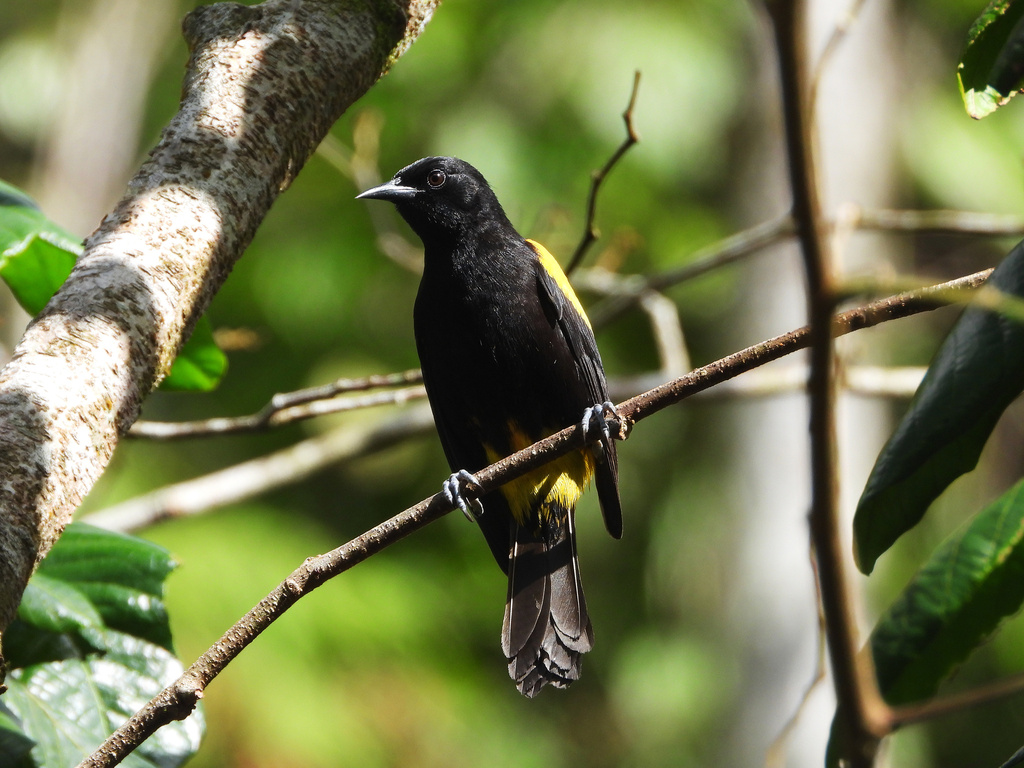
Males and females are similar in size and color. Males weigh about 41.0 grams and females weigh about 36.6 g. The average wingspan of males and females is 96.9 and 92.1 mm, respectively. In 2008, Hofmann, Cronin, and Omland, conducted a study that showed there is little color difference in the feathers between the males and females of many tropical orioles, including the Puerto Rican oriole. This means that males and females both have elaborate colors, in contrast many temperate-zoned birds have brightly colored males and dull colored females. Adults are black with yellow on their lower belly and shoulder. The closely related Hispaniolan oriole (Icterus dominicensis) and Bahama oriole (Icterus northropi) have more yellow on their bodies, but, the Cuban oriole (Icterus melanopsis) has more black. Juveniles are tawny colored with an olive tint to their rump. Puerto Rican orioles develop their bright colors as they age. The tawny color offers a selective advantage to the adolescents since by helping with camouflage in the dense forest. This is likely the ancestral state for the genus Icterus.
Range & habitat
The oriole is endemic to Puerto Rico. Its natural habitats are the tropical forests, mangrove forests, and plantations. The bird also shows a natural preference for nesting in palm trees.
Wikipedia: “Habitat”
What it does
After breeding, adult Puerto Rican orioles and their young will remain together in a family group. It primarily forages in dense vegetation looking for a wide range of foods that includes fruits, insects, lizards, and nuts and grains.
Wikipedia: “Behavior”
Listen
Looking for field recordings…
Where it lives
Recorded sightings
—
geo-referenced records in GBIF, from museums, herbaria and field observers.
Drag the globe to turn it. Dots are where records exist, not a range map; darker means more records.
In the stacks
Searching the stacks…
Every page naming Icterus portoricensis in the Biodiversity Heritage Library →
This page is assembled live from iNaturalist, GBIF, Wikipedia, the Source Library and the Internet Archive. It is not yet part of the hand-edited codex. iNaturalist taxon 72952.