On eBird ↗
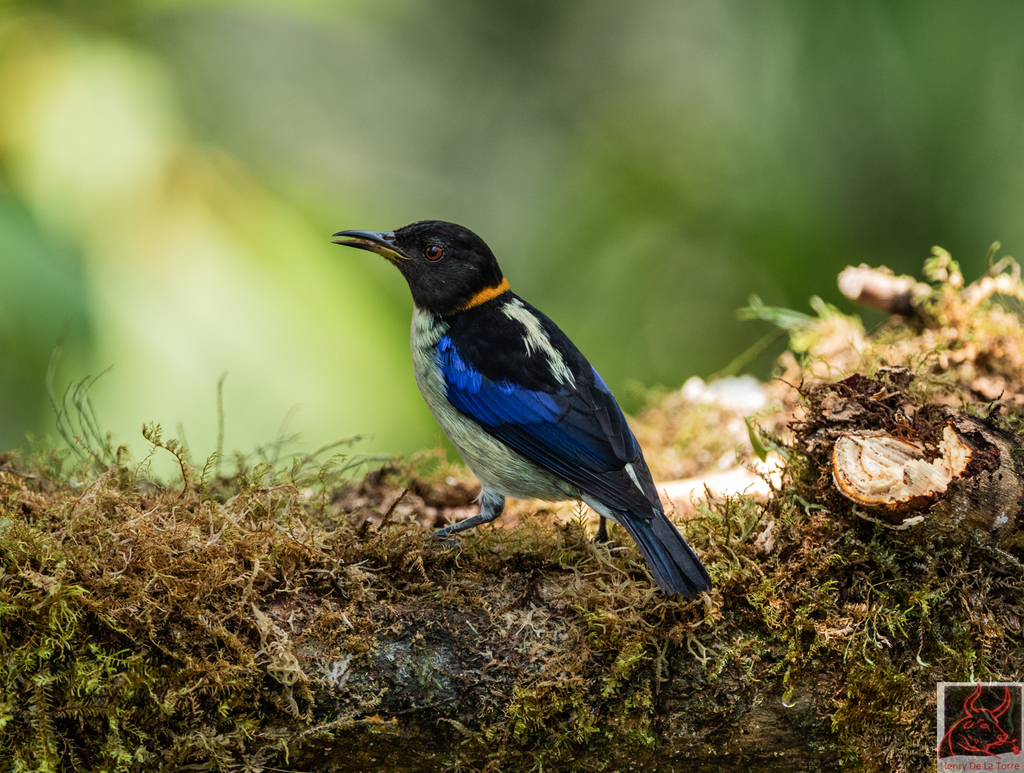
Golden-collared Honeycreeper
Live sightings near you, the range map, bar charts of when it is seen, and Macaulay Library photos and recordings.
Golden-collared Honeycreeper
Iridophanes pulcherrimus
The golden-collared honeycreeper (Iridophanes pulcherrimus) is a species of bird in the family Thraupidae, the tanagers and allies. It is found in Colombia, Ecuador, and Peru.
From the article Golden-collared honeycreeper on Wikipedia (CC BY-SA), quoted section by section
Description
The golden-collared honeycreeper is 11 cm (4.3 in) to 12.5 cm (4.9 in) long. It weighs 14 to 17 g (0.49 to 0.60 oz). It has a slender and slightly decurved bill. The species is sexually dimorphic. Adult males of the nominate subspecies have a black head and throat with the eponymous thin yellow-orange nuchal collar. Their mantle and scapulars are black with pale greenish straw blotches in the center of the mantle. Their lower back and most of their uppertail coverts are pale greenish straw; the rearmost coverts are black. Their wings are mostly black with rich cobalt-blue edges on the coverts and flight feathers. Their tail is mostly black with thin cobalt-blue feather edges. Their underparts are pale yellowish to greenish opal with a whitish belly. Adult females have a dull grayish olive head and a paler grayish olive back, rump, and tail. They also have a yellow-orange nuchal collar but it is inconspicuous. Their wings are grayish olive with wide bluish green edges on the coverts and flight feathers. Their underparts are dull grayish to yellowish buff with an olive tinge on the sides. Males of subspecies I. p. aureinucha have a sooty, rather than black, head and upper back, with a deeper golden nuchal collar, buffier sides and flanks, and a longer bill than the nominate. Females are essentially the same as nominate females. …
Range & habitat
The golden-collared honeycreeper has a disjunct distribution. The subspecies' ranges are not contiguous and the nominate's range has gaps. The nominate is found in Colombia in the upper reaches of the Magdalena Valley in Huila Department. A second part of its range is on the eastern slope of Colombia's Eastern Andes from Caquetá Department south through eastern Ecuador to northern Zamora-Chinchipe Province. A third begins in southern Zamora-Chinchipe and continues on the eastern Andean slope through Peru almost to Puno Department. Subspecies I. p. aureinucha is found along the western slope of Colombia's Western Andes from Valle del Cauca Department to slightly into far northwestern Ecuador. The golden-collared honeycreeper inhabits the interior and edges of humid to wet forest and mature secondary forest. In the forest interior it is found mostly in the canopy. In elevation it is found between 1,200 and 1,600 m (3,900 and 5,200 ft) in Colombia, below 650 m (2,100 ft) in northwestern Ecuador, and between 1,100 and 2,000 m (3,600 and 6,600 ft) in eastern Ecuador and Peru.
Wikipedia: “Distribution and habitat”
What it does
The golden-collared honeycreeper feeds primarily on berries but includes some insects in its diet. It usually forages singly or in pairs and frequently joins mixed-species feeding flocks. It moves quickly through the canopy and even at the forest edge seldom comes lower.
Wikipedia: “Feeding”
Listen
Looking for field recordings…
Where it lives
Recorded sightings
—
geo-referenced records in GBIF, from museums, herbaria and field observers.
Drag the globe to turn it. Dots are where records exist, not a range map; darker means more records.
In the stacks
Searching the stacks…
Every page naming Iridophanes pulcherrimus in the Biodiversity Heritage Library →
This page is assembled live from iNaturalist, GBIF, Wikipedia, the Source Library and the Internet Archive. It is not yet part of the hand-edited codex. iNaturalist taxon 72957.