- Animals
- ›Chordates
- ›Vertebrates
- ›Birds
- ›Perching Birds
- ›Ovenbirds and Woodcreepers
- ›Typical Ovenbirds
- ›Limnoctites
On eBird ↗
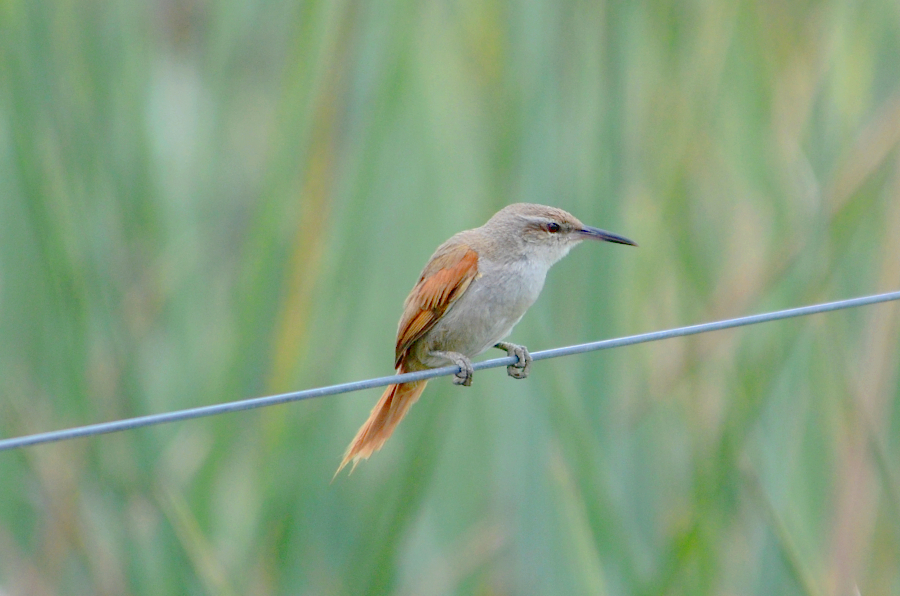
Straight-billed Reedhaunter
Live sightings near you, the range map, bar charts of when it is seen, and Macaulay Library photos and recordings.
Straight-billed Reedhaunter
Limnoctites rectirostris
The straight-billed reedhaunter (Limnoctites rectirostris) is a South American bird species in the family Furnariidae.
From the article Straight-billed reedhaunter on Wikipedia (CC BY-SA), quoted section by section
Range & habitat
This bird is found in north-eastern Argentina, south-eastern Brazil and Uruguay. In its range, it is essentially limited to marshy areas in pampas and campos from coastal lowlands to highlands. In Brazil, it is found in Rio Grande do Sul and Santa Catarina States. In Argentina, it occurs in Entre Ríos and the extreme north-east of Buenos Aires Provinces. In Uruguay, it is limited to the eastern and southern part of the country. In recent years, it has been recorded in Cerro Largo, Canelones, Maldonado – where Charles Darwin found it in 1833 at Laguna José Ignacio and Laguna del Diario, where it can still be found –, Rocha, San José and Treinta y Tres Departments (especially at the Quebrada de los Cuervos). From Lavalleja Department, there are only records from 1994, but the bird probably is still found there. This species prefers marshy and swampy areas between sea level and 1,100 m ASL. A key feature of prime habitat is an abundant growth of caraguata (spiny eryngos, Eryngium spp.), such as E. pandanifolium which it utilizes particularly in upland localities. It is sometimes claimed that the two reedhaunters differ in microhabitat preference, occurring sympatrically in the same region but not within the same locality, but this seems to be incorrect.
Wikipedia: “Distribution and habitat”
What it does
As with many of its relatives, rather little is known about its reproductive habits. In southern Uruguay, a juvenile was observed in mid-January (i.e. midsummer).
Wikipedia: “Behaviour”
Listen
Looking for field recordings…
Where it lives
Recorded sightings
—
geo-referenced records in GBIF, from museums, herbaria and field observers.
Drag the globe to turn it. Dots are where records exist, not a range map; darker means more records.
In the stacks
Searching the stacks…
Every page naming Limnoctites rectirostris in the Biodiversity Heritage Library →
This page is assembled live from iNaturalist, GBIF, Wikipedia, the Source Library and the Internet Archive. It is not yet part of the hand-edited codex. iNaturalist taxon 72986.