On eBird ↗
Bugun Liocichla
Live sightings near you, the range map, bar charts of when it is seen, and Macaulay Library photos and recordings.
Bugun Liocichla
Liocichla bugunorum
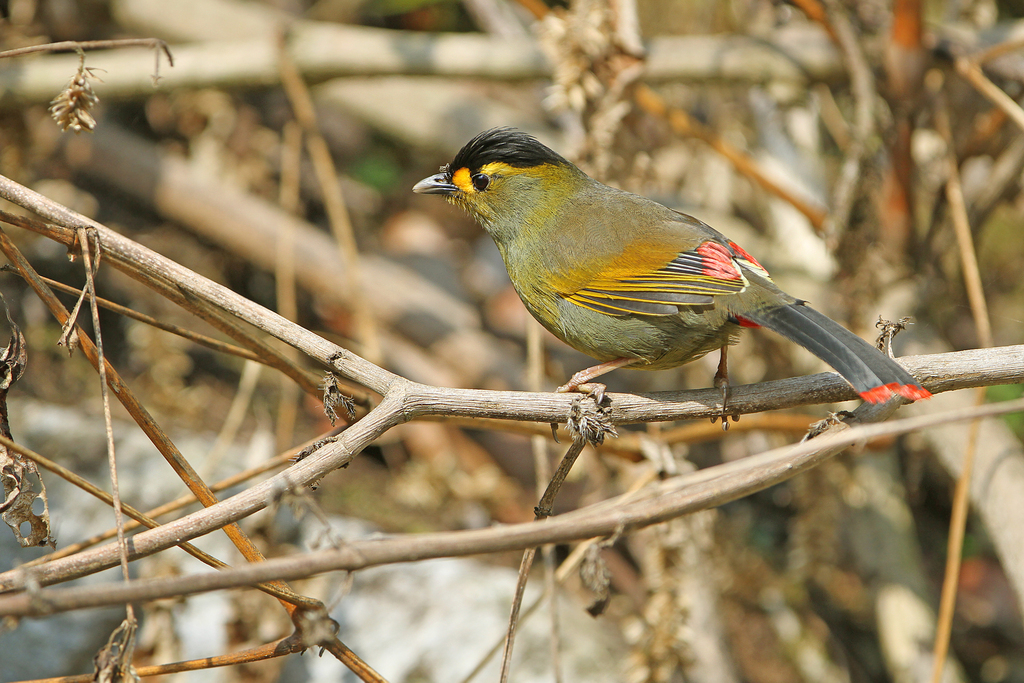
The Bugun liocichla (Liocichla bugunorum) is a passerine bird species from the family Leiothrichidae closely related to the Emei Shan liocichla. First spotted in 1995 in Arunachal Pradesh, India, it was described as a new species in 2006. The description was made without the collection of a type specimen as they were too few to risk killing one. It is thought to be an endangered species, with a small population, and a very restricted distribution range within which commercial development threatens the habitat.
From the article Bugun liocichla on Wikipedia (CC BY-SA), quoted section by section
Description
The Bugun liocichla is a small laughingthrush (20 cm (7.9 in)) with olive-grey plumage and a black cap. The face is marked with prominent orange-yellow lores, and the wings have yellow, red and white patches. The tail is black with crimson coloured undertail coverts and red tips. The feet are pink and the bill is black at the face fading to pale white. A second duller individual was mist netted, which was probably the female. The voice is described as fluty and distinctive. A study of the evolution of the species within the genus Liocichla based on mitochondrial DNA sequence similarity showed that the species is most closely related to L. omeiensis with the Hengduan Mountains possibly acting as the isolating barrier between the two.
Range & habitat
All sightings of the species have been at an altitude of 2,000 m (6,600 ft) on disturbed hillsides covered with shrubs and small trees, with the exception of one sighting on the edge of primary forest. It lives in a territory similar to that of the Emei Shan liocichla. Small flocks were observed during January, whereas pairs were observed in May, with an estimated total of 14 individuals. It is thought that pairs may hold and defend territories. The Bugun liocichla is only currently known from just one location. Populations may be discovered in other areas of Arunachal Pradesh or neighbouring Bhutan. Attempts have been made to identify new locations where the species could occur based on identification of suitable habitats using computational models.
Wikipedia: “Distribution and habitat”
Listen
Looking for field recordings…
Where it lives
Recorded sightings
—
geo-referenced records in GBIF, from museums, herbaria and field observers.
Drag the globe to turn it. Dots are where records exist, not a range map; darker means more records.
In the stacks
Searching the stacks…
Every page naming Liocichla bugunorum in the Biodiversity Heritage Library →
This page is assembled live from iNaturalist, GBIF, Wikipedia, the Source Library and the Internet Archive. It is not yet part of the hand-edited codex. iNaturalist taxon 72987.