On eBird ↗
Floreana Mockingbird
Live sightings near you, the range map, bar charts of when it is seen, and Macaulay Library photos and recordings.
Floreana Mockingbird
Mimus trifasciatus
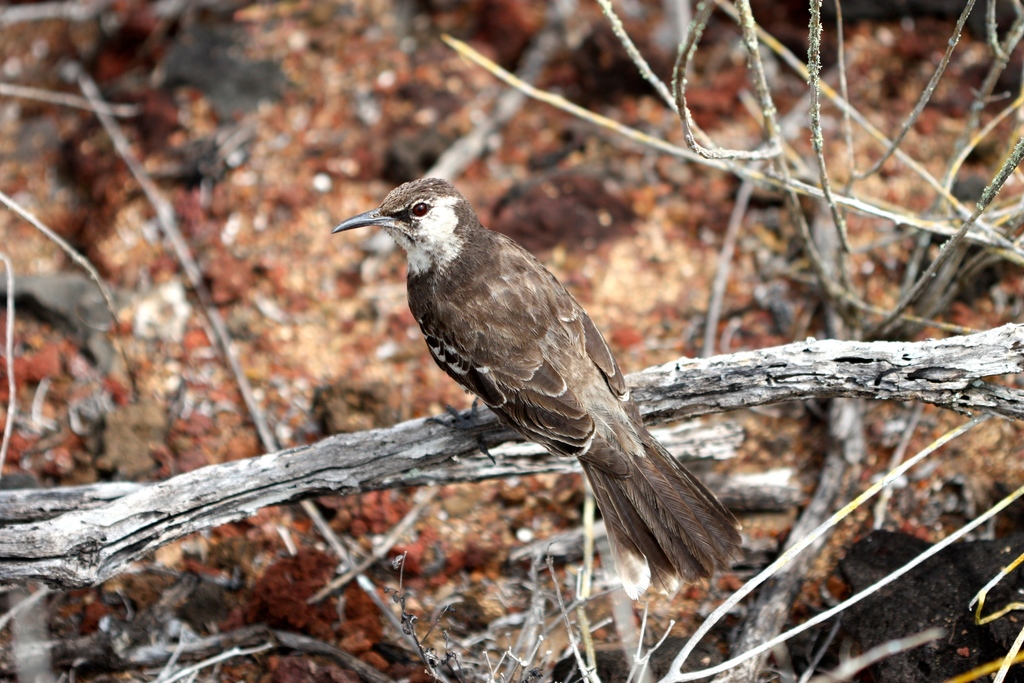
The Floreana mockingbird (Mimus trifasciatus) or the Charles Island mockingbird, is a species of bird in the family Mimidae. It was endemic to Floreana, one of the Galápagos Islands, but now is found only on two nearby islets, Campeón and Gardner-near-Floreana. The Floreana mockingbird is also known as Darwin's mockingbird, as it was the arguable inspiration for Charles Darwin's work on the origins of species; he noticed distinct differences between them and previous species he had encountered and consequently established the existence of other variants on neighboring islands.
From the article Floreana mockingbird on Wikipedia (CC BY-SA), quoted section by section
Description
The Floreana mockingbird is 25 to 26 cm (9.8 to 10.2 in) long. Males weigh an average of 65.7 g (2.32 oz) and females 59.8 g (2.11 oz). Adults have a pied appearance. They have a pale supercilium, a black patch in front of the eye, a darkish one below it, and white cheeks. Their crown, upperparts, and tail are grayish brown with a few faint darker streaks. Their whitish underparts have a dark patch on the side of the breast and faint spots on the breast and flanks. The folded wing shows two white bars. The juvenile is similar to the adult but more heavily streaked.
Range & habitat
The Floreana mockingbird was formerly abundant on Floreana Island but had been extirpated from there by 1888. It now occurs only on two islets off Floreana's shore, Campeón and Gardner-near-Floreana. The islets provide a habitat of low vegetation along their shores and arid scrub with cacti and a few trees inland.
Wikipedia: “Distribution and habitat”
What it does
The Floreana mockingbird mostly forages on the ground, but also in vegetation. It is primarily insectivorous but also eats cactus fruit, carrion, and probably seabird eggs.
Wikipedia: “Feeding”
Listen
Looking for field recordings…
Where it lives
Recorded sightings
—
geo-referenced records in GBIF, from museums, herbaria and field observers.
Drag the globe to turn it. Dots are where records exist, not a range map; darker means more records.
In the stacks
Searching the stacks…
Every page naming Mimus trifasciatus in the Biodiversity Heritage Library →
This page is assembled live from iNaturalist, GBIF, Wikipedia, the Source Library and the Internet Archive. It is not yet part of the hand-edited codex. iNaturalist taxon 73052.