On eBird ↗
Pink Pigeon
Live sightings near you, the range map, bar charts of when it is seen, and Macaulay Library photos and recordings.
Pink Pigeon
Nesoenas mayeri
The pink pigeon (Nesoenas mayeri) is a species of pigeon in the family Columbidae endemic to Mauritius. The pink pigeon nearly became extinct in the 1970s and the 1990s and is still very rare. It is the only Mascarene pigeon that has not become extinct. It was on the brink of extinction in 1991 when only 10 individuals remained, but its numbers have increased due to the efforts of the Durrell Wildlife Conservation Trust since 1977. While the population remains at below 500 birds as of 2011, the IUCN downlisted the species from critically endangered to endangered on the IUCN Red List in 2000, and then downlisted it again to vulnerable in 2018.
From the article Pink pigeon on Wikipedia (CC BY-SA), quoted section by section
Description
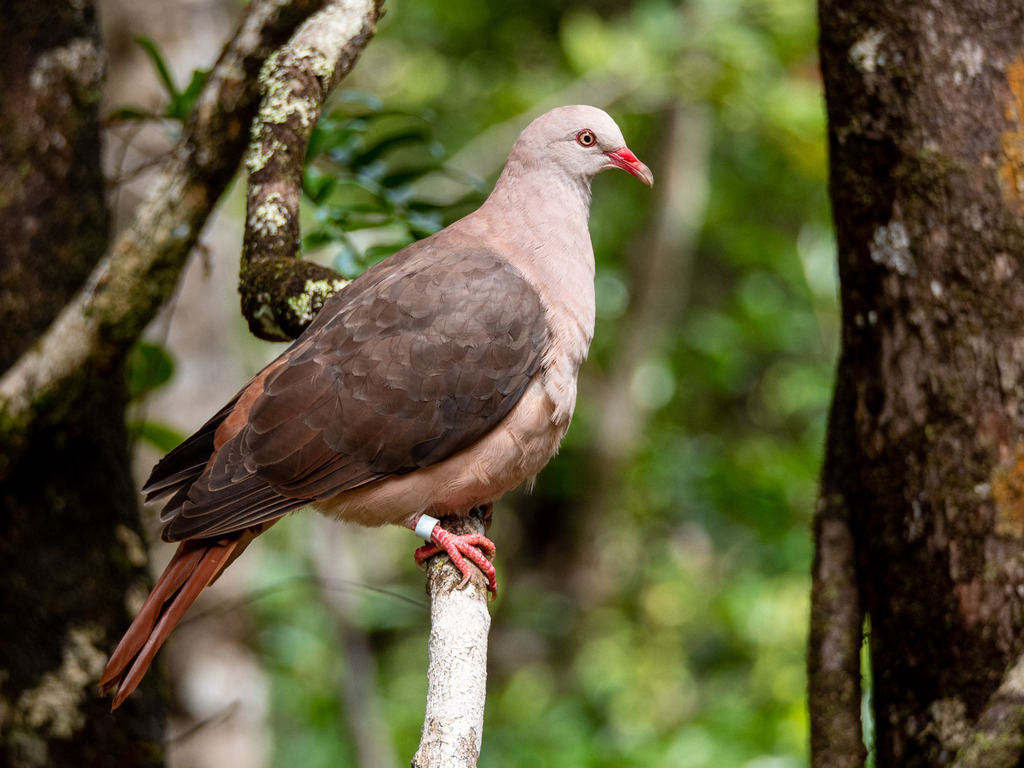
An adult pink pigeon is about 36–38 centimetres (14–15 in) from beak to tail and 350 grams in weight. Pink pigeons have pale pinkish-grey plumage on their head, shoulders and underside, along with pink feet. The beak is a dark pink color with a white tip. They have dark brown wings, and a broad, rust-colored tail. Their eyes are dark brown surrounded by an eye-ring of red skin. Newly hatched pigeons have sparse, downy-white feathers and closed eyes. The voice of the pink pigeon consists of a flight call that is a short, hardened "hoo hoo". The territorial call of the male pink pigeon is a series of coos.
Range & habitat
The species is endemic to the Mascarene island of Mauritius, a small island to the east of Madagascar in the Indian Ocean, and the tiny predator-free island of Île aux Aigrettes off its eastern coast. A subspecies, the Réunion pink pigeon, became extinct on the neighbouring Reunion Island around 1700. As of 2016, there are five places where wild populations of the pink pigeon can be found. Four of these locations belong to Black River Gorges National Park and the fifth to Isle aux Aigrettes. All are monitored by the Mauritian Wildlife Foundation. The species is not migratory. The species prefers upland evergreen forests, but is equally at home in coastal forests as long as the vegetation is native and not dominated by introduced species such as Chinese Guava (Psidium cattleianum) or the privet (Ligustrum robustum). Destruction of such primal forests has been a major reason for its decline.
Wikipedia: “Distribution and habitat”
What it does
The breeding season of the pink pigeon begins in August–September, although birds may breed all year round. The male courts the female with a "step and bow" display. Mating is generally monogamous, with the pair making a flimsy platform nest and defending a small area around it (even though the pigeons initially had no natural predators, one mating pair must defend their territory from other mating pairs). Pink pigeons generally mate for life. The female usually lays two white eggs, and incubation duration is two weeks. The male incubates during the day, and the female during night and early day. They may breed often, laying five to 10 eggs in a season; breeding only pauses in the wild whilst in molt, which may be full or a partial-body/head molt. There are more males than females in a population due to greater life expectancy of the male (about five years more) and in the wild a higher chance of the female being predated. One reason for the difference in life span is that producing eggs is extremely metabolically taxing, and since female birds are nearly constantly producing eggs (even when they are not fertilized, just like domestic chickens do) this can end up totaling to a large metabolic tax on the female's survival. …
Wikipedia: “Behavior and ecology”
In human culture
The book Golden Bats and Pink Pigeons by Gerald Durrell describes the conservation efforts. Mauritius has published a series of postage stamps depicting the pink pigeon.
Wikipedia: “In culture”
Listen
Looking for field recordings…
Where it lives
Recorded sightings
—
geo-referenced records in GBIF, from museums, herbaria and field observers.
Drag the globe to turn it. Dots are where records exist, not a range map; darker means more records.
In the stacks
Searching the stacks…
Every page naming Nesoenas mayeri in the Biodiversity Heritage Library →
This page is assembled live from iNaturalist, GBIF, Wikipedia, the Source Library and the Internet Archive. It is not yet part of the hand-edited codex. iNaturalist taxon 73093.