- Animals
- ›Chordates
- ›Vertebrates
- ›Birds
- ›Hawks, Eagles, Kites, and Allies
- ›Hawks, Eagles, and Kites
- ›Typical Eagles and Hawk-Eagles
- ›Nisaetus
On eBird ↗
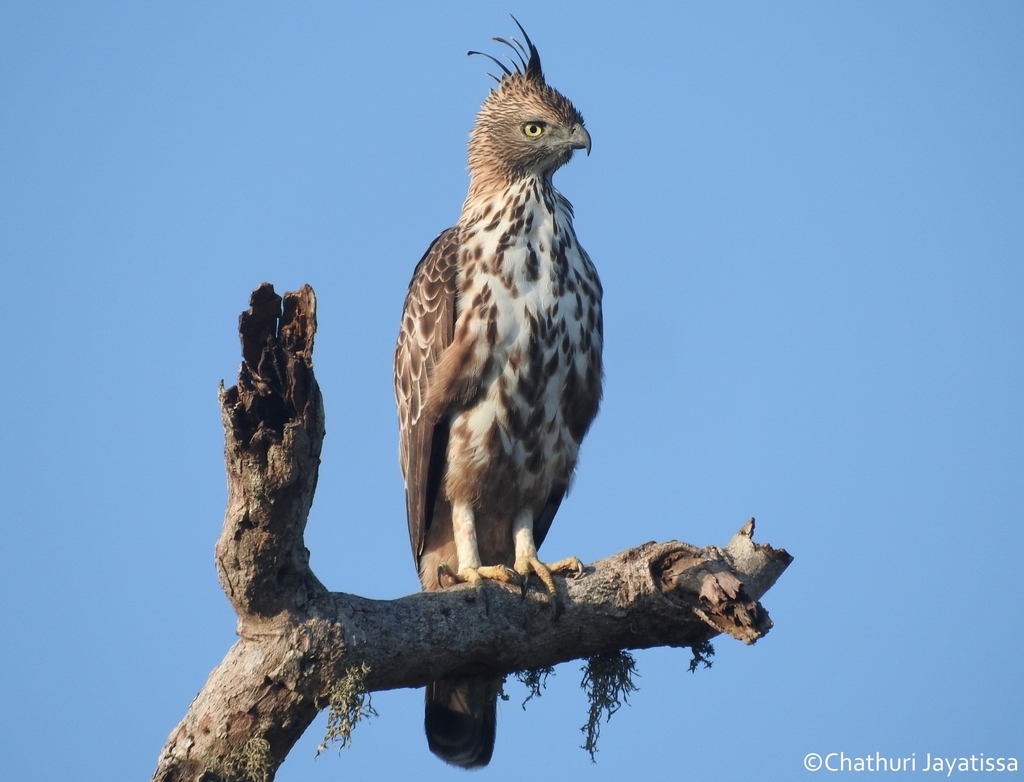
Changeable Hawk-Eagle
Live sightings near you, the range map, bar charts of when it is seen, and Macaulay Library photos and recordings.
Changeable Hawk-Eagle
Nisaetus cirrhatus
The changeable hawk-eagle (Nisaetus cirrhatus) or crested hawk-eagle is a large bird of prey species of the family Accipitridae. More informal or antiquated English common names include the marsh hawk-eagle or Indian crested hawk-eagle. It is a member of the subfamily Aquilinae, with signature feathers, absent in tropical raptors from outside this subfamily, covering the tarsus. It was formerly placed in the genus Spizaetus, but studies pointed to the group being paraphyletic resulting in the Old World members being placed in Nisaetus and separated from the New World species. It is a typical "hawk-eagle" in that it is an agile forest-dwelling predator and like many such eagles readily varies its prey selection between birds, mammals or reptiles as well as other vertebrates. Among the members of its genus, the changeable hawk-eagle stands out as the most widely distributed, adaptable and abundant species. Individuals show a wide range of variation in plumage from pale to dark, varying with moult and age giving rise to the name "changeable".
From the article Changeable hawk-eagle on Wikipedia (CC BY-SA), quoted section by section
Description
The changeable hawk-eagle is a largish but slender eagle. They fall near the middle of sizes among the currently accepted species in the genus Nisaetus. As in most birds of prey, females are larger than males with an average overall size difference of 7% but this can individually range to an 18-22% difference, with island races apparently thought to be less dimorphic on average. Size is quite variable and total length has been reported in the past to vary from 51 to 82 cm (20 to 32 in) and wingspan from 100 to 160 cm (39 to 63 in), however these figures appear to include the much more massive hawk-eagles from Flores that are currently considered their own separate species by modern authorities. Nonetheless, total lengths of up to 77 cm (30 in) have been listed for N. c. limnaeetus in Nepal. Ali & Ripley (1978) estimated these average total lengths for the following subspecies: N. c. cirrhatus at 72 cm (28 in), N. c. limnaeetus at 70 cm (28 in) and N. c. andamanensis at 61 cm (24 in). Legge (1880) measured the length of Sri Lankan changeable hawk-eagles (N. c. ceylanensis) without including the beak as 55 to 60 cm (22 to 24 in). The average length of birds from the Philippines (N. c. limnaeetus) was measured as 58.4 cm (23.0 in) in males and 64.9 cm (25.6 in) in females. …
Range & habitat
The extensive range of the changeable hawk-eagle includes much of the Indian subcontinent and Southeast Asia. Its distribution includes Garhwal Himalaya to Assam, southern Nepal and Bhutan, Sri Lanka, east through Myanmar, Thailand and Peninsular Malaysia, western Laos, southern Vietnam, Cambodia. In India, it occurs almost continuously from the peninsular tip north to Rajasthan, Uttar Pradesh, Bihar, Odisha and the Andaman Islands. In Indonesia, it occurs in Sumatra, Simeulue and Mentawai off the west side and Riau, Bangka Island and Belitung, Java, Borneo; and the western and southern Philippines on Palawan, Calamian Islands, Lubang Island, Mindoro, Mindanao and Bohol. The changeable hawk-eagle inhabits savannawoodland, agricultural land, wetlands, tea plantations, forest villages and even suburbs. Beyond these often degraded haunts, it ranges also in open or less dense parts of undisturbed vast evergreen forest and tropical and subtropical dry broadleaf forestss, but also secondary forests. In elevation, they may be found anywhere from sea level to 2,200 m (7,200 ft) but mainly live below 1,500 m (4,900 ft).
Wikipedia: “Distribution and habitat”
What it does
Changeable hawk-eagles are at home in a variety of wooded and semi-open habitats. Their physical form and flight style is typical of forest-dwelling raptors in general and is often compared to the features of true hawks or Accipiters in particular larger species such as goshawks. Like most other forest raptors, changeable hawk-eagles (and Nisaetus species in general) have a long tail, short broad wings and relatively long but powerful legs, all of which impart greater maneuverability and quicker strike times in denser wooded hunting grounds than other raptorial body plans. The common name hawk-eagle is apparently in reference to their similar adaptations to true hawks. Even compared to the variable prey of large goshawks, the prey selection of changeable hawk-eagles appears to be somewhat indiscriminate and opportunistic. Unfortunately, compared to tropical raptors from the neotropics and especially Africa, the life histories of raptors from tropical Asia are generally quite poorly-known, even in the case of easily observed raptors such as changeable hawk-eagles. Therefore, what is known of changeable hawk-eagles dietary biology is largely drawn together based on reliable eye-witness and anecdotal accounts, photographic evidence and wide-ranging bird census surveys, rather than direct, extensive study. …
Wikipedia: “Behaviour and ecology”
Listen
Looking for field recordings…
Where it lives
Recorded sightings
—
geo-referenced records in GBIF, from museums, herbaria and field observers.
Drag the globe to turn it. Dots are where records exist, not a range map; darker means more records.
In the stacks
Searching the stacks…
Every page naming Nisaetus cirrhatus in the Biodiversity Heritage Library →
This page is assembled live from iNaturalist, GBIF, Wikipedia, the Source Library and the Internet Archive. It is not yet part of the hand-edited codex. iNaturalist taxon 73100.