On eBird ↗
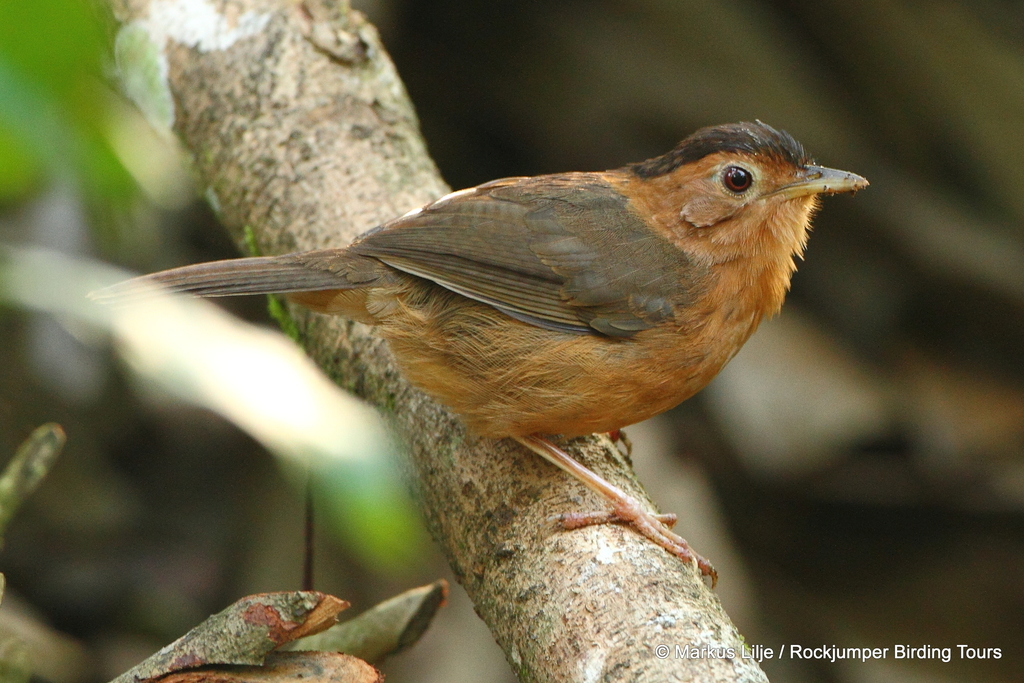
Brown-capped Babbler
Live sightings near you, the range map, bar charts of when it is seen, and Macaulay Library photos and recordings.
Brown-capped Babbler
Pellorneum fuscocapillus
The brown-capped babbler (Pellorneum fuscocapillus) is a member of the Pellorneidae family.
From the article Brown-capped babbler on Wikipedia (CC BY-SA), quoted section by section
Description
The brown-capped babbler is a smallish to medium-sized babbler, at 16 cm (6.3 in) including its long tail. It is brown above and rich cinnamon below. It has a dark brown crown. Brown-capped babblers have short dark bills. Their food is mainly insects. They can be difficult to observe in the dense vegetation they prefer, but like other babblers, these are noisy birds, and their characteristic calls are often the best indication that these birds are present.
Range & habitat
The brown-capped babbler is an endemic resident breeding bird in Sri Lanka. Its habitat is forest undergrowth and thick scrub. This species, like most babblers, is not migratory, and has short rounded wings and a weak flight.
Wikipedia: “Distribution”
What it does
This babbler builds its nest on the ground or in a hole, concealed in dense masses of foliage. The normal clutch is two or three eggs.
Wikipedia: “Ecology”
In human culture
In Sri Lanka, this bird is known as parandel-kurulla (translates to 'dried-grass(colored) bird') or redi diang (onomatopoeic in origin) in Sinhala language. Brown-capped babbler appears in a 4 rupee Sri Lankan postal stamp,
Wikipedia: “In culture”
Listen
Looking for field recordings…
Where it lives
Recorded sightings
—
geo-referenced records in GBIF, from museums, herbaria and field observers.
Drag the globe to turn it. Dots are where records exist, not a range map; darker means more records.
In the stacks
Searching the stacks…
Every page naming Pellorneum fuscocapillus in the Biodiversity Heritage Library →
This page is assembled live from iNaturalist, GBIF, Wikipedia, the Source Library and the Internet Archive. It is not yet part of the hand-edited codex. iNaturalist taxon 73157.