On eBird ↗
Allpahuayo Antbird
Live sightings near you, the range map, bar charts of when it is seen, and Macaulay Library photos and recordings.
Allpahuayo Antbird
Percnostola arenarum
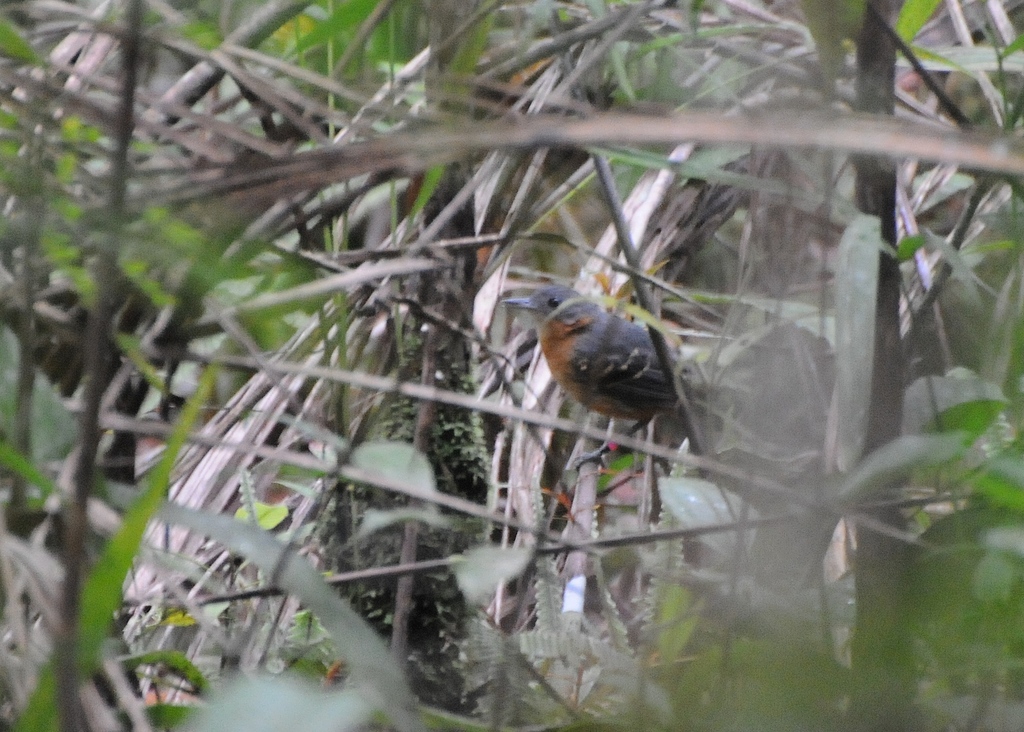
The Allpahuayo antbird (Percnostola arenarum) is a Vulnerable species of bird in subfamily Thamnophilinae of family Thamnophilidae, the "typical antbirds". It is endemic to northeastern Peru.
From the article Allpahuayo antbird on Wikipedia (CC BY-SA), quoted section by section
Description
The Allpahuayo antbird is 13 to 15 cm (5.1 to 5.9 in) long. One male weighed 22.9 g (0.81 oz) and one female 24.2 g (0.85 oz). Adult males have mostly dark gray upperparts that are darkest on their forecrown and lightest in the center of their back. Their wings are dark gray and their wing coverts black with white edges and tips. Their tail is dark gray with paler gray outer edges. Their lores and ear coverts are dark gray, their chin and throat blackish, and the rest of their underparts dark gray. Adult females have dark gray crown, nape, and upperparts. Their wings are dark gray and their wing coverts black with reddish yellow-brown tips. Their tail is dark gray with paler bluish gray outer edges on the feathers. Their face is a paler gray than their crown and has a yellowish brown tinge. Their chin and the center of their throat are white with a reddish yellow-brown tinge. The underparts of most females are mostly reddish yellow-brown that is darker on the breast than on their belly and crissum. The center of their belly is white and their sides and flanks have a dusky tinge. In one area females have tawny underparts. Both sexes have a gray iris and bluish gray legs and feet. Males have a black bill; females have a black maxilla and a bluish gray mandible.
Range & habitat
The Allpahuayo antbird is known only from the Department of Loreto in northeastern Peru. It apparently has a disjunct distribution, with sub-populations known in several areas north of the Amazon River. The main part of its distribution appears to be the drainages of the Nanay and Itaya rivers and a smaller sub-population is along the Morona River to the west. It primarily inhabits the understorey of a forest type locally called varillal. It grows on white sand soils and is characterized by a stunted canopy and dense undergrowth. The western sub-population occurs in a similar forest type (irapayal) on both sandy and weathered clay soils and that is taller with a different understorey plant community. In elevation the species ranges between about 100 and 250 m (330 and 820 ft).
Wikipedia: “Distribution and habitat”
What it does
The Allpahuayo antbird feeds on insects but no details of its diet are known. It typically forages in pairs or in family groups in dense vegetation, mostly on the ground and within about 1 m (3 ft) above it. It actively hops between short feeding stops. It captures prey by gleaning from vegetation and stems and by searching leaf litter. The western sub-population regularly follows army ant swarms to capture prey fleeing the ants. The main eastern population has not been observed doing so, possibly because ant swarms are known to be rare in its habitat. The species does not join mixed-species feeding flocks.
Wikipedia: “Feeding”
Listen
Looking for field recordings…
Where it lives
Recorded sightings
—
geo-referenced records in GBIF, from museums, herbaria and field observers.
Drag the globe to turn it. Dots are where records exist, not a range map; darker means more records.
In the stacks
Searching the stacks…
Every page naming Percnostola arenarum in the Biodiversity Heritage Library →
This page is assembled live from iNaturalist, GBIF, Wikipedia, the Source Library and the Internet Archive. It is not yet part of the hand-edited codex. iNaturalist taxon 73162.