On eBird ↗
Bachman's Sparrow
Live sightings near you, the range map, bar charts of when it is seen, and Macaulay Library photos and recordings.
Bachman's Sparrow
Peucaea aestivalis
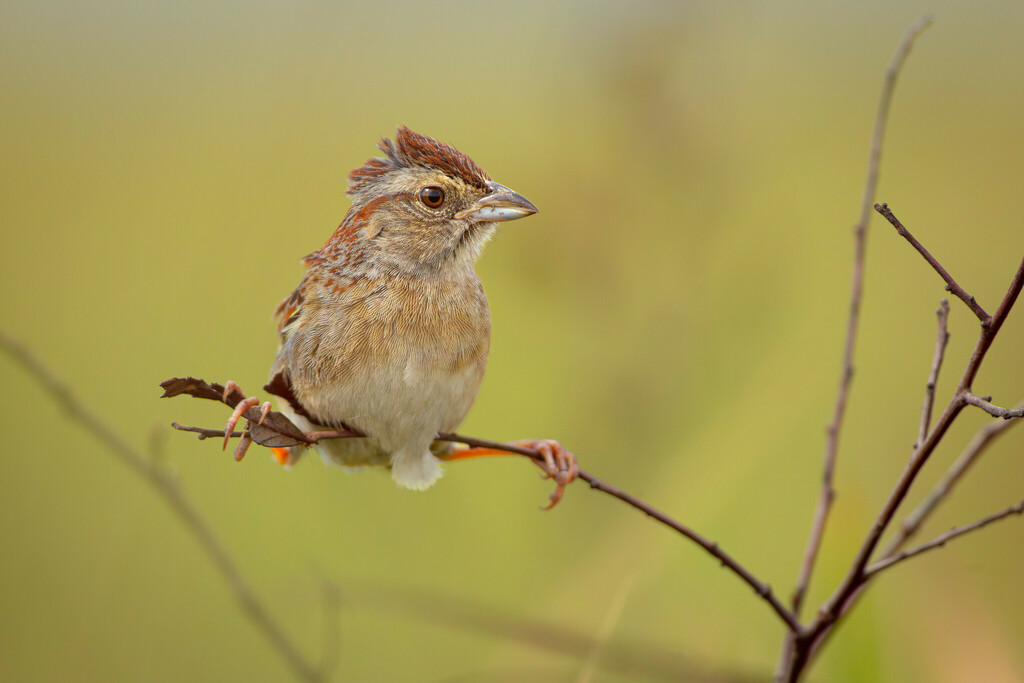
Bachman's sparrow (Peucaea aestivalis), also known as the pinewoods sparrow or oakwoods sparrow, is a small American sparrow that is endemic to the southeastern United States. This species was named in honor of Reverend John Bachman.
Adults have rufous brown upperparts and crown with gray and black streaking on the nape, back and primaries. The face is gray with a rufous brown eyestripe. It has a buff colored breast and whitish belly. These are mid-sized New World sparrows, measuring 12.2–16.2 cm (4.8–6.4 in) and weighing 18.4–23 g (0.65–0.81 oz).
From the article Bachman's sparrow on Wikipedia (CC BY-SA), quoted section by section
Range & habitat
Bachman's sparrows occur primarily in the southeastern United States from the central region of peninsular Florida north to southeastern North Carolina and west through portions of Tennessee, Kentucky and Missouri to eastern Oklahoma and eastern Texas. Following forest conversion and the spread of agricultural fields up into the early 1900s, Bachman's sparrows rapidly expanded their range and began breeding in Illinois, Indiana, Ohio, West Virginia, Virginia, Maryland, and parts of Pennsylvania. However, this trend reversed during the 1930s as much of the eastern deciduous forest recovered. Bachman's sparrows are thought to have been extirpated from Virginia in the early 2000s, and North Carolina is now the northern periphery of their eastern range. Among the three subspecies of Bachman's sparrow, Peucaea aestivalis aestivalis breeds furthest east, from southeast South Carolina to peninsular Florida. Peucaea a. bachmanii occurs west of P. a. aestivalis to Mississippi and north to Kentucky. P. a. illinoensis occurs in the westernmost region of the species' range.
Wikipedia: “Distribution”
At the table
Bachman's sparrows forage on the ground for plant seeds and arthropods. In a predominately loblolly and shortleaf pine habitat of eastern Texas, all Bachman's sparrow foraging observations were on the ground and a literature review states that Bachman's sparrows rarely forage in shrubs. Reviews and an investigation of the Bachman sparrow's diet in eastern Texas summarize the species that comprise the Bachman's sparrow's diet. A variety of grass seeds such as panicgrasses, bristlegrasses (Setaria sp.), crowngrasses (Paspalum spp.), and threeawns are eaten by Bachman's sparrows as well as seeds of several other taxa, including blueberries (Vaccinium spp.), pines, and sedges (Carex spp). Arthropods in the Bachman's sparrow's diet include grasshoppers and crickets (order Orthoptera), spiders (order Araneae), beetles (order Coleoptera), caterpillars (order Lepidoptera), wasps (order Hymenoptera), and leafhoppers (family Cicadellidae). Insects comprise more of the Bachman's sparrow diet in spring and fall than in winter. Stomach contents of Bachman's sparrow collected in eastern Texas in summer (n=5) and fall (n=11) had a greater abundance of insects than those collected in winter (n=4).
Wikipedia: “Food habits”
Listen
Looking for field recordings…
Where it lives
Recorded sightings
—
geo-referenced records in GBIF, from museums, herbaria and field observers.
Drag the globe to turn it. Dots are where records exist, not a range map; darker means more records.
In the stacks
Searching the stacks…
Every page naming Peucaea aestivalis in the Biodiversity Heritage Library →
This page is assembled live from iNaturalist, GBIF, Wikipedia, the Source Library and the Internet Archive. It is not yet part of the hand-edited codex. iNaturalist taxon 73172.