On eBird ↗
Cassin's Sparrow
Live sightings near you, the range map, bar charts of when it is seen, and Macaulay Library photos and recordings.
Cassin's Sparrow
Peucaea cassinii
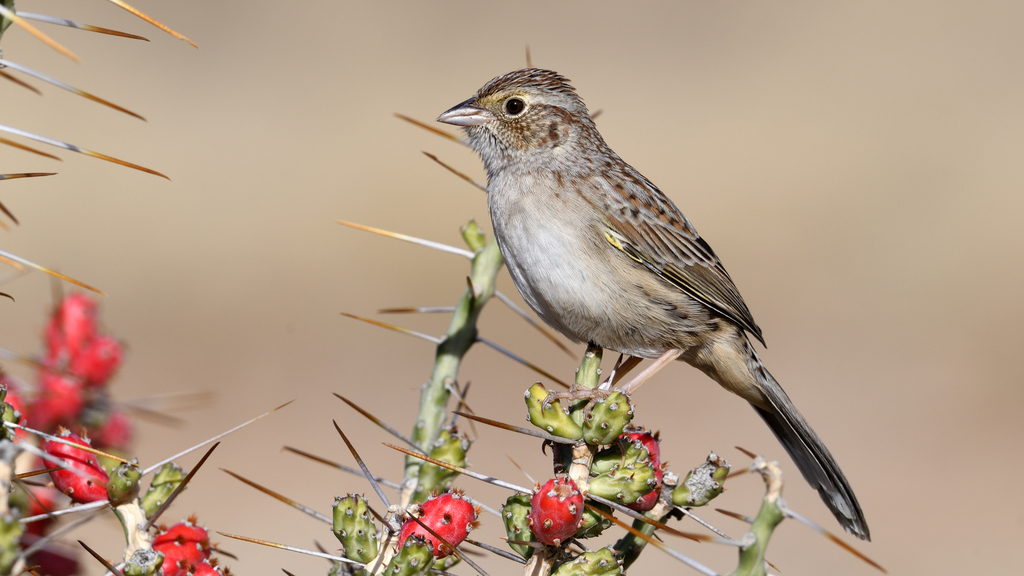
Cassin's sparrow (Peucaea cassinii) is a medium-sized sparrow.
This passerine bird's range is from western Nebraska to north-central Mexico.
From the article Cassin's sparrow on Wikipedia (CC BY-SA), quoted section by section
Description
The sparrow has a long tail, gray-brown with white corners, and has dark marks on the back and sides. The species resembles Botteri's sparrow because of its size and marks, but Botteri's sparrow is a weaker shade of gray. The best way to tell the differences between the two is the song of Cassin's sparrow. Both the males and females are the same shade of gray and are 5 to 6 inches, although males are bigger. The Cassin's sparrow is a fairly large, plain, grayish sparrow that lacks conspicuous markings. In flight, the long, roundish tail is obvious and the white tips of the tail feathers are sometimes apparent. This species is most easily identified by its distinctive song and dramatic skylarking behavior during the breeding season. Although often characterized in the literature as secretive and difficult to observe when not singing, Schnase (1984) observed that Cassin's sparrows readily accommodated the presence of an observer, especially early in the breeding season.
Adult. The head is brown streaked with gray and dark brown; the supercilium is buff, and there is a thin, dark brown submoustachial stripe. The bill is brownish gray, with darker upper mandible and pale bluish gray tomial edge and lower mandible. The iris is dark brown. …
Range & habitat
Cassin's sparrow can commonly be found in brushy grassland and is nomadic. Between 1955 and 1989, there was a below average amount of this species although the number rises and falls each year. The sparrow can be found in south-central states. It is known that the sparrow is rarely found in the northern part of its range which might be because of rainfall. The bird's nest is in grass and is a mixture of various weeds and grasses. The female lays from to 3 to 5 eggs. Although Cassin's sparrows use slightly different habitats in different parts of their range, the common denominator across all habitats seems to be that they require both a grass component (usually short grass) and a shrub component. The latter component may be actual shrub species [e.g., mesquite, sage (Artemisia spp.), hackberry (Celtis spp.), rabbitbrush (Chrysothamnus spp.), or oaks (Quercus spp.)] or other vegetative forms that approximate shrub structure [e.g. yucca (Yucca spp.), paddle cacti (Opuntia spp.), ocotillo or bunch grasses]. The need for the structure provided by shrubs or similar plants is related to the bird's need for perches from which to sing or launch itself for its flight song and its frequent use of low shrubs for nest placement. Schnase (1984) also noted that the mesquite thickets within Cassin's sparrow territories were distinctly preferred when fledglings were present. …
Wikipedia: “Habitat”
What it does
The bird's diet consists of insects and seeds. The summer diet of Cassin's sparrows consists primarily of insects, especially grasshoppers, caterpillars, and beetles. Additional insects specifically mentioned in the literature include true bugs, ants, bees, wasps, weevils, spiders, snails, and moths. The young are fed almost entirely insects. Bock, Bock & Grant (1992) note that observations of a Cassin's sparrow nest for 18 hours in 1984 showed that of 208 insects delivered to nestlings, 197 (95%) were acridid grasshoppers. However, Wolf (1977) reported that the stomachs of ten adults taken during the breeding season (late June and early July) contained animal and vegetable matter in about equal proportions (52% and 48%, respectively; range = 5–95%). He also found that five migrant Cassin's sparrow stomachs contained 99% animal material (range = 90–100%). There is a report of Cassin's sparrows eating flower buds of blackthorn bush (Condalia spathulata) in season. In fall and winter, Cassin's sparrows eat the seeds of weeds and grasses. Oberholser (1974) particularly mentions the consumption of seeds of chickweed (family Alsinaceae), plantain (Plantago spp.), woodsorrel (Xanthoxalis spp.), sedge (Carex spp.), panicum (Panicum spp.), other grasses, and sorghum (Sorghum spp.). Schnase (1984) reports observing birds drinking water from a small pool immediately following a rain. …
Wikipedia: “Diet”
Listen
Looking for field recordings…
Where it lives
Recorded sightings
—
geo-referenced records in GBIF, from museums, herbaria and field observers.
Drag the globe to turn it. Dots are where records exist, not a range map; darker means more records.
In the stacks
Searching the stacks…
Every page naming Peucaea cassinii in the Biodiversity Heritage Library →
This page is assembled live from iNaturalist, GBIF, Wikipedia, the Source Library and the Internet Archive. It is not yet part of the hand-edited codex. iNaturalist taxon 73175.