On eBird ↗
Cinnamon-tailed Sparrow
Live sightings near you, the range map, bar charts of when it is seen, and Macaulay Library photos and recordings.
Cinnamon-tailed Sparrow
Peucaea sumichrasti
The cinnamon-tailed sparrow (Peucaea sumichrasti) is a Near Threatened species of bird in the family Passerellidae, the New World sparrows. It is endemic to Mexico.
From the article Cinnamon-tailed sparrow on Wikipedia (CC BY-SA), quoted section by section
Description
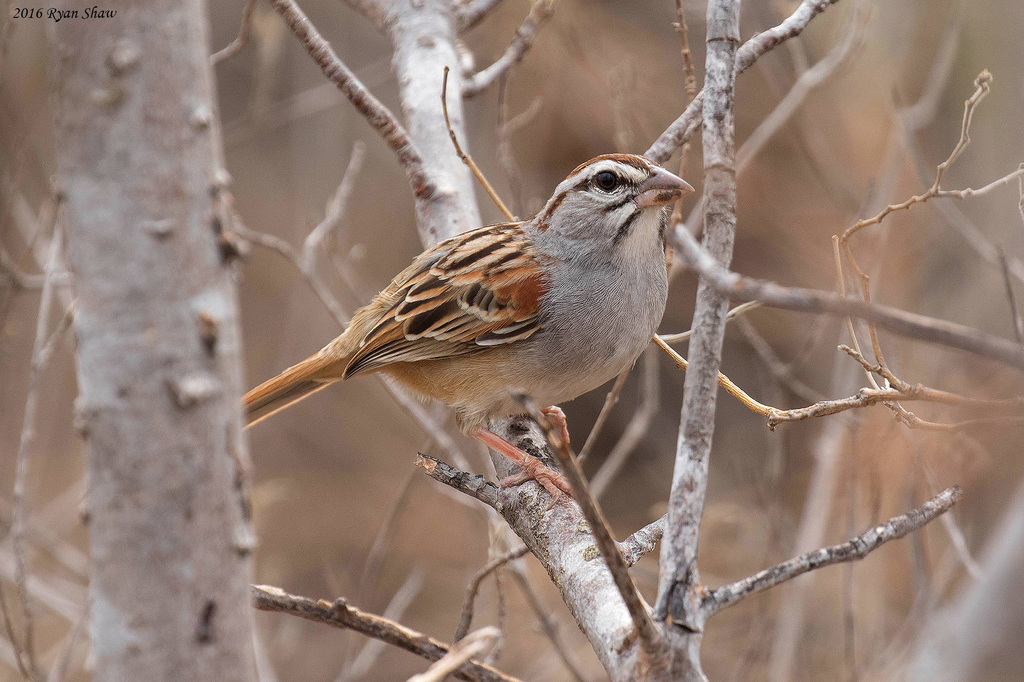
The cinnamon-tailed sparrow is 14.5 to 16.5 cm (5.7 to 6.5 in) long and weighs 23 to 30 g (0.81 to 1.1 oz). The sexes have the same plumage. Adults have a chesnut brown crown with a thin gray stripe down its middle and black streaks on the brown. Their nape and most of their face are light gray with black lores, a wide whitish supercilium, a white crescent below the eye, and a dark brown stripe behind the eye. Their back and scapulars are light brown to grayish brown with wide black streaks. Their uppertail coverts and tail are cinnamon. Their lesser wing coverts are cinnamon rufous and the median and greater coverts blackish brown with pale rufous edges. Their flight feathers are dark brown with pale rufous edges. Their chin and throat are white with two black stripes on the latter. The center of their breast is whitish, their sides light gray, their flanks grayish buff, and their undertail coverts light rufous. They have a deep brown or brownish red iris, a dark gray maxilla, a horn-pink mandible, and brownish to pink legs and feet.
Range & habitat
The cinnamon-tailed sparrow is found on the Pacific side of southern Mexico's Isthmus of Tehuantepec from the Tehuantepec River basin in eastern Oaxaca to far southwestern Chiapas. It inhabits arid scrublands and the edges of tropical thorn forest. In elevation it ranges from sea level to 950 m (3,100 ft).
Wikipedia: “Distribution and habitat”
What it does
The cinnamon-tailed sparrow's diet has not been studied but probably includes "seeds, small insects, spiders, fruit, and nectar ". It usually forages on the ground in pairs or small groups that are thought to be families.
Wikipedia: “Feeding”
Listen
Looking for field recordings…
Where it lives
Recorded sightings
—
geo-referenced records in GBIF, from museums, herbaria and field observers.
Drag the globe to turn it. Dots are where records exist, not a range map; darker means more records.
In the stacks
Searching the stacks…
Every page naming Peucaea sumichrasti in the Biodiversity Heritage Library →
This page is assembled live from iNaturalist, GBIF, Wikipedia, the Source Library and the Internet Archive. It is not yet part of the hand-edited codex. iNaturalist taxon 73179.