- Animals
- ›Chordates
- ›Vertebrates
- ›Birds
- ›Cuckoos
- ›Cuckoos
- ›Typical Cuckoos, Malkohas, and allies
- ›Phaenicophaeus
On eBird ↗
Chestnut-breasted Malkoha
Live sightings near you, the range map, bar charts of when it is seen, and Macaulay Library photos and recordings.
Chestnut-breasted Malkoha
Phaenicophaeus curvirostris
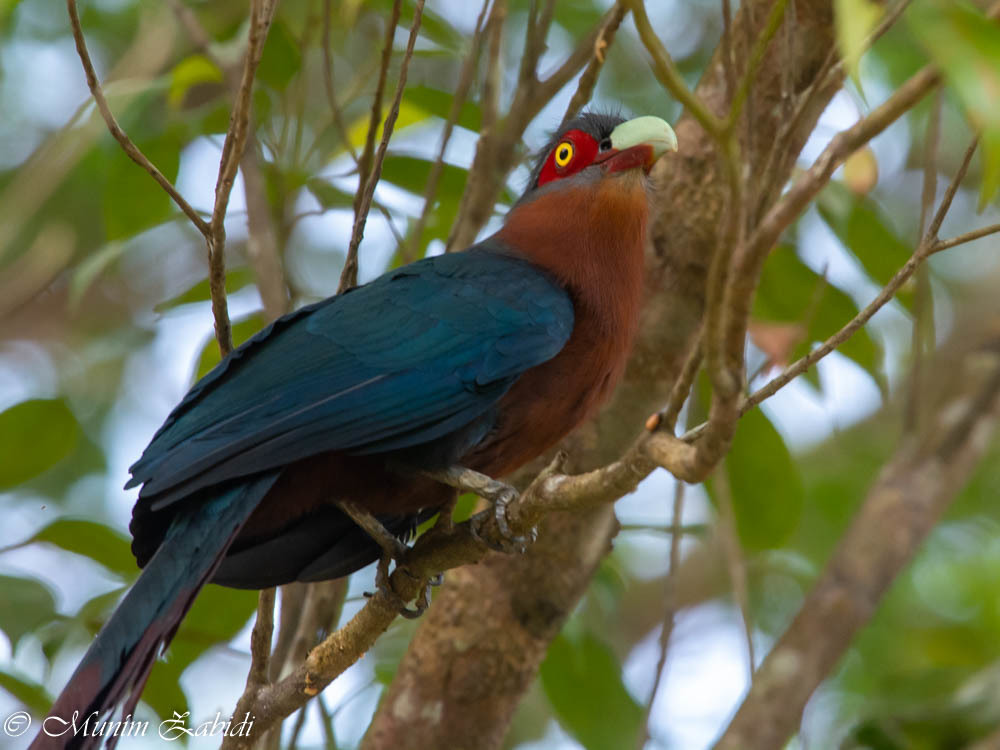
The chestnut-breasted malkoha (Phaenicophaeus curvirostris) is a species of cuckoo in the family Cuculidae. Found in Southeast Asia from Myanmar through to eastern Java, the Philippines and Borneo, it is a large cuckoo measuring up to 49 cm (19 in) with grey and dark green upperparts and chestnut underparts, and a large curved pale upper mandible. The male and female are similar in plumage. Unlike many cuckoos, it builds its nest and raises its own young.
From the article Chestnut-breasted malkoha on Wikipedia (CC BY-SA), quoted section by section
Description
Measuring 42–49 cm (17–19 in) in length, the chestnut-breasted malkoha has a large, curved, pale yellow upper mandible and darker red or black lower mandible, and a bare red patch of rough skin around the eye. The head is grey and wings are dark green fading to blue with age. Its underparts and rump are chestnut, and feet are dark grey. Little sexual dimorphism is seen, as the male and female are similar in plumage, although the male has a pale blue iris and the female yellow.
Range & habitat
It is found in Brunei, Indonesia, Malaysia, Myanmar, the western Philippines, and southern Thailand. Its natural habitats are subtropical or tropical moist lowland forests and subtropical or tropical mangrove forests. It resides mainly in the middle story in dense foliage. Much of its forest habitat is being cleared.
Wikipedia: “Distribution and habitat”
What it does
It eats small vertebrates, such as small lizards, frogs, and baby birds, and insects, including caterpillars, grasshoppers, cicadas, stick insects, mantises, cockroaches, beetles, and bugs, as well as spiders and small crabs.
Wikipedia: “Feeding”
Listen
Looking for field recordings…
Where it lives
Recorded sightings
—
geo-referenced records in GBIF, from museums, herbaria and field observers.
Drag the globe to turn it. Dots are where records exist, not a range map; darker means more records.
In the stacks
Searching the stacks…
Every page naming Phaenicophaeus curvirostris in the Biodiversity Heritage Library →
This page is assembled live from iNaturalist, GBIF, Wikipedia, the Source Library and the Internet Archive. It is not yet part of the hand-edited codex. iNaturalist taxon 73186.