On eBird ↗
Blue-headed Macaw
Live sightings near you, the range map, bar charts of when it is seen, and Macaulay Library photos and recordings.
Blue-headed Macaw
Primolius couloni
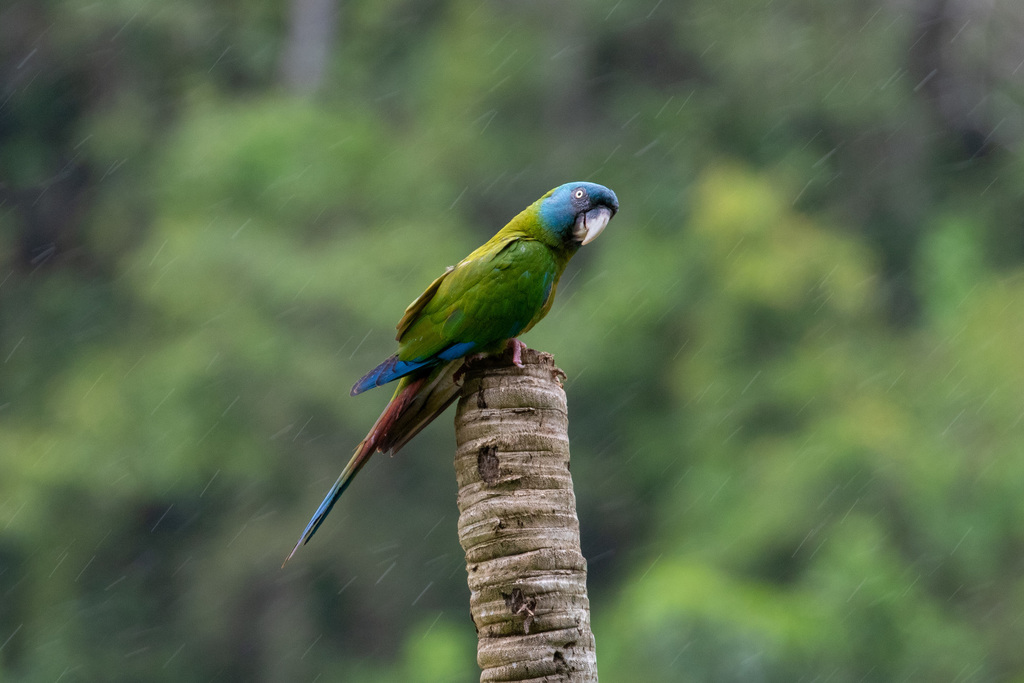
The blue-headed macaw or Coulon's macaw (Primolius couloni) is a macaw native to eastern Peru, northwestern Bolivia (mainly in Pando), and far western Brazil (in Acre). It has a total length of about 41 cm (16 in), making it a member of the group of smaller macaws sometimes known as the mini-macaws, which includes any species of macaw with a total length of 50 cm (20 in) or less. As in all macaws, its tail is long and pointed and the bill is large and heavy.
The specific epithet couloni is in honor of Swiss naturalist Paul Louis Coulon (1804-1894).
From the article Blue-headed macaw on Wikipedia (CC BY-SA), quoted section by section
Description
The blue-headed macaw is 41 cm (16 in) long. It has mainly green plumage (often tinged olive, esp. below) with the head, flight feathers and primary coverts blue. The uppertail has a maroon base, a narrow green center and a blue tip. The undertail and underwing are greenish-yellow similar to that of several other small macaws (e.g. red-bellied and golden-collared macaw). The medium-sized bill is pale greyish-horn with a black base (extent varies, but upper mandible in adults typically appears mainly pale). The iris is whitish with a narrow, often barely visible, maroon eye-ring. Unlike most other macaws, the facial skin and lores are dark greyish. The legs are dull pinkish. Juveniles resemble adults, but with the entire bill black, greyer legs, darker iris and the facial skin and lores white.
Range & habitat
It is found in the south-west Amazon and adjacent east Andean foothills. It prefers openings in humid forest, e.g. along rivers or clearings, but has also been observed in Moriche Palm swamps and outskirts of towns. It occurs from the lowlands up to an altitude of 1550 m (5100 ft). As several other parrots, the blue-headed macaw is known to visit clay-licks.
Wikipedia: “Habitat”
What it does
Little is known about its reproductive behavior in the wild, but a possible nest has been recorded in a bamboo cavity and another in a tree cavity. In captivity, the reproductive cycle appears to be roughly annual with a clutch size of 2-4 being the norm. In the wild it is typically seen in groups of 2-4 individuals, with occasional records of groups up to c. 60 individuals. Its call is higher-pitched and softer than that of most other macaws.
Wikipedia: “Behavior”
Listen
Looking for field recordings…
Where it lives
Recorded sightings
—
geo-referenced records in GBIF, from museums, herbaria and field observers.
Drag the globe to turn it. Dots are where records exist, not a range map; darker means more records.
In the stacks
Searching the stacks…
Every page naming Primolius couloni in the Biodiversity Heritage Library →
This page is assembled live from iNaturalist, GBIF, Wikipedia, the Source Library and the Internet Archive. It is not yet part of the hand-edited codex. iNaturalist taxon 73273.