On eBird ↗
Namaqua Warbler
Live sightings near you, the range map, bar charts of when it is seen, and Macaulay Library photos and recordings.
Namaqua Warbler
Phragmacia substriata
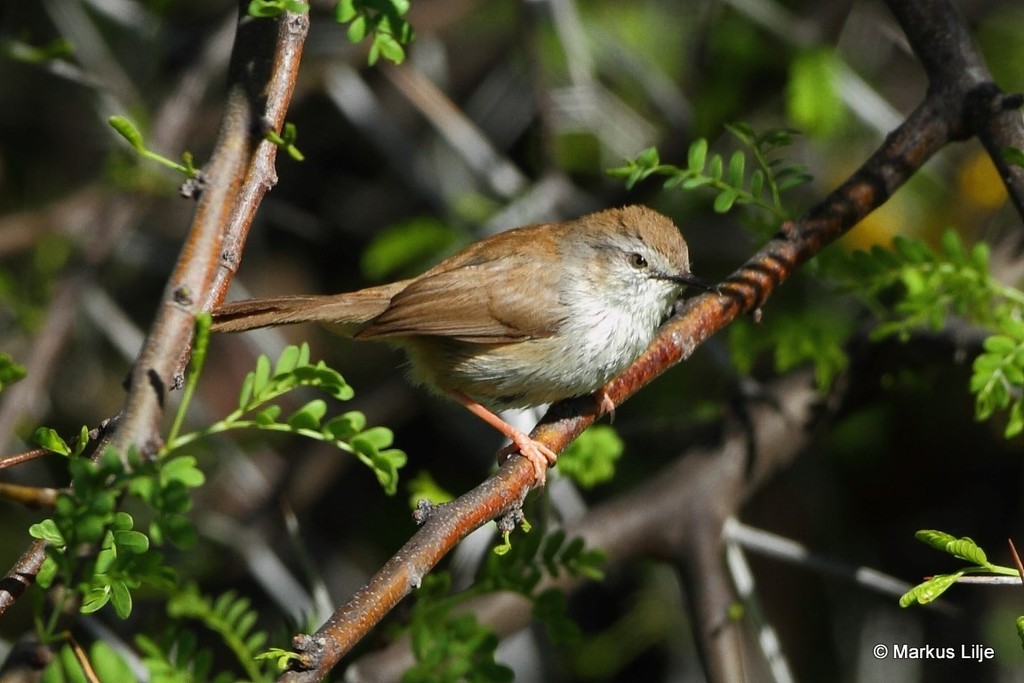
The Namaqua warbler (Phragmacia substriata), also known as the Namaqua prinia or white-breasted prinia, is a small passerine bird, a cisticolid warbler and the sole member of the genus Phragmacia. It was formerly placed in the genus Prinia, but was found to be sufficiently distinct to warrant a genus of its own.
From the article Namaqua warbler on Wikipedia (CC BY-SA), quoted section by section
Description
The Namaqua warbler is 12–13 cm long, with short rounded wings, a long tail, strong legs and a short straight black bill. The head has a whitish eyebrow and the upperparts are otherwise a rich russet brown. The throat and lower face are whitish with no streaking, and the breast is white with faint streaking. The rear flanks are buff. The long, brown tail is typically cocked up at an angle. The feet and legs are pinkish-brown, and the eye is brown. The sexes are identical, but juveniles are duller than the adults. The calls include a high-pitched treeep-treep-trrrrrr. The Namaqua warbler can only be confused with the Karoo prinia, but that species has a shorter, less whispy tail, duller brown back and buff tips to the undertail feathers.
Range & habitat
This is a resident breeder in western South Africa and southern Namibia. It is a species endemic to the Karoo in thick bushes in dry river gullies and reedbeds near rivers and dams.
Wikipedia: “Distribution and habitat”
What it does
The warbler is usually seen in pairs or small groups, typically low in scrub, foraging for small insects, with tail cocked.
Wikipedia: “Behaviour”
Listen
Looking for field recordings…
Where it lives
Recorded sightings
—
geo-referenced records in GBIF, from museums, herbaria and field observers.
Drag the globe to turn it. Dots are where records exist, not a range map; darker means more records.
In the stacks
Searching the stacks…
Every page naming Phragmacia substriata in the Biodiversity Heritage Library →
This page is assembled live from iNaturalist, GBIF, Wikipedia, the Source Library and the Internet Archive. It is not yet part of the hand-edited codex. iNaturalist taxon 73280.