On eBird ↗
Olive Oropendola
Live sightings near you, the range map, bar charts of when it is seen, and Macaulay Library photos and recordings.
Olive Oropendola
Psarocolius bifasciatus
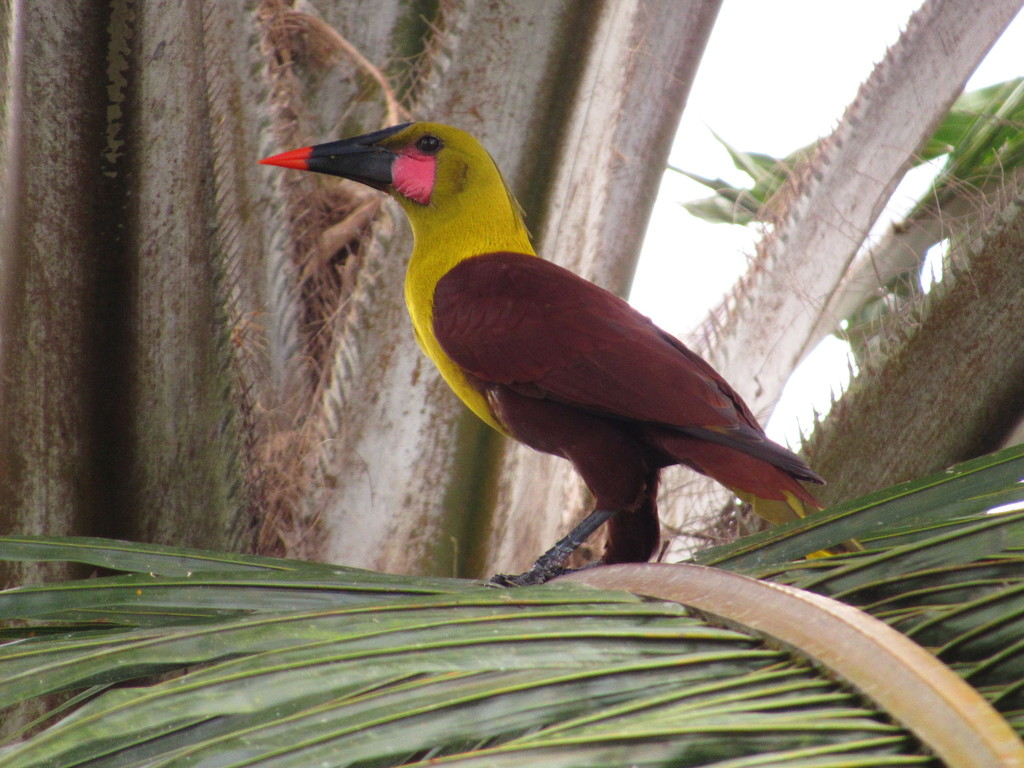
The olive oropendola (Psarocolius bifasciatus) is the largest member of the icterid family and rivals the Amazonian umbrellabird as the largest passerine bird in South America. It is sometimes placed in the genus Gymnostinops instead of Psarocolius. As suggested by its name, it is found widely – but often in low densities – throughout humid lowland forests of the Amazon Basin, with the notable exception of most of the Guiana Shield. It is sometimes split into...
From the article Olive oropendola on Wikipedia (CC BY-SA), quoted section by section
Description
The olive oropendola is the largest member of its genus. Males are about 47 to 53 cm (19 to 21 in) long and females 34 to 38 cm (13 to 15 in). Adult males have long feathers on their nape that form a crest. Females lack the crest but are otherwise like males except for their smaller size and somewhat duller plumage. Adults of the nominate subspecies P. b. bifasciatus have a blackish brown head, neck, and upper breast that combined look like a hood. They have a patch of bare pinkish skin on their face. Their mantle, rump, underparts, and thighs are chestnut with a smooth transition from the blackish brown. Their wings are mostly black; the primaries and secondaries have chestnut outer edges so the folded wing looks that color. Their tail's central pair of feathers are dark brown and the rest yellow; because the dark ones are shorter than the others the tail often looks completely yellow from below. They have a large bill with a swollen casque; it is mostly black with a vermilion outer third. They have a dark brown iris and black to brownish black legs and feet. Subspecies P. b. yuracares has a mostly yellow-olive head with a somewhat darker face and the same pink patch of skin as the nominate. Its upper back, neck, breast, and upper belly are also yellow-olive. The rest of its body is chestnut that is sharply demarcated from the yellow-olive. …
Range & habitat
The olive oropendola is a bird of the Amazon and upper Orinoco river basins. Subspecies P. b. yuracares is the most northerly of the three and has much the largest range. It is found in approximately the southeastern half of Colombia and from there east into the western parts of southern Venezuela's Amazonas and Bolívar states. From there its range continues south through eastern Ecuador and eastern Peru into central Bolivia. From those countries its range extends into Amazonian Brazil's Rondônia, Amazonas, and Acre states and east to the Negro River north of the Amazon and to the Tapajós River south of it. Subspecies P. b. neivae is found in Brazil east of yuracares from the Tapajós to the Tocantins River in northern Tocantins, northeastern Mato Grosso, and northern Goiás. The nominate P. b. bifasciatus has the smallest range, from the Tocantins eastward in eastern Pará and western Maranhão. The olive oropendola primarily inhabits mature humid terra firme (including bamboo) forest. It also inhabits várzea, gallery, and secondary forest, plantations near its primary habitat, and river islands. Though it is often seen flying over all of these habitats, it seems to feed, roost, and nest almost entirely in the canopy and edges of terra firme. …
Wikipedia: “Distribution and habitat”
What it does
The olive oropendola is an omnivore. Known components of its diet include insects, snails, nectar, and both wild and cultivated fruits. It forages mostly in the canopy but will move lower to find nectar. It forages mostly individually or in flocks of up to five of its species but will occasionally join mixed-species feeding flocks that may include other oropendola species, caciques, and jays (Corvidae). At a termite swarm it was observed to behave aggressively toward the other species.
Wikipedia: “Feeding”
Listen
Looking for field recordings…
Where it lives
Recorded sightings
—
geo-referenced records in GBIF, from museums, herbaria and field observers.
Drag the globe to turn it. Dots are where records exist, not a range map; darker means more records.
In the stacks
Searching the stacks…
Every page naming Psarocolius bifasciatus in the Biodiversity Heritage Library →
This page is assembled live from iNaturalist, GBIF, Wikipedia, the Source Library and the Internet Archive. It is not yet part of the hand-edited codex. iNaturalist taxon 73284.