On eBird ↗
Gray-hooded Parakeet
Live sightings near you, the range map, bar charts of when it is seen, and Macaulay Library photos and recordings.
Gray-hooded Parakeet
Psilopsiagon aymara
The grey-hooded parakeet (Psilopsiagon aymara), also known as the Aymara parakeet or Sierra parakeet, is a species of parrot in the family Psittacidae. It is found in northwestern Argentina and Bolivia.
Its natural habitat is subtropical or tropical high-altitude shrubland.
From the article Grey-hooded parakeet on Wikipedia (CC BY-SA), quoted section by section
Description
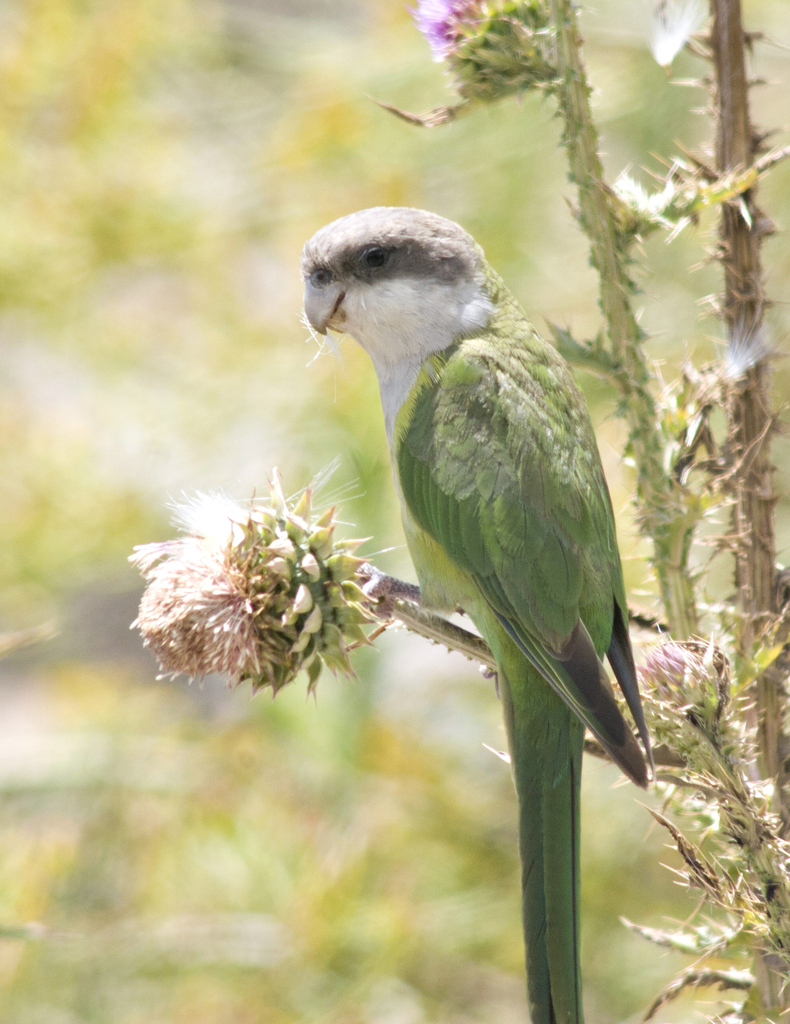
The grey-hooded parakeet is a small, slender parakeet growing to a length of about 20 cm (8 in). The upper parts are green and the flanks and underwing coverts are greenish-yellow. The forehead and crown are brownish-grey, and the chin, throat and breast are whitish-grey, sometimes with a bluish tinge at the side of the breast. The belly is green with a bluish tinge. The upper side of the long, narrow, pointed tail is green and the underside is grey. The beak is flesh-coloured, the iris is brown and the legs and feet are brownish-grey. The sexes are similar in appearance, but the male often has a more vivid grey breast, and immature birds have shorter tails.
Range & habitat
The grey-hooded parakeet is native to the eastern Andes of Bolivia and northern Argentina, as well as the sierras de Córdoba. It is a bird of arid shrubby or wooded habitats, wooded ravines, and dense shrubby areas near villages or agricultural land. Its altitudinal range is from about 1,800 to 4,000 m (6,000 to 13,000 ft).
Wikipedia: “Distribution and habitat”
What it does
The grey-hooded parakeet is a gregarious bird, forming small flocks of about twenty birds, several of which groups may gather together at watering places. The flocks roam the countryside in rapid low, undulating flight, sometimes resting on top of or among the branches of shrubs and small trees, making twittering and warbling sounds rather similar to those made by a barn swallow. They feed in low vegetation, consuming grass seeds, seeds of plants in the aster family, berries and fruits, also foraging on the ground for fallen seeds and fruits. Breeding takes place in November. The nest is situated in a hole excavated in an earth bank, in a crevice, in a hole in a cactus or sometimes in a ruined building. Several nests are sometimes grouped together semi-colonially. Clutches are usually of four or five eggs.
Wikipedia: “Ecology”
Listen
Looking for field recordings…
Where it lives
Recorded sightings
—
geo-referenced records in GBIF, from museums, herbaria and field observers.
Drag the globe to turn it. Dots are where records exist, not a range map; darker means more records.
In the stacks
Searching the stacks…
Every page naming Psilopsiagon aymara in the Biodiversity Heritage Library →
This page is assembled live from iNaturalist, GBIF, Wikipedia, the Source Library and the Internet Archive. It is not yet part of the hand-edited codex. iNaturalist taxon 73297.