On eBird ↗
Orange-cheeked Parrot
Live sightings near you, the range map, bar charts of when it is seen, and Macaulay Library photos and recordings.
Orange-cheeked Parrot
Pyrilia barrabandi
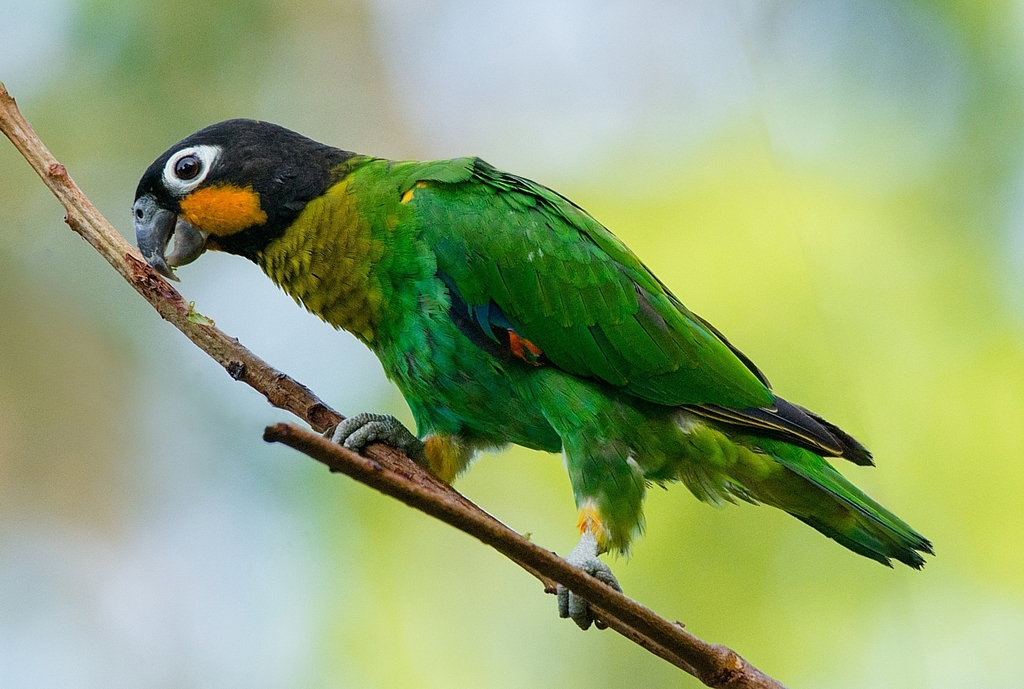
The orange-cheeked parrot (Pyrilia barrabandi), also known as Barraband's parrot, is a species of parrot in the family Psittacidae. It was formerly placed in the genus Pionopsitta, which is now monotypic.
It is found in the Amazonian Andes, in humid lowland forests in the northwestern, southwestern, and south-central Amazon Basin in South America.
From the article Orange-cheeked parrot on Wikipedia (CC BY-SA), quoted section by section
Description
The parrots are 25 cm (9.8 in) in size and weigh 165–190 g (5.8–6.7 oz). Adults have an olive throat and breast. The thighs are yellow, with the bend of the wing and lesser wing coverts ranging from yellow to orange, and the carpal edge and underwing coverts being orange to red. The tips of the tail and the wing feathers are blue. P.b. aurantiigena has deep orange cheeks, bend of wing, underwing and lesser wing coverts, and thighs, lacking the yellow possessed by barrabandi. They have a black head and orange to yellow cheeks, with a distinctive white eye-ring around a brown eye. The beak is gray to black. Juveniles have a brown crown and olive forehead, nape, cheeks and chin, with a brown margin. The bend of the wings and lesser wing coverts are green with a scattered yellow. The carpal edge and underwing coverts are red with scattered green feathers.
Vocalizations. Distinctive calls that are reedy and slurred in flight. They have guttural alarm calls.
Range & habitat
It is found in northwestern Brazil, western Ecuador and Peru, southern Venezuela and Colombia, and extreme northern Bolivia. They are found at elevations of up to 400 m (1,300 ft) in lowland terra firme forest and uncommonly in varzea stands. They also inhabit forest edges and partly disturbed forests.
Wikipedia: “Distribution and habitat”
What it does
They are active in the early morning. They are often seen singly, in pairs or in small groups of up to 10 individuals at clay banks.
Diet. They feed on seeds, fruit, and on wasp larvae in galls. Foraging occurs high in canopy or just below the canopy. They also visit clay banks to consume antacid-like soil which neutralizes the acids found in their food.
Wikipedia: “Ecology and behaviour”
Listen
Looking for field recordings…
Where it lives
Recorded sightings
—
geo-referenced records in GBIF, from museums, herbaria and field observers.
Drag the globe to turn it. Dots are where records exist, not a range map; darker means more records.
In the stacks
Searching the stacks…
Every page naming Pyrilia barrabandi in the Biodiversity Heritage Library →
This page is assembled live from iNaturalist, GBIF, Wikipedia, the Source Library and the Internet Archive. It is not yet part of the hand-edited codex. iNaturalist taxon 73321.