On eBird ↗
Lesser Rhea
Live sightings near you, the range map, bar charts of when it is seen, and Macaulay Library photos and recordings.
Lesser Rhea
Rhea pennata
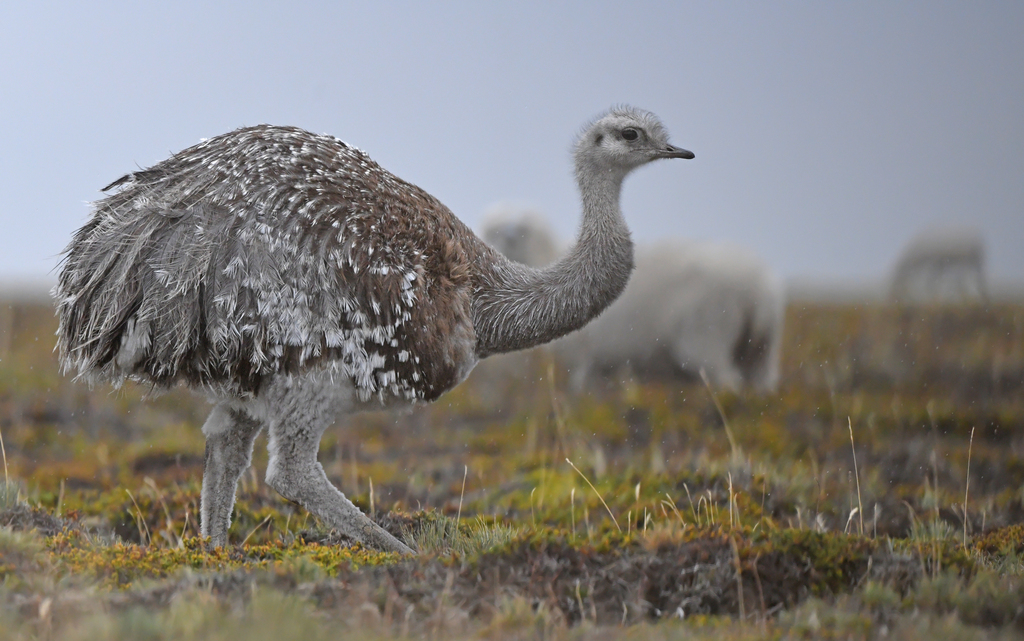
Darwin's rhea (Rhea pennata), also known as the lesser rhea, is a large flightless bird, but the smaller of the two extant species of rheas. It is found in the Altiplano and Patagonia in South America.
From the article Darwin's rhea on Wikipedia (CC BY-SA), quoted section by section
Description
The lesser rhea stands at 90 to 100 cm (35–39 in) tall. Length is 92 to 100 cm (36–39 in) and weight is 15 to 28.6 kg (33–63 lb). Like most ratites, it has a small head and a small bill, the latter measuring 6.2 to 9.2 cm (2.4 to 3.6 in), but has long legs and a long neck. It has relatively larger wings than other ratites, enabling it to run particularly well. It can reach speeds of 60 km/h (37 mph), enabling it to outrun predators. The sharp claws on the toes are effective weapons. Their feathers are similar to those of ostriches, in that they have no aftershaft. Their plumage is spotted brown and white, and the upper part of their tarsus is feathered. The tarsus is 28 to 32 cm (11 to 13 in) long and has 18 horizontal plates on the front.
Range & habitat
Darwin's rhea lives in areas of open scrub in the grasslands of Patagonia and on the Andean plateau (the Altiplano), through the countries of Argentina, Bolivia, Chile, and Peru. All subspecies prefer grasslands, brushlands and marshland. However, the nominate subspecies prefers elevations less than 1,500 m (4,900 ft), where the other subspecies typically range from 3,000 to 4,500 m (9,800–14,800 ft), but locally down to 1,220 m (4,000 ft) in the south.
Wikipedia: “Distribution and habitat”
What it does
The lesser rhea is mainly a herbivore, with the odd small animal (lizards, beetles, grasshoppers) eaten on occasion. It predominantly eats saltbush and fruits from cacti, as well as grasses, roots, seeds, and leaves. They tend to be quiet birds, except as chicks when they whistle mournfully, and as males looking for a female, when they emit a booming call. The males of this species become aggressive once they are incubating eggs, even towards females. The females thus lay the later eggs near the nest, rather than in it. Most of the eggs are moved into the nest by the male, but some remain outside, where they rot and attract flies. The male, and later the chicks, eat these flies. The incubation period is 30–44 days, and the clutch size is from 6–50 eggs (laid by multiple females) and the eggs measure 11.7–13.6 cm (4.6–5.4 in) in length 8.3–10 cm (3.3–3.9 in) in width, with a mass of 488–722 g (1.076–1.592 lb). Parental care is done solely by the male. Young birds become sexually mature at 20 to 24 months of age. Outside the breeding season, Darwin's rhea is quite sociable: it lives in groups of from 5 to 30 birds, of both sexes and a variety of ages.
Wikipedia: “Behavior”
In human culture
It is known as ñandú petiso, or ñandú del norte, in Argentina, where the majority live. Other names are suri and choique. The name ñandú comes from the greater rhea's name in Guaraní, ñandu guazu, meaning big spider, possibly in relation to their habit of alternately opening and lowering their wings when they run. In English, Darwin's rhea gets its scientific name from Rhea, a Greek goddess, and pennata, meaning winged. The specific name was bestowed in 1837 by Darwin's contemporary and rival Alcide d'Orbigny, who first described the bird to Europeans from a specimen from the lower Río Negro south of Buenos Aires, Argentina. As late as 2008, it was classified in the monotypic genus Pterocnemia. This word is formed from two Greek words pteron, meaning feathers, and knēmē, meaning the leg between the knee and the ankle, hence feather-legged, alluding to their feathers that cover the top part of the leg. In 2008, the SACC subsumed Pterocnemia into the genus Rhea.
Wikipedia: “Etymology”
Listen
Looking for field recordings…
Where it lives
Recorded sightings
—
geo-referenced records in GBIF, from museums, herbaria and field observers.
Drag the globe to turn it. Dots are where records exist, not a range map; darker means more records.
In the stacks
Searching the stacks…
Every page naming Rhea pennata in the Biodiversity Heritage Library →
This page is assembled live from iNaturalist, GBIF, Wikipedia, the Source Library and the Internet Archive. It is not yet part of the hand-edited codex. iNaturalist taxon 73338.