On eBird ↗
Australian Painted-Snipe
Live sightings near you, the range map, bar charts of when it is seen, and Macaulay Library photos and recordings.
Australian Painted-Snipe
Rostratula australis
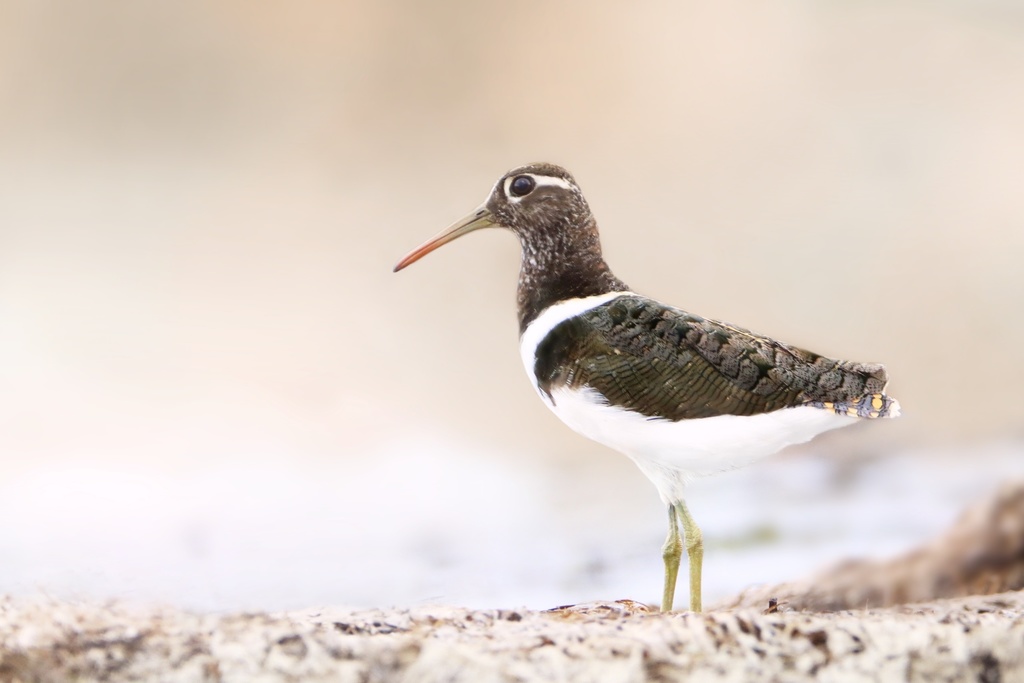
The Australian painted-snipe (Rostratula australis) is a medium-sized, long-billed, distinctively patterned wader.
From the article Australian painted-snipe on Wikipedia (CC BY-SA), quoted section by section
Description
The head, neck and upper breast is chocolate brown (in the male, dark grey with a buff median stripe on the crown), fading to rufous in the centre of the hindneck and merging to dark, barred grey on the back. There is a cream comma-shaped mark around the eye. A white stripe on the side of the breast and over the shoulders is diagnostic. The upperwing is grey (with buff spots in the male). The lower breast and underbody are white. Males are generally slightly smaller and less bright than females. Juveniles are similar to adult males. No call has been recorded. The length ranges from 24 to 30 cm, the wingspan from 50 to 54 cm, the weight from 125 to 130 g.
Range & habitat
The Australian painted-snipe is endemic to Australia, though its distribution is patchy and its presence in any particular area is unpredictable. A previous stronghold was the Riverina. It frequents shallow, freshwater wetlands with a thick cover of low vegetation, disappearing when conditions become unsuitable.
Conservation. The species has declined drastically during the 20th century and is rare throughout its range. Causes of the decline are ascribed to wetland drainage, river management and salinisation, as well as grazing and trampling of wetlands by stock. As of 2022, the global population is estimated to be 270 – 410 mature individuals. Because of this very small population size, the species is listed as Endangered by the IUCN. In Australia it is classified as being nationally threatened with a rating of Endangered as of May 2013.
Wikipedia: “Distribution and habitat”
What it does
Wetland invertebrates such as worms, molluscs, insects and crustaceans; also seeds and other vegetation.
Wikipedia: “Diet”
Listen
Looking for field recordings…
Where it lives
Recorded sightings
—
geo-referenced records in GBIF, from museums, herbaria and field observers.
Drag the globe to turn it. Dots are where records exist, not a range map; darker means more records.
In the stacks
Searching the stacks…
Every page naming Rostratula australis in the Biodiversity Heritage Library →
This page is assembled live from iNaturalist, GBIF, Wikipedia, the Source Library and the Internet Archive. It is not yet part of the hand-edited codex. iNaturalist taxon 73358.