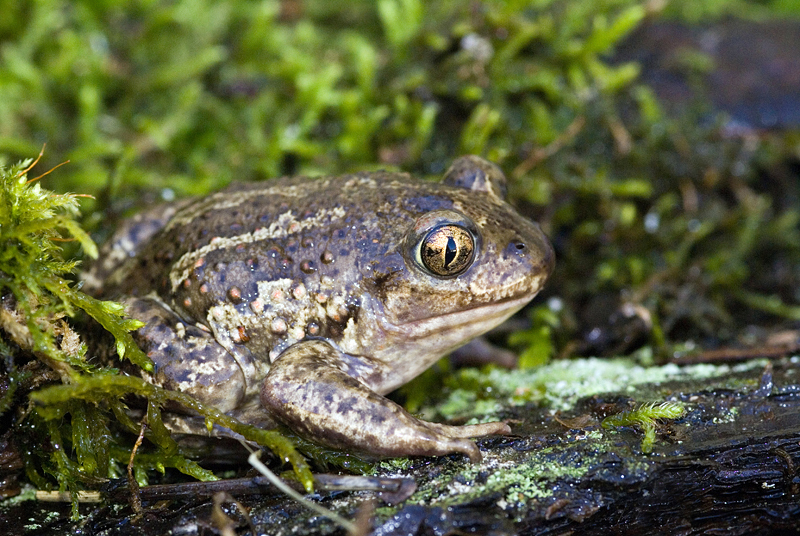
Pallas' Spadefoot
Pelobates vespertinus
Pelobates vespertinus, commonly known as Pallas’ spadefoot toad, is a species of toad in the family Pelobatidae. It is native to Eastern Europe and parts of Central Asia, with a broad range extending from eastern Ukraine and southern Russia to western Siberia and northern Kazakhstan. Previously considered a subspecies of Pelobates fuscus, it is now recognized as a distinct species based on morphological, cytogenetic, and genomic evidence.
From the article Pelobates vespertinus on Wikipedia (CC BY-SA), quoted section by section
Description
Pallas’ spadefoot is a medium-sized toad, measuring 29–61 mm in length. It has a robust body and a relatively short, rounded snout. Its coloration is typically brownish or grayish with darker markings that vary among individuals. Like other members of its genus, it has a keratinized, spade-like tubercle on each hind foot, which it uses for burrowing. Its eyes are prominent and directed slightly upward, an adaptation to its fossorial and nocturnal lifestyle. Morphologically, it is similar to P. fuscus, but it can usually be distinguished by three pale longitudinal stripes along the dorsum and a dark interocular stripe—features generally absent in P. fuscus.
Range & habitat
Pelobates vespertinus occurs across parts of Eastern Europe and Central Asia. Confirmed records include areas of central and southern Russia (e.g., Samara, Kursk, Saratov), northern and eastern Kazakhstan, and northeastern Ukraine. The hybrid zone with P. fuscus is narrow, generally less than 20 km wide, with genetic transitions documented between the Kursk region and southern Ukraine. It typically inhabits open or semi-open lowland environments such as steppes, forest-steppes, river valleys, and floodplains. It prefers loose sandy or loamy soils suitable for burrowing. Breeding occurs in temporary or permanent ponds, ditches, or slow-moving water bodies, often formed after spring rains.
Wikipedia: “Distribution and habitat”
What it does
Like other spadefoot toads, P. vespertinus is primarily nocturnal and fossorial, spending most of its life underground. It emerges mainly during the breeding season, which typically begins in spring following significant rainfall. Males call from the water to attract females, and eggs are laid in long gelatinous strings attached to submerged vegetation. Tadpoles develop quickly in temporary water bodies, completing metamorphosis before they dry out. Outside the breeding season, the species feeds on various invertebrates, including insects, earthworms, and other small soil-dwelling animals.
Wikipedia: “Ecology and behavior”
Listen
Looking for field recordings…
Where it lives
Recorded sightings
—
geo-referenced records in GBIF, from museums, herbaria and field observers.
Drag the globe to turn it. Dots are where records exist, not a range map; darker means more records.
In the stacks
Searching the stacks…
Every page naming Pelobates vespertinus in the Biodiversity Heritage Library →
This page is assembled live from iNaturalist, GBIF, Wikipedia, the Source Library and the Internet Archive. It is not yet part of the hand-edited codex. iNaturalist taxon 733747.