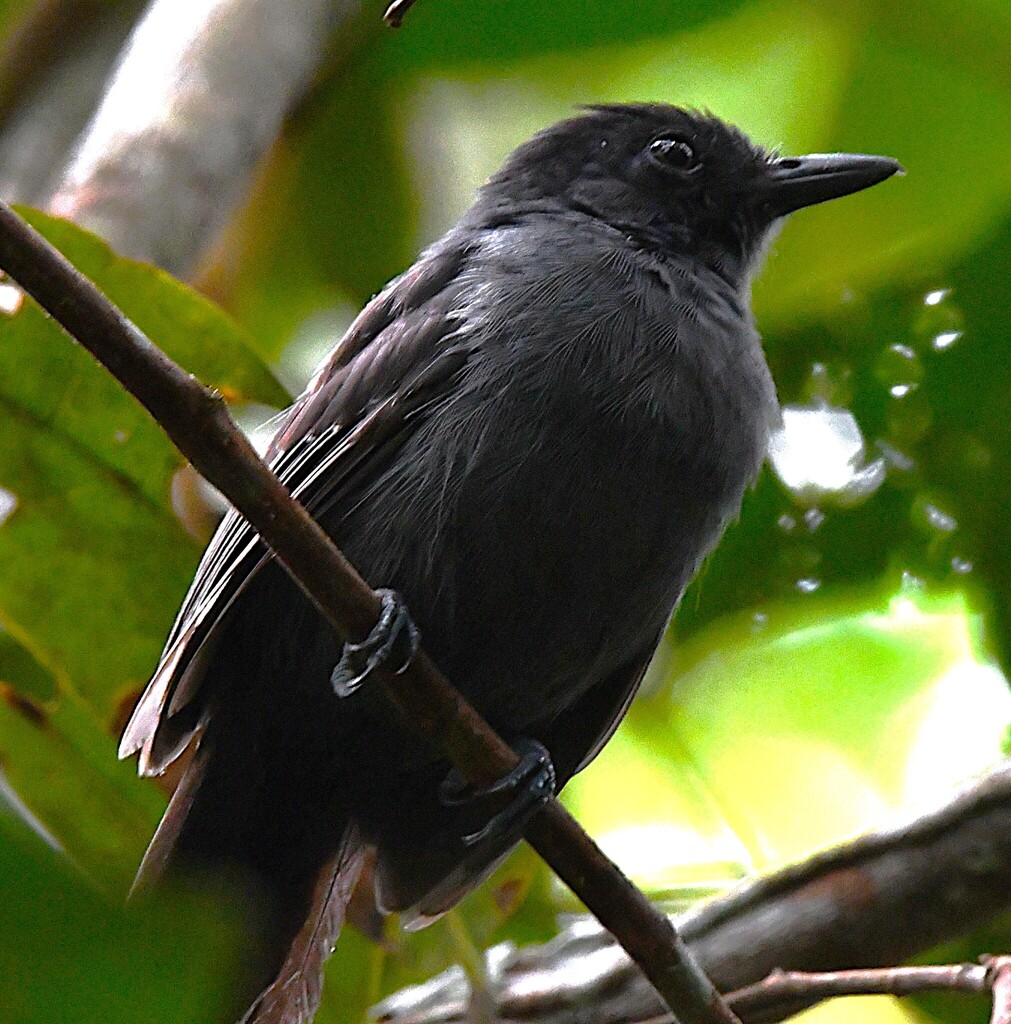
On eBird ↗
Acre Antshrike
Live sightings near you, the range map, bar charts of when it is seen, and Macaulay Library photos and recordings.
Acre Antshrike
Thamnophilus divisorius
The Acre antshrike (Thamnophilus divisorius) is a member of the antbird family (Thamnophilidae). Its closest relatives are the streak-backed antshrike and the Amazonian antshrike.
From the article Acre antshrike on Wikipedia (CC BY-SA), quoted section by section
Description
The Acre antshrike is about 16 cm (6.3 in) long and weighs about 22 g (0.78 oz). Members of genus Thamnophilus are largish members of the antbird family; all have stout bills with a hook like those of true shrikes. This species exhibits significant sexual dimorphism. Adult males have a glossy black crown and nape with a few white feathers on the forehead and nape; the rest of their head and neck are a less glossy black. Their back is mostly bluish black with dark bluish gray rump and uppertail coverts. Their wings, scapulars, and wing coverts are mostly black and their primaries blackish. Their tail is black; all feathers except the central pair have white tips. Their underparts are mostly dark bluish gray with a somewhat darker throat. Adult females have a dark bluish gray crown. Their face is dark bluish gray with orangish shafts on the ear coverts. Their upperparts are unmarked dark bluish gray. Their wings are blackish; their tail is blackish with small buff-orange tips on the outermost feathers. Their chin and throat are deep ochraceous with darker mottling and the rest of their underparts are deep ochraceous or brownish orange. Both sexes have a chestnut brown iris and dull bluish gray legs and feet. Their maxilla is black or dark gray and their mandible black or dark gray with sometimes a pale horn base.
Range & habitat
The Acre antshrike was originally known to occur only in the immediate area of its discovery, the Sierra da Jaquiran in Brazil's Serra do Divisor National Park, though the discovery team expected it to also occur on other ridges with similar habitat in and near the park. Its range was extended by nearly 100 km (60 mi) with the 2006 discovery of the species in Peru's Ojo de Contaya and Diviso in Zona Reservada Sierra del Divisor, which is part of the same complex of ridges as the discovery site. In both known locations it occurs in areas of nutrient-poor sandy soil with forest generally shorter than 15 m (50 ft), and within the narrow elevational range of about 400 to 600 m (1,300 to 2,000 ft). Most of the few encounter sites on the two ridges had a dense understory dominated by terrestrial bromeliads.
Wikipedia: “Distribution and habitat”
What it does
Little is known about the Acre antshrike's diet or feeding behavior. Whitney et al. observed pairs foraging low to the ground, hopping and hitching on thin branches and vines. They captured prey by reaching and lunging from a perch; all of the identified prey were arthropods. It was not observed joining mixed-species feeding flocks, which were however scarce in its habitat.
Wikipedia: “Feeding”
Listen
Looking for field recordings…
Where it lives
Recorded sightings
—
geo-referenced records in GBIF, from museums, herbaria and field observers.
Drag the globe to turn it. Dots are where records exist, not a range map; darker means more records.
In the stacks
Searching the stacks…
Every page naming Thamnophilus divisorius in the Biodiversity Heritage Library →
This page is assembled live from iNaturalist, GBIF, Wikipedia, the Source Library and the Internet Archive. It is not yet part of the hand-edited codex. iNaturalist taxon 73490.