On eBird ↗
Yellow-legged Thrush
Live sightings near you, the range map, bar charts of when it is seen, and Macaulay Library photos and recordings.
Yellow-legged Thrush
Turdus flavipes
The yellow-legged thrush (Turdus flavipes) is a songbird of northern and eastern South America. In recent times, it is increasingly often placed in the genus Turdus again, however some taxonomists place this species in the genus Platycichla based on morphology. The South American Classification Committee of the American Ornithologists' Union places it in the genus Turdus, as does the International Ornithological Committee.
From the article Yellow-legged thrush on Wikipedia (CC BY-SA), quoted section by section
Description
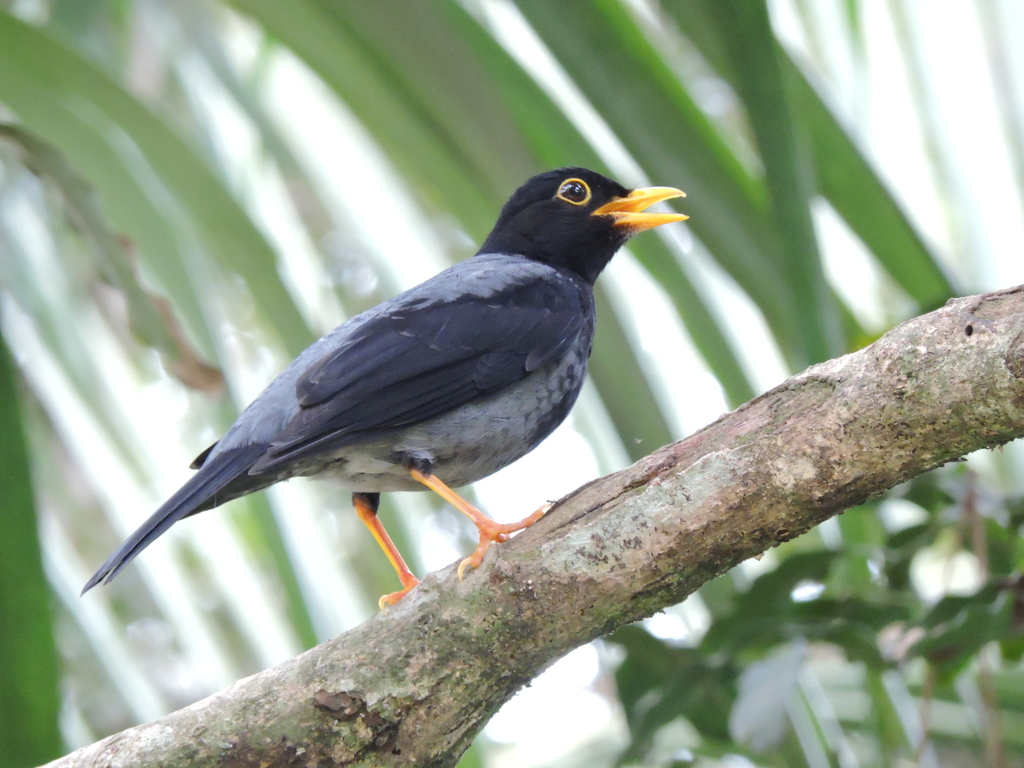
The yellow-legged thrush is 20 to 22 cm (7.9 to 8.7 in) long and weighs 55 to 72 g (1.9 to 2.5 oz). The species is sexually dimorphic. Adult males of the nominate subspecies T. f. flavipes have a black head, wings, tail, and breast. Their back, rump, flanks, belly, and vent are slate-gray. They have a yellow eye-ring, bill, legs, and feet. Adult females have a mostly warm darkish brown head, upperparts, wings, and tail. Their throat and underparts are a paler and more orangey brown. They have a yellowish eye-ring, a dull bill, and yellow legs and feet. Juvenile males are mostly slate-brown with black wings and tail; juvenile females resemble adults. Both sexes of juveniles have buffy-orange spots on their crown, nape, and back and buffy-orange spots and bars on their underparts. The other subspecies of the yellow-legged thrush differ from the nominate and each other thus:
T. f. venezuelensis: male is paler gray on mantle and belly, female has more olive upperparts T. f. melanopleura: male is variable but has more black especially on belly, female has duller underparts T. f. xanthoscelus: male is entirely black, female is like nominate T. f. polionotus: male is paler gray on mantle and belly like venezuelensis, female grayer on crown to tail than nominate
Range & habitat
The yellow-legged thrush has a highly disjunct distribution. The subspecies are found thus:
T. f. venezuelensis: in Venezuela, mountains in states of Falcón, Yaracuy and Bolívar; Coastal Range from Carabobo to eastern Miranda; and Andes from Lara; from last southwest into northeastern Colombia T. f. melanopleura: in Venezuela, mountains in Anzoátegui and northeastern Monagas and on Isla Margarita; Trinidad T. f. xanthoscelus: Tobago T. f. polionotus: Cerro Roraima in Venezuela; west-central Guyana; far northeastern Brazil T. f. flavipes: southeastern Brazil from northern Bahia south to northern Rio Grande do Sul with isolated records further north; historical records in northeastern Argentina's Misiones Province; formerly Paraguay and as a vagrant to Uruguay The yellow-legged thrush inhabits the interior, edges, and clearings of humid primary and secondary forest and woodlands and also shade coffee plantations. In Venezuela it ranges in elevation between 480 and 2,500 m (1,600 and 8,200 ft) north of the Orinoco River, between 1,000 and 1,800 m (3,300 and 5,900 ft) south of it, and between 100 and 900 m (300 and 3,000 ft) on Isla Margarita. In southeastern Brazil it ranges from sea level to 2,000 m (6,600 ft) but is found only above 1,000 m (3,300 ft) in the north. It ranges between 350 and 1,800 m (1,100 and 5,900 ft) in Colombia.
Wikipedia: “Distribution and habitat”
What it does
The yellow-legged thrush feeds mostly on fruit and also includes insects in its diet. It forages at all levels of the forest but seldom on the ground. It sometimes feeds in small groups in fruiting trees. It only occasionally joins mixed-species flocks.
Wikipedia: “Feeding”
Listen
Looking for field recordings…
Where it lives
Recorded sightings
—
geo-referenced records in GBIF, from museums, herbaria and field observers.
Drag the globe to turn it. Dots are where records exist, not a range map; darker means more records.
In the stacks
Searching the stacks…
Every page naming Turdus flavipes in the Biodiversity Heritage Library →
This page is assembled live from iNaturalist, GBIF, Wikipedia, the Source Library and the Internet Archive. It is not yet part of the hand-edited codex. iNaturalist taxon 73542.