- Animals
- ›Chordates
- ›Vertebrates
- ›Reptiles
- ›Snakes and Lizards
- ›Lizards
- ›Skinks and allies
- ›Skinks
- ›Eugongyline skinks
- ›Ablepharus
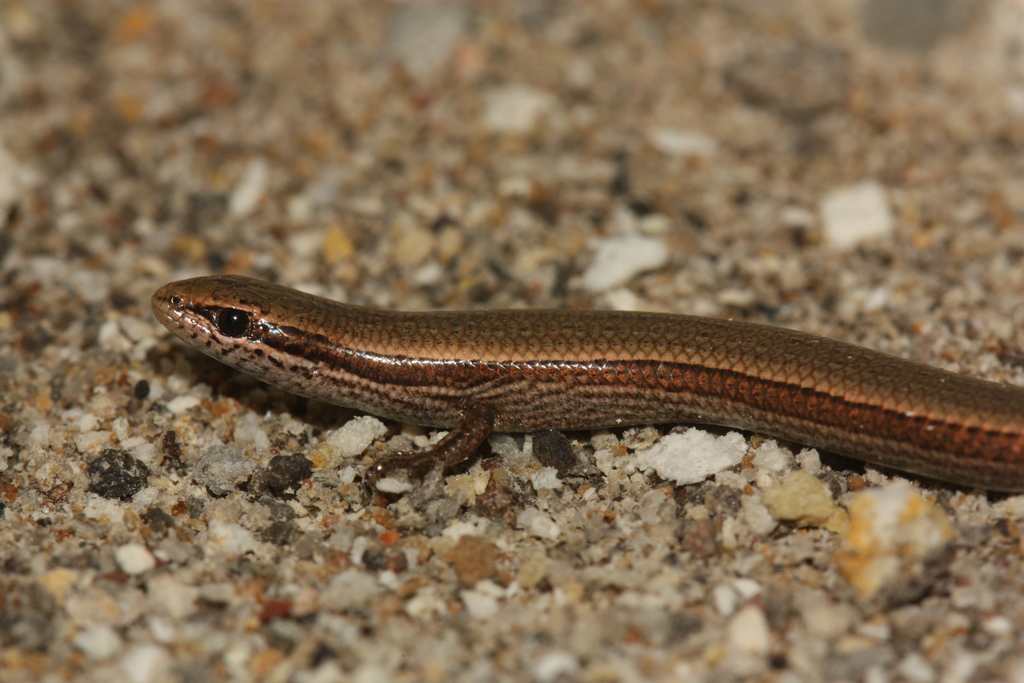
European Copper Skink
Ablepharus kitaibelii
Ablepharus kitaibelii, also known commonly as the European copper skink, the European snake-eyed skink, the juniper skink, and the snake-eyed skink, is a species of skink, a lizard in the subfamily Eugongylinae of the family Scincidae. The species is native to Eastern Europe and Southwestern Asia.
From the article Ablepharus kitaibelii on Wikipedia (CC BY-SA), quoted section by section
Description
A small, slender lizard, A. kitaibelii grows up to 15 cm (5.9 in) in total length (including tail). The skin is bronze-coloured, with dark sides. The eyelids are immovable, in contrast to many other skinks.
Range & habitat
A. kitaibelii is native to Greece (including the Aegean Islands), Romania, Bulgaria, the former Yugoslavia, Hungary, Albania, Slovakia, the Caucasus, Turkey, Syria, Israel, Jordan, Lebanon, the Sinai Peninsula of Egypt and possibly Iraq. The subspecies A. k. fitzingeri is known from Slovakia, Hungary, Greece and the island of Corfu. The subspecies A. k. stepaneki is known from Bulgaria and Romania. Also Macedonia
Wikipedia: “Geographic range”
What it does
A. kitaibelii is a shy species, which lives under stones and leaves in dry places, such as south slopes, fields, and meadows. It is active during twilight, and hunts for insects and small snails. It is a typical ground dweller, and dislikes climbing.
Wikipedia: “Habitat and behaviour”
Where it lives
Recorded sightings
—
geo-referenced records in GBIF, from museums, herbaria and field observers.
Drag the globe to turn it. Dots are where records exist, not a range map; darker means more records.
In the stacks
Searching the stacks…
Every page naming Ablepharus kitaibelii in the Biodiversity Heritage Library →
This page is assembled live from iNaturalist, GBIF, Wikipedia, the Source Library and the Internet Archive. It is not yet part of the hand-edited codex. iNaturalist taxon 73585.