- Animals
- ›Chordates
- ›Vertebrates
- ›Reptiles
- ›Snakes and Lizards
- ›Lizards
- ›Wall lizards, amphisbaenians, and allies
- ›Whiptails and Tegus
- ›Whiptails and Ameivas
- ›Aspidoscelis
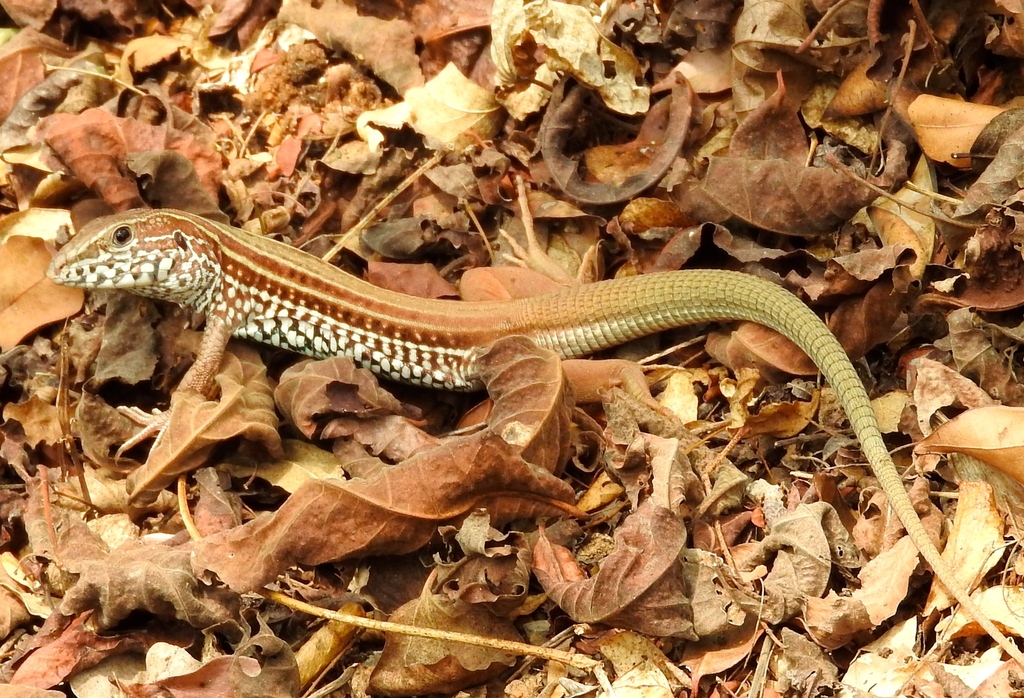
Western Mexico Whiptail
Aspidoscelis costatus
Aspidoscelis costatus, also known as the western Mexico whiptail, is a species of whiptail lizard endemic to Mexico, including Guerrero, Morelos, and Puebla in southern Mexico, as well as other Mexican states. Its range spans both temperate and tropical habitats, and even densely populated urban areas. Its common name, the Western Mexico Whiptail, can easily be confused with the Western Whiptail, which refers to a different lizard, Aspidoscelis tigris.
A small lizard, up to only 4 inches SVL (snout to vent length), this striped lizard has a pointed snout, a slender body, a pair of long hind legs, and an extremely long tail. Its whip-like, tapering tail, if not recently shortened from caudal autotomy (self-amputation of the tail), may be more than two times its SVL. Therefore, although this dwarf lizard has a short SVL length, it can reach a total length of close to 1 foot, tail included, giving the false impression that it's a long lizard. When the lizards fight to maintain territory or compete for mates, they whip their long tails around, therefore its common name is the whiptail lizard. They are often found under low desert scrubs, rocks, or nosing around leaf litter. Whiptails are diurnal but mostly solitary creatures, except during the breeding season, when males start accompanying females around.
From the article Aspidoscelis costatus on Wikipedia (CC BY-SA), quoted section by section
Range & habitat
Most species of whiptail lizards prefer dry climates and seek out habitats in deserts. Therefore, many species of whiptail lizards are found throughout Sonoran Desert, spanning northwestern Mexico and southern California, a region with sparse vegetation, such as sagebrush, low desert scrubs, grasslands, woodlands and pine forests. Similarly, Aspidoscelis costatus prefers natural habitats such as savanna, and shrubland in brushy, broken country. But they also extend their habits into open areas of tropical low deciduous forest and thorn forest, low spiny sub-evergreen forest and medium sub-deciduous forest. spanning both temperate and tropical climates in western and southwestern Mexico. Since considerable habitat clearance has taken place for intensive agriculture or human settlements, we are starting to see urban population of Aspidoscelis costatus, even in densely populated cities, at least for Aspidoscelis costatus costatus, which is a subspecies of Western Mexico Whiptail lizard, commonly named Balsas Basin Whiptail. One research paper suggested that global warming has affected the habitats of Western Mexico Whiptail lizard. Some climatic groups of Aspidoscelis costatus costatus are exhibiting reductions and others exhibiting expansions in their distribution. Redistribution to higher elevation may potentially occur in response to climate warming.
Wikipedia: “Distribution and habitat”
What it does
Western Mexico whiptail are striped lizards, which tend to be active foragers, constantly moving around than lizards with cryptic patterns. It records very high moves per minute or percent time moving values. All whiptail lizards in the genera Aspidoscelis are active at body temperatures between 37 and 40 °C (99 and 104 °F). Since they need the sunlight to heat their bodies up for activities, whiptails adjust their activity to take advantage of heat sources. Larger whiptails are present in shaded regions more so that their bodies don't overheat. Smaller whiptails can heat and cool their bodies quickly so they are more comfortable in open areas even in the summer. Aspidoscelis are not sit-and-wait ambush predators. Instead, they are active foragers. They move quite frequently, and almost constantly, in short gaits and at a frenetic pace. Foraging is their primary activity throughout the day. When they are on the move under plants or through leaf-litter, their jerky, start-stop movements create unique crunching switch sounds from disturbed dry leaves. When Whiptails must run away from threats, they run fast at top speeds of 18 mph (29 km/h), and appear to keep theirs tail behind the body in a straight line. They do not whip their tails when they run.
Wikipedia: “Ecology and behavior”
In human culture
There are several genus of whiptail lizards in the family Teiidae. The genus of Aspidoscelis lizard was originally under the genus Cnemidophorus until 2002, when Reeder proposed that there are significant divergent characters, including morphological and genetic differences, for many species that warrant regrouping. Morphological deviations between Cnemidophorus and Aspidoscelis are detailed in the Physical Description section. Nomenclatural changes of genus unavoidably causes confusion and difficulties for researchers. To illustrate this dramatic change, the subspecies Aspidoscelis costata zweifeli was named Cnemidophorus sacki zweifeli when it was first reported by Duellman et al. in 1960. In this seminal 1960 publication, Duellman states "In recognition of the important contributions to the systematics of the genus Cnemidophorus made by Dr. Richard G. Zweifel, I propose that the subspecies of Cnemidophorus sacki in the Tepalcatepec Valley be named as follows: Cnemidophorus sacki zweifeli, a new subspecies." That subspecies is the nowadays Aspidoscelis costata zweifeli. The subspecies name of "zweifeli" is still kept to in honor of Dr. Zweifel, an American herpetologist, who contributed immensely to the documentation of the nowadays Aspidoscelis costata species. Out of the eight costata subspecies, Dr. Zweifel reported/named five of them.
Wikipedia: “Taxonomy, history, and etymology”
Where it lives
Recorded sightings
—
geo-referenced records in GBIF, from museums, herbaria and field observers.
Drag the globe to turn it. Dots are where records exist, not a range map; darker means more records.
In the stacks
Searching the stacks…
Every page naming Aspidoscelis costatus in the Biodiversity Heritage Library →
This page is assembled live from iNaturalist, GBIF, Wikipedia, the Source Library and the Internet Archive. It is not yet part of the hand-edited codex. iNaturalist taxon 73661.