- Animals
- ›Chordates
- ›Vertebrates
- ›Reptiles
- ›Snakes and Lizards
- ›Lizards
- ›Wall lizards, amphisbaenians, and allies
- ›Whiptails and Tegus
- ›Whiptails and Ameivas
- ›Aspidoscelis
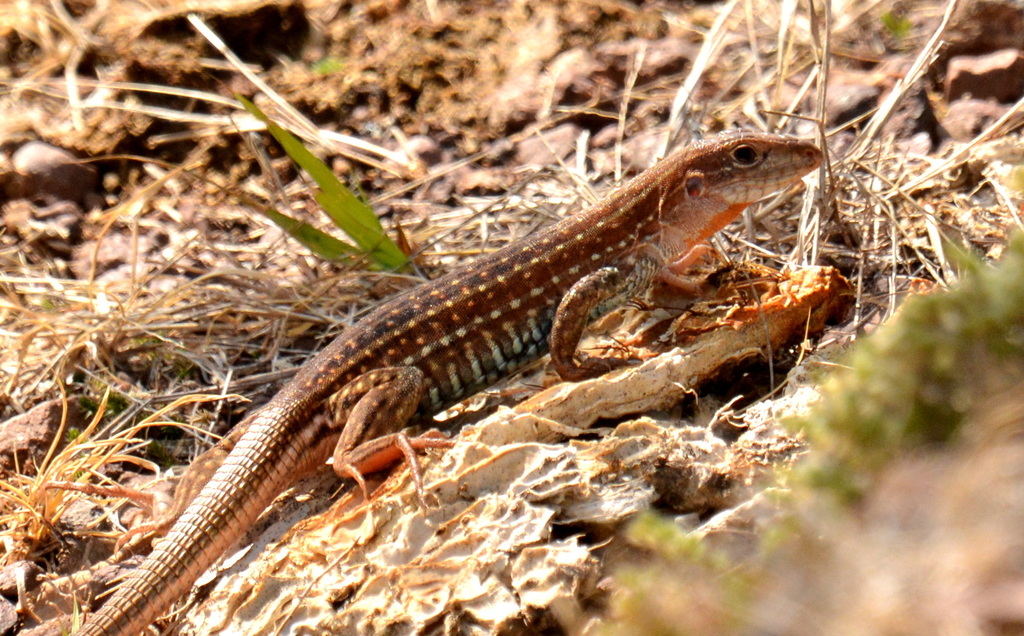
Common Spotted Whiptail
Aspidoscelis gularis
The Texas spotted whiptail (Cnemidophorus gularis or Aspidocelis gularis) is a species of long-tailed lizard native to the southern United States, in Texas, New Mexico, and Oklahoma, and northern Mexico in Coahuila, Nuevo León, Tamaulipas, San Luis Potosí, Querétaro, and Veracruz.
From the article Texas spotted whiptail on Wikipedia (CC BY-SA), quoted section by section
Description
The Texas spotted whiptail grows to 6.5 to 11 inches (17 to 28 cm) in total length (including tail). It is typically a tan brown or green-brown in color, with a pattern of seven distinct grey or white stripes that run the length of the body, and stop at the tail, with light colored spots along the sides. The underside is uniformly white in color. Males often have a red-colored throat, blue belly, and black or blue patches on the chest, while females have only a pink-colored throat. The tail is long compared to the body, usually close to three times the body length. The tail is usually a uniform peach or tan color.
Range & habitat
A. gularis is found in New Mexico, Oklahoma, and Texas, and in the Mexican states of Aguascalientes, Campeche, Coahuila, Guanajuato, Hidalgo, Jalisco, Michoacán, Nuevo León, Querétaro, San Luis Potosí, Tamaulipas, and Veracruz.
Wikipedia: “Geographic range”
What it does
A. gularis is diurnal and insectivorous. It is highly active and found in a wide variety of habitats, from grassland and semi-arid regions, to canyons and rocky terrain, typically not far from a permanent water source. Like many other whiptail lizards, it is capable of tail autotomy, shedding its tail to escape predation.
Wikipedia: “Behavior and habitat”
In human culture
The subspecific name, rauni, is in honor of American zoologist Gerald George Raun (born 1932).
Wikipedia: “Etymology”
Where it lives
Recorded sightings
—
geo-referenced records in GBIF, from museums, herbaria and field observers.
Drag the globe to turn it. Dots are where records exist, not a range map; darker means more records.
In the stacks
Searching the stacks…
Every page naming Aspidoscelis gularis in the Biodiversity Heritage Library →
This page is assembled live from iNaturalist, GBIF, Wikipedia, the Source Library and the Internet Archive. It is not yet part of the hand-edited codex. iNaturalist taxon 73669.