- Animals
- ›Chordates
- ›Vertebrates
- ›Reptiles
- ›Snakes and Lizards
- ›Lizards
- ›Skinks and allies
- ›Skinks
- ›Typical skinks
- ›Plestiodon
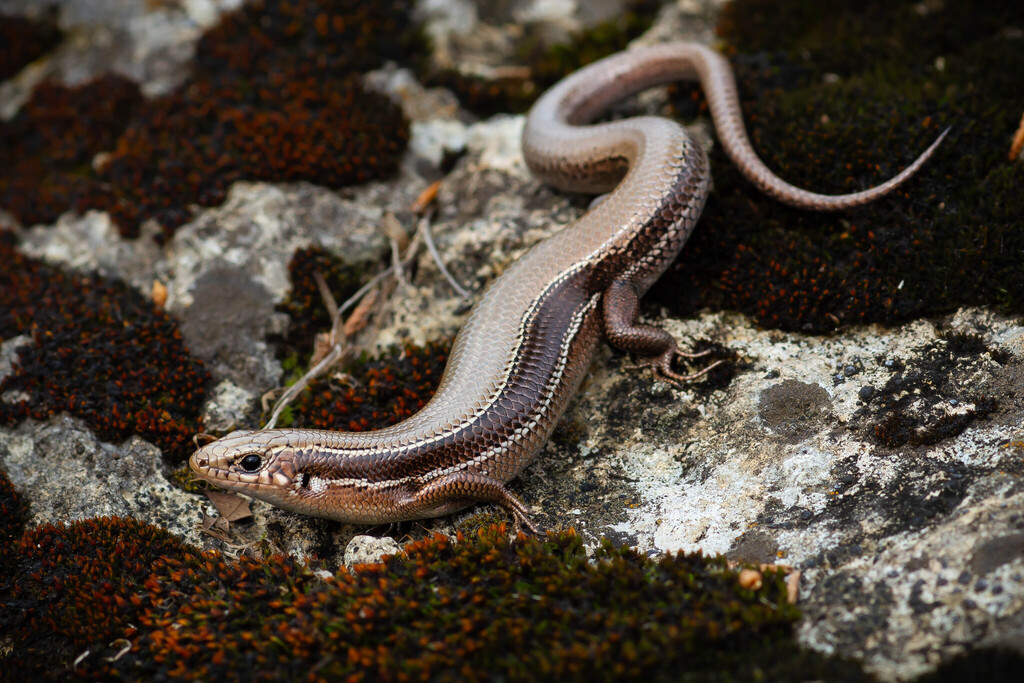
Coal Skink
Plestiodon anthracinus
Plestiodon anthracinus, the coal skink, is a species of lizard which is endemic to the United States.
From the article Plestiodon anthracinus on Wikipedia (CC BY-SA), quoted section by section
Description
It is a mid-sized lizard with short well developed legs, and overlap when addressed in most specimens, except gravid females. It grows to 13–18 cm (5.1–7.1 in) in total length with a maximum snout-to-vent length (SVL) of 7 cm (2.8 in). It is a four-lined skink whose light stripes extend onto the tail. The broad dark lateral stripe is 4–4.5 scales wide and there are no light lines on top of the head. The dorsolateral light stripe is on the edges of the 3rd and 4th scale rows, counting from midline of back. One postmental scale is present. The sides of the head of the male are reddish during spring breeding season, at least in some parts of the range.
Range & habitat
The more humid portions of wooded hillsides with abundant leaf litter or loose stones are favorite habitats. Coal skinks' habitat may also include areas around springs, rocky bluffs overlooking creek valleys, and mesic sites. If pursued, they will take refuge in shallow water, going to the bottom and hiding under stones or debris. The northern coal skink (blue in the figure) occurs in western New York and central Pennsylvania and in isolated colonies in the Appalachians. The southern coal skink (orange) can be found on the eastern Gulf coast from the Florida panhandle to Louisiana as well as west of the Mississippi from eastern Kansas and central Missouri to eastern Texas and northern Louisiana. Scattered intermingled occurrences of both subspecies (green in the figure) occur in Alabama and in Georgia. Their current natural threats include a number of small mammals, snakes, and larger species of lizards. Human influence has also been known to pose a threat to this species, due to habitat decrease and degradation for a number of reptile species.
Wikipedia: “Habitat and Geographic range”
What it does
The coal skink mates in spring or early summer, laying a clutch of 8 or 9 eggs. Their eggs are typically around 10–11 mm in length. Courting for this species usually involves the male's initial investigation and recognition of a potential female through pheromonal cues. The young hatch after four to five weeks and are about 5 cm (2.0 in) long. The hatchlings have a blue tail; those of the northern coal skink are striped like the adults, but young southern coal skinks have black bodies with at the utmost faint traces of stripes.
Wikipedia: “Reproduction”
Where it lives
Recorded sightings
—
geo-referenced records in GBIF, from museums, herbaria and field observers.
Drag the globe to turn it. Dots are where records exist, not a range map; darker means more records.
In the stacks
Searching the stacks…
Every page naming Plestiodon anthracinus in the Biodiversity Heritage Library →
This page is assembled live from iNaturalist, GBIF, Wikipedia, the Source Library and the Internet Archive. It is not yet part of the hand-edited codex. iNaturalist taxon 73781.