- Animals
- ›Chordates
- ›Vertebrates
- ›Reptiles
- ›Snakes and Lizards
- ›Snakes
- ›Colubrid Snakes
- ›Colubrine Snakes
- ›Boiga
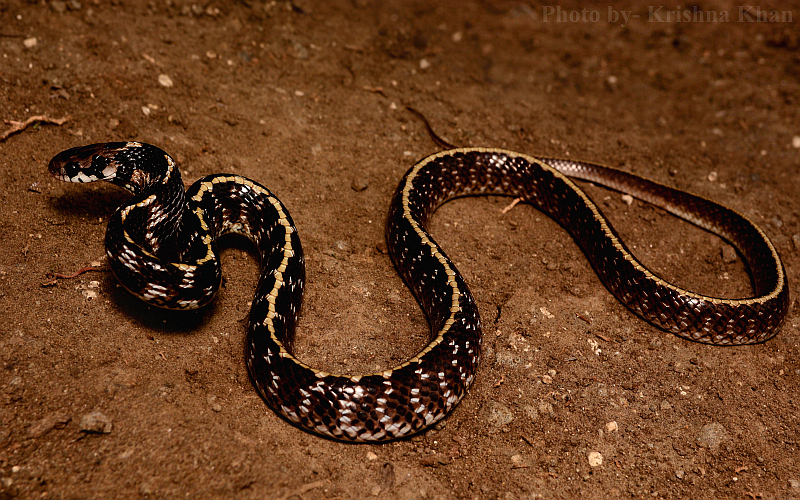
Indian Egg-eater
Boiga westermanni
The Indian egg-eating snake or Indian egg-eater (Boiga westermanni ) is a rare species of egg-eating snake found in the Indian subcontinent. It is also called Westermann's snake, reflecting its scientific name. The snake belongs to the monotypic genus Elachistodon.
From the article Indian egg-eating snake on Wikipedia (CC BY-SA), quoted section by section
Description
B. westermanni is glossy brown to black, with bluish white flecks posteriorly and a middorsal creamy stripe from neck to tail tip. The head is brown with a black arrow mark. The ventrals are white with brown dots. Adults may attain a total length of 78 cm (31 inches), with a tail 11 cm (4+1⁄4 inches) long.
Range & habitat
The Indian egg-eating snake is found in Bangladesh, India, and Nepal. Recent discoveries of the species come from Maharashtra, Gujarat, Punjab, Madhya Pradesh, Telangana and Karnataka.
Wikipedia: “Geographic range”
What it does
The Indian egg-eating snake is a diurnal or nocturnal, terrestrial species that shows remarkable dexterity in scaling vegetation. When provoked, it raises the anterior portion of the body, forming S-shaped coils as a defensive strategy.
Wikipedia: “Behaviour”
In human culture
The specific name, westermanni, is in honor of Dutch zoologist Geraldus Frederick Westermann (1807–1890).
Wikipedia: “Etymology”
Where it lives
Recorded sightings
—
geo-referenced records in GBIF, from museums, herbaria and field observers.
Drag the globe to turn it. Dots are where records exist, not a range map; darker means more records.
In the stacks
Searching the stacks…
Every page naming Boiga westermanni in the Biodiversity Heritage Library →
This page is assembled live from iNaturalist, GBIF, Wikipedia, the Source Library and the Internet Archive. It is not yet part of the hand-edited codex. iNaturalist taxon 738068.