- Animals
- ›Chordates
- ›Vertebrates
- ›Mammals
- ›Therians
- ›Placental Mammals
- ›Primates, Rodents, and Allies
- ›Primates
- ›Monkeys, Apes, and Tarsiers
- ›Monkeys and Apes
- ›New World Monkeys
- ›Sakis, Titis, and Uakaris
- ›Titis
- ›Plecturocebus
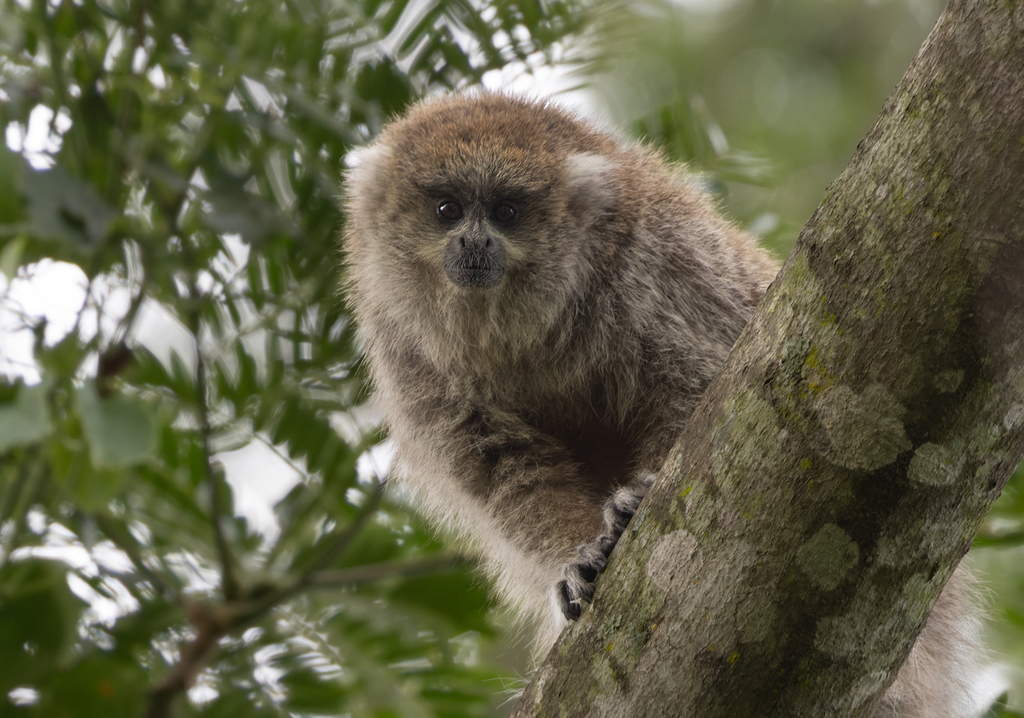
Bolivian Gray Titi
Plecturocebus donacophilus
The white-eared titi monkey (Plecturocebus donacophilus) also known as the Bolivian titi or Bolivian gray titi, is a species of titi monkey, a type of New World monkey, from eastern Bolivia and an area of western Brazil. The species has a range that extends east from the Manique River in Beni Department, Bolivia to southern Rondônia in Brazil. The southern end of its range includes forests around the city of Santa Cruz de la Sierra.
It is a medium-sized monkey with a grey back, orange underside and distinctive white ear tufts. It has an omnivorous diet, eating fruits, other plant materials and invertebrates. It is a monogamous species and lives in small groups of two to seven members consisting of the pair and their offspring. The family group has a home range of 0.5 to 14 hectares (1.2 to 34.6 acres) and the adults have a complex vocal repertoire to maintain their territory. It is also known for its characteristic twining of tails when groups are sitting together. White-eared titis can live for more than 25 years in captivity.
From the article White-eared titi monkey on Wikipedia (CC BY-SA), quoted section by section
Range & habitat
The white-eared titi is found in tropical humid forests, preferring drier regions to more humid ones. It is found in riparian zones and gallery forests and is clearly associated with open habitats like grasslands and swampy grasslands. It is found in areas with dense vegetation, often choosing to inhabit the thickest parts of the forest. The species seems to be quite tolerant of habitat disturbance. In Bolivia, the white-eared titi is found in the upper parts of the Mamoré, Grande, and San Miguel river basins, east of the Manique River in Beni and in the forests surrounding the city of Santa Cruz de la Sierra. Its range extends north to southern Rondônia in Brazil.
Wikipedia: “Habitat and distribution”
What it does
The white-eared titi is cryptic, diurnal and known to live in small family groups. It is a monogamous species that is thought to mate for life and lives in groups that usually consist of two to seven members; an adult pair and up to five young. Multi-male groups have also been recorded. Offspring are carried by the male, and are always with them, except when feeding. Between the ages of two and four years, offspring will disperse from the natal group, with females leaving earlier than the males.
There is a strong bond between the adult mating pair, they stay close and carry out activities together. Either member of the pair may follow the other and leadership changes through the day. Evidence of the strength of the pair bond is shown by grooming, huddling together with their tails twined, nuzzling, and gentle grasping. Titi monkeys are highly territorial and when confronted with another family group, both will respond with threatening behaviour, males showing increased agitation towards intruding males. When not close together, the pair show a significant amount of distress and agitation. Titi monkeys are well known for their vocal communication, and have a complex repertoire of calls. The calls can be divided into two categories: high-pitched quiet calls and low-pitched loud calls. …
Wikipedia: “Behaviour”
Listen
Looking for field recordings…
Where it lives
Recorded sightings
—
geo-referenced records in GBIF, from museums, herbaria and field observers.
Drag the globe to turn it. Dots are where records exist, not a range map; darker means more records.
In the stacks
Searching the stacks…
Every page naming Plecturocebus donacophilus in the Biodiversity Heritage Library →
This page is assembled live from iNaturalist, GBIF, Wikipedia, the Source Library and the Internet Archive. It is not yet part of the hand-edited codex. iNaturalist taxon 738182.