- Animals
- ›Chordates
- ›Vertebrates
- ›Reptiles
- ›Snakes and Lizards
- ›Snakes
- ›Colubrid Snakes
- ›Colubrine Snakes
- ›Hierophis
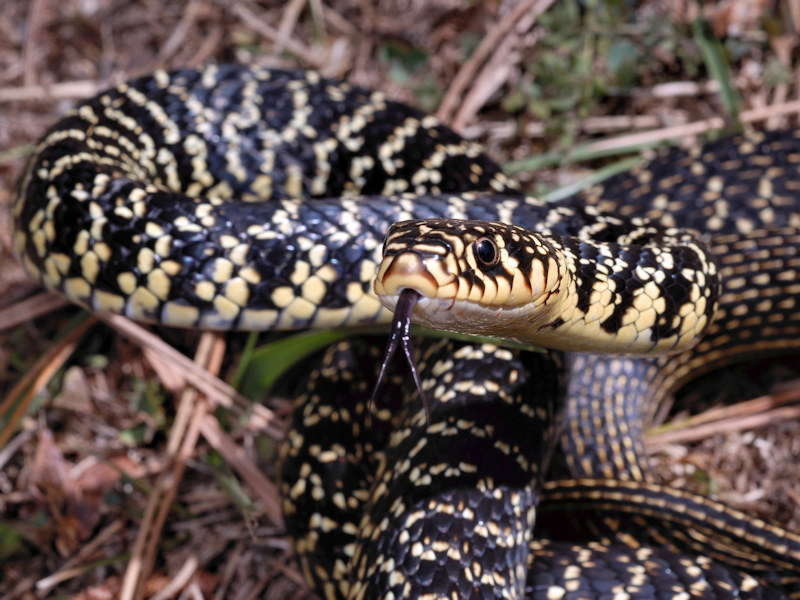
Green Whip Snake
Hierophis viridiflavus
The green whip snake or western whip snake (Hierophis viridiflavus) is a species of snake in the Colubridae family. There is a larger, often pure black variant found in Italy and Malta referred to there as 'Il Biacco'.
From the article Green whip snake on Wikipedia (CC BY-SA), quoted section by section
Description
The green whip snake is a slender species with a small but well-defined head, prominent eyes with circular pupils, and smooth scales. The background colour is greenish-yellow but this is mostly obscured by heavy, somewhat irregular bands of dark green or black, particularly in the front half of the snake. The underparts are grey or yellowish and the tail has narrow longitudinal stripes. The young are a greyish colour and develop their full adult colouring by about their fourth year. This snake grows to a total length of about 150 cm (60 in). In the northeastern part of its range, in Sicily and southern Italy, most individuals are blackish in colour. There is a larger, up to two metres (6.5 ft) long, often pure black variant – Coluber viridiflavus carbonarius (Bonaparte, 1833) – found in Italy and Malta. referred to there as 'Il Biacco'.
Range & habitat
This species is present in Andorra, Croatia, France, Greece, Italy, Malta, Slovenia, Spain, Switzerland, and possibly Luxembourg. Currently two subspecies are distinguished, a melanic (H. v. carbonarius) and a striped form (H. v. viridiflavus). The melanic form occurs in the eastern part of the range and the striped in the western part, with a contact zone throughout most of northern Italy.
Wikipedia: “Geographic range and subspecies”
Toxicity
Commonly regarded as non-venomous, it is described that a subject who endured 'sustained biting' of up to 5 minutes began showing suspect symptoms, including problems with neuromotor skills. The presence of modified rear maxillary fangs in correspondence to a gland called the Duvernoy's gland, similar to the venom gland and involved in the production of toxins, has recently been discovered.
Wikipedia: “Venom”
Where it lives
Recorded sightings
—
geo-referenced records in GBIF, from museums, herbaria and field observers.
Drag the globe to turn it. Dots are where records exist, not a range map; darker means more records.
In the stacks
Searching the stacks…
Every page naming Hierophis viridiflavus in the Biodiversity Heritage Library →
This page is assembled live from iNaturalist, GBIF, Wikipedia, the Source Library and the Internet Archive. It is not yet part of the hand-edited codex. iNaturalist taxon 73823.