- Animals
- ›Chordates
- ›Vertebrates
- ›Reptiles
- ›Snakes and Lizards
- ›Lizards
- ›Wall lizards, amphisbaenians, and allies
- ›Wall Lizards
- ›Lacertinae
- ›Iberolacerta
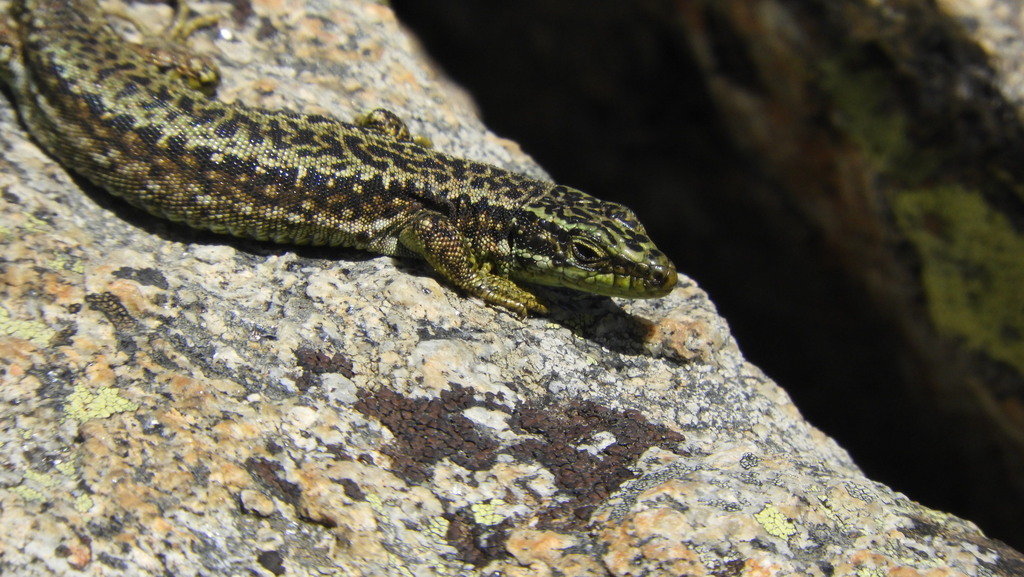
Cyren’s Rock Lizard
Iberolacerta cyreni
Iberolacerta cyreni, commonly known as the Cyren's rock lizard, is a species of lizard in the family Lacertidae. The species is endemic to central Spain and is currently listed as endangered by the IUCN due to global warming. I. cyreni has evolved to exhibit key behavioral characteristics, namely individual recognition, in which a lizard is able to identify another organism of the same species, as well as thermoregulation.
From the article Iberolacerta cyreni on Wikipedia (CC BY-SA), quoted section by section
Description
Iberolacerta cyreni, or the rock lizard, can measure up to 8 cm (3.1 in) snout-to-vent and 24 cm (9.4 in) including the tail. I. cyreni are most likely species where males compete over females; in such cases, bigger lizards demonstrate greater reproductive success, thus resulting in overall larger body sizes and larger combat-related structures, such as the size of the head. In contrast, females are responsible for bearing offspring, and as a result, selection pressures that act on clutch volume or clutch size may favor larger abdomen sizes. As such, males demonstrate larger head sizes compared to females, while female lizards exceed males in abdomen length. I.cyreni may appear brown or brown with a green undertone. They have dark brown spots aligned vertically down the length of their body. They can be distinguished from other western Iberian Rock Lizards by the lack of blue ocelli, or marks that looks like eyes, on its shoulders.
Range & habitat
Lizards of the Iberolacerta genus reside in the mountainous areas of the Western Mediterranean region. In particular, I. cyreni are endemic to Spain's central mountain system in the Sierra del Guadarrama, Sierra de Gredos, Sierra de Bejar, and La Ser. These lizards are found near the tree line in more damp, rocky territories, but can also be found in temperate forests, temperate shrubland, temperate grassland, and plantations.
Wikipedia: “Habitat”
What it does
The diet of I. cyreni is composed mainly of invertebrates such as insects or spiders.
Wikipedia: “Diet”
In human culture
The genus name, "Iberolacerta," signifies how these lizards are native to Spain, which is located on the Iberian peninsula. The specific name, "cyreni," is in honor of Swedish herpetologist Carl August Otto Cyrén.
Wikipedia: “Etymology”
Where it lives
Recorded sightings
—
geo-referenced records in GBIF, from museums, herbaria and field observers.
Drag the globe to turn it. Dots are where records exist, not a range map; darker means more records.
In the stacks
Searching the stacks…
Every page naming Iberolacerta cyreni in the Biodiversity Heritage Library →
This page is assembled live from iNaturalist, GBIF, Wikipedia, the Source Library and the Internet Archive. It is not yet part of the hand-edited codex. iNaturalist taxon 73829.