- Animals
- ›Chordates
- ›Vertebrates
- ›Reptiles
- ›Snakes and Lizards
- ›Snakes
- ›Colubrid Snakes
- ›Colubrine Snakes
- ›Pantherophis
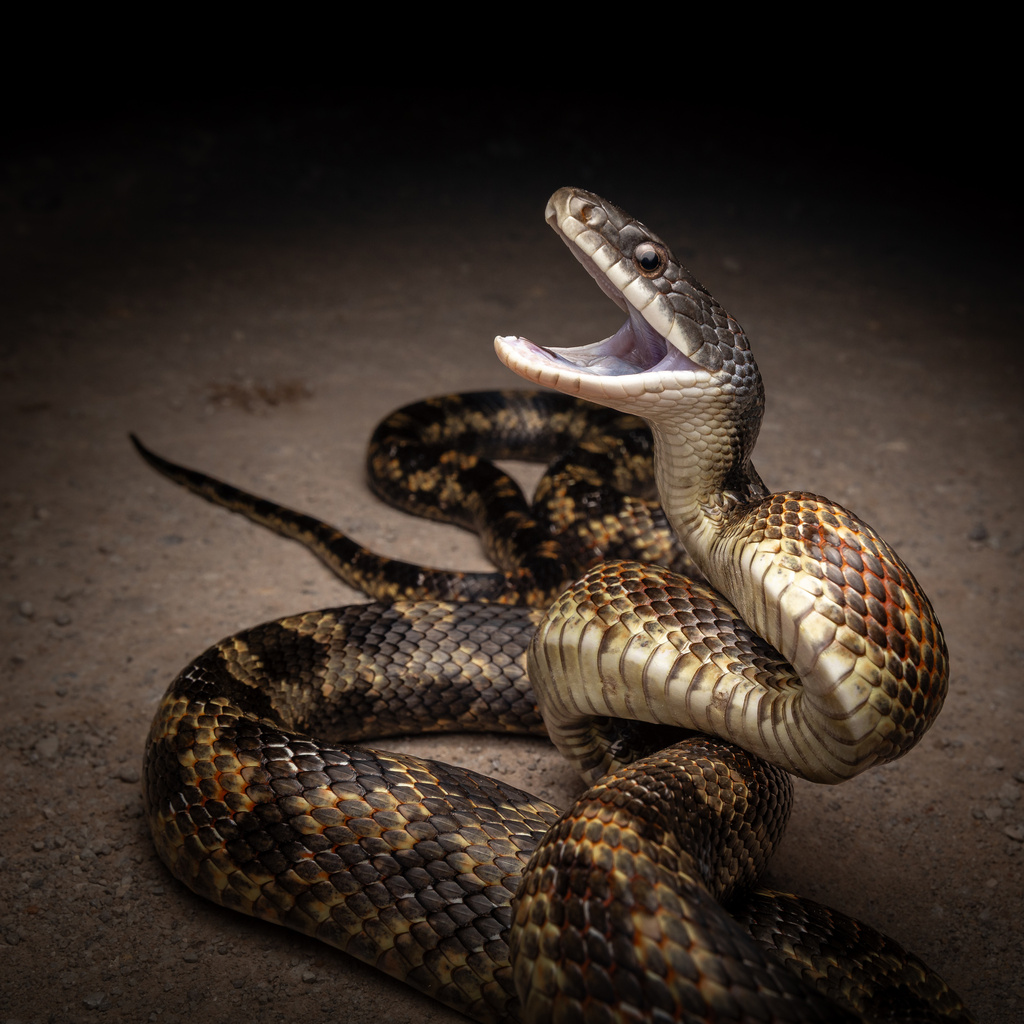
Western Ratsnake
Pantherophis obsoletus
Pantherophis obsoletus, also known commonly as the western rat snake, black rat snake (not to be confused with Pantherophis alleghaniensis), pilot black snake, or simply black snake, is a nonvenomous species of snake in the family Colubridae. The species is native to central North America west of the Mississippi River. No subspecies are recognized as being valid. Its color variations include the Texas rat snake. Along with other snakes of the eastern United States, like the eastern indigo snake (Drymarchon couperi) and the eastern racer (Coluber constrictor), it is called "black snake".
From the article Pantherophis obsoletus on Wikipedia (CC BY-SA), quoted section by section
Description
Western rat snakes typically range 106.7 ‒183 cm. (42 ‒ 72 in.) in total length, with a record individual of 218.4 cm. (86 in.). Juveniles are strongly patterned with brown blotches on a gray background (like miniature fox snakes: P. gloydi, P. ramspotti, and P. vulpinus). Darkening occurs rapidly as they grow. Adults are glossy black above with white lips, chin, and throat. Sometimes, traces of the "obsolete" juvenile pattern are still discernible in the skin between the scales, especially when stretched after a heavy meal.
Range & habitat
Pantherophis obsoletus is found west of the Mississippi River, from eastern and southern Iowa southward through Missouri and Arkansas to western Louisiana, westward to eastern Texas, northward through Oklahoma and eastern Kansas to southeastern Nebraska. Aside from the usual variety that is black or has patches of black on a lighter background, color variations include the Texas rat snake, which is a brown-to-black variant, often with tinges of orange or red, that can be found in southern Oklahoma, Texas, and Louisiana.
Wikipedia: “Geographic range”
What it does
When not fully grown, rat snakes of the genus Pantherophis are subject to predation by many animals, including other snakes. Once they attain maturity, they are readily preyed on by mammalian carnivores (including the American mink, which weighs no more than an adult rat snake) and large birds of prey (especially red-tailed hawks). When startled, they may freeze and wrinkle themselves into a series of kinks. If they feel further threatened, they may flee quickly or tail vibrate; although this act of tail vibration is indeed a behavior that rat snakes share with rattlesnakes, it is not a form of mimicry, as researchers have observed that snakes have used this method of tail vibration as a defense mechanism against predation long before the emergence of rattlesnakes. They are also capable of producing a foul-smelling musk, which they will release onto predators if picked up. They spread the musk with their tails in hopes of deterring the threat. When cornered or provoked, rat snakes are known to stand their ground and can become aggressive. Counterattacks on large birds of prey, often committed by large snakes in excess of 150 cm (59 in) in length, have resulted in violent, prolonged struggles. …
Wikipedia: “Behavior”
Where it lives
Recorded sightings
—
geo-referenced records in GBIF, from museums, herbaria and field observers.
Drag the globe to turn it. Dots are where records exist, not a range map; darker means more records.
In the stacks
Searching the stacks…
Every page naming Pantherophis obsoletus in the Biodiversity Heritage Library →
This page is assembled live from iNaturalist, GBIF, Wikipedia, the Source Library and the Internet Archive. It is not yet part of the hand-edited codex. iNaturalist taxon 73888.