- Animals
- ›Chordates
- ›Vertebrates
- ›Mammals
- ›Therians
- ›Placental Mammals
- ›Primates, Rodents, and Allies
- ›Rodents
- ›Mice, Rats, and Hamsters
- ›Muroids
- ›Hamsters, Voles, Lemmings, and Allies
- ›South American Mice and Rats
- ›Rice Rats
- ›Aegialomys
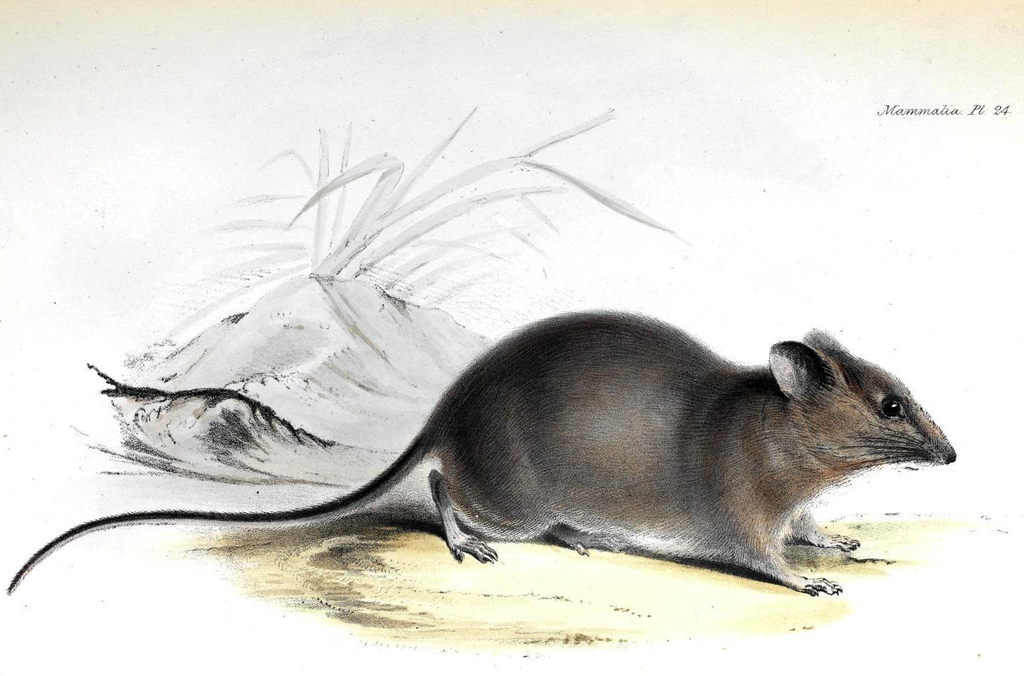
Galápagos Rice Rat
Aegialomys galapagoensis
Aegialomys galapagoensis, also known as the Galápagos rice rat or Galápagos oryzomys, is a species of rodent in the family Cricetidae from the Galápagos Islands.
From the article Aegialomys galapagoensis on Wikipedia (CC BY-SA), quoted section by section
Description
The Galapagos rice rat is a medium-sized rodent, with a head-body length of 20 to 35 centimetres (7.9 to 13.8 in), and a tail 14 to 17 centimetres (5.5 to 6.7 in) long. It has very long, soft and dense fur that is grizzled copper-brown above and yellowish-grey on the underparts. The ears are long and covered with dense hair, and the feet have large pads on the soles, with claws up to 2.5 millimetres (0.1 in) in length, suggesting that it has little, if any, climbing ability.
Range & habitat
The Galapagos rice rat is found only in the eastern Galapagos. Today, it occurs only on Santa Fé Island, and possibly on Santiago Island. A separate population formerly existed on San Cristóbal Island, and is considered to represent a separate subspecies, but is thought to have been extinct for many decades. Its natural habitat is subtropical or tropical dry shrubland.
Wikipedia: “Distribution and habitat”
What it does
The Galapagos rice rat is primarily nocturnal, but may sometimes be active before sunset, spending the day resting in crevices beneath lava blocks or under shrubs. It is omnivorous, feeding on plant matter and insects. Like many of the animals of the Galápagos, it is tame and unafraid of humans. Scientists working on Santa Fé Island and Fernandina Island have reported that it is necessary to keep tents open to prevent these rice rats from chewing in during the night. It is also commonly seen on beaches, where it is attracted by fish remains left behind by human activity. Breeding seems to take place primarily in the hot season with young being born between March and May, but may occur at other times of year, perhaps depending on the availability of food resources. Litters of 2–7 young are born hairless and blind, opening their eyes and developing the adult coat by day 13 after birth. The maximum lifespan in the wild has been recorded as 599 days.
Wikipedia: “Biology and behaviour”
Listen
Looking for field recordings…
Where it lives
Recorded sightings
—
geo-referenced records in GBIF, from museums, herbaria and field observers.
Drag the globe to turn it. Dots are where records exist, not a range map; darker means more records.
In the stacks
Searching the stacks…
Every page naming Aegialomys galapagoensis in the Biodiversity Heritage Library →
This page is assembled live from iNaturalist, GBIF, Wikipedia, the Source Library and the Internet Archive. It is not yet part of the hand-edited codex. iNaturalist taxon 74033.