- Animals
- ›Chordates
- ›Vertebrates
- ›Mammals
- ›Therians
- ›Placental Mammals
- ›Primates, Rodents, and Allies
- ›Primates
- ›Monkeys, Apes, and Tarsiers
- ›Monkeys and Apes
- ›New World Monkeys
- ›Spider, Howler, and Woolly Monkeys
- ›Howler Monkeys
- ›Alouatta
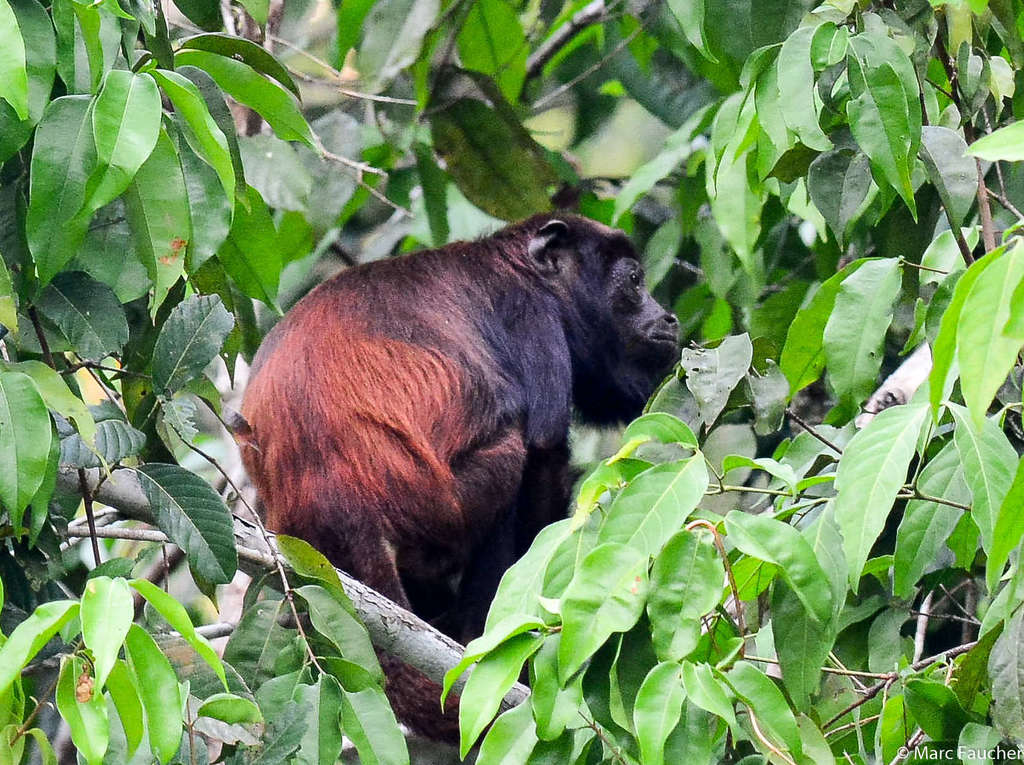
Spix's Red-handed Howler Monkey
Alouatta discolor
Spix's red-handed howler (Alouatta discolor) is a species of Howler monkey native to the southeastern Amazon in Brazil. It is threatened by deforestation and hunting.
From the article Spix's red-handed howler on Wikipedia (CC BY-SA), quoted section by section
Description
Spix's red-handed howler has a similar appearance to the red-handed howler, but it has a yellowish-brown to reddish-brown back. Males weigh about 7.2 kg, females about 5.5 kg.
Range & habitat
The species is endemic to central Brazil, specifically along the southeastern Amazon River in the State of Pará. It occurs mainly in the interfluvial land area between four rivers, Tapajós, Juruena, Xingú and Irirí. The westernmost limit of native habitat lies on the right bank of the Tapajós River and Juruena River and stretches east to the banks of the Xingú River and Irirí River. This strip of land extends northward to Forte Curupá (Gurupá), Brazil, which is the northernmost extent of the distribution of Spix's red-handed howler and also its type locality. Spix's red-handed howler mainly inhabits lowland forests separated by dry areas as well as forests affected by seasonal flooding.
Wikipedia: “Distribution and habitat”
What it does
The primary food source of this species is ripe and unripe fruit; it has the highest reliance on this food source of all species in this genus. A variety of species provide fruit year-round, but leaves supplement the sugars of the fruits with protein in their diets. When these food sources are limited, the howlers also supplement their diets with more mature leaves, flowers, woody plant matter, and sometimes fungi to possibly help digest the increased plant matter. Spix's red-handed howlers generally move in groups of 4-11 individuals, and have relatively small home ranges, 5-45 ha in size.
Wikipedia: “Ecology”
Listen
Looking for field recordings…
Where it lives
Recorded sightings
—
geo-referenced records in GBIF, from museums, herbaria and field observers.
Drag the globe to turn it. Dots are where records exist, not a range map; darker means more records.
In the stacks
Searching the stacks…
Every page naming Alouatta discolor in the Biodiversity Heritage Library →
This page is assembled live from iNaturalist, GBIF, Wikipedia, the Source Library and the Internet Archive. It is not yet part of the hand-edited codex. iNaturalist taxon 74052.