- Animals
- ›Chordates
- ›Vertebrates
- ›Mammals
- ›Therians
- ›Placental Mammals
- ›Primates, Rodents, and Allies
- ›Primates
- ›Monkeys, Apes, and Tarsiers
- ›Monkeys and Apes
- ›New World Monkeys
- ›Night Monkeys
- ›Aotus
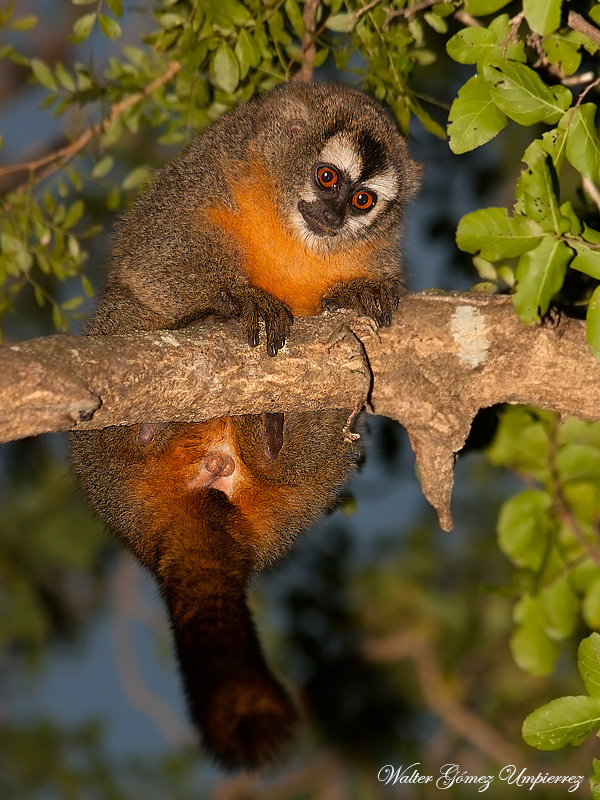
Azara’s Night Monkey
Aotus azarae
Azara's night monkey (Aotus azarae), also known as the Azara's owl monkey, the southern night monkey, or the mirikiná, is a night monkey species from South America. It is found in Argentina, Bolivia, Brazil, Peru and Paraguay. The species is monogamous, with males providing a large amount of parental care. It is named after Spanish naturalist Félix de Azara. Although primarily nocturnal, some populations of Azara's night monkey are unique among night monkeys in being cathemeral: active at both day and night. The species is listed as Least Concern on the IUCN Red List.
From the article Azara's night monkey on Wikipedia (CC BY-SA), quoted section by section
Range & habitat
Azara's night monkey is found in northern Argentina, Bolivia, central Brazil, Paraguay and far southeastern Peru. Its range includes the southern Amazon, ranging into more open habitats such as the Gran Chaco. Aotus a. azarae is found in gallery forest and semi-deciduous forest, A. a. infulatus is found in humid lowland forest and gallery forest, and A. a. infulatus is found in various forest types. The last has been recorded as high as 1,250 m (4,100 ft) in the Andean foothills.
Wikipedia: “Habitat and distribution”
What it does
Azara's night monkey is assigned to the genus Aotus which is the only nocturnal genus of monkeys. However, uniquely among night monkeys, populations of Azara's night monkey from the Gran Chaco are active both day and night. Azara's night monkey can be found sleeping in groups of between 2 and 5 in trees. The average group size is about 3 monkeys, consisting of an adult pair and their offspring. It leaps from tree to tree but also moves quadrupedally throughout the forest. It spends its life in trees and becomes more active when the moon is brighter, tending to keep to its well-known paths.
Diet. Azara's night monkey is primarily a frugivore, but also will eat leaves, flowers, insects and other small invertebrates, and some small vertebrates. Leaves and flowers are a secondary food choice to fruits and is more typically consumed during the dry season as access to fruits become more scarce. Fruits consumed by this species are of the fig, guava, and nettle families as well as some cultivated species for monkeys living closer to urban areas. Examples of prey consumed by Azara's night monkeys are grasshoppers, moths, millipedes, and sometimes bird eggs or small animals. The hunting of insects occurs at dawn and dusk and is typically done by grabbing the insects midair rather than searching in crevices. …
Wikipedia: “Behavior and ecology”
Listen
Looking for field recordings…
Where it lives
Recorded sightings
—
geo-referenced records in GBIF, from museums, herbaria and field observers.
Drag the globe to turn it. Dots are where records exist, not a range map; darker means more records.
In the stacks
Searching the stacks…
Every page naming Aotus azarae in the Biodiversity Heritage Library →
This page is assembled live from iNaturalist, GBIF, Wikipedia, the Source Library and the Internet Archive. It is not yet part of the hand-edited codex. iNaturalist taxon 74066.