- Animals
- ›Chordates
- ›Vertebrates
- ›Mammals
- ›Therians
- ›Placental Mammals
- ›Ungulates, Carnivorans, and Allies
- ›Even-toed Ungulates and Cetaceans
- ›Cetaceans and Hippopotamuses
- ›Cetaceans
- ›Baleen Whales
- ›Rorquals
- ›Balaenoptera
- ›Balaenoptera edeni
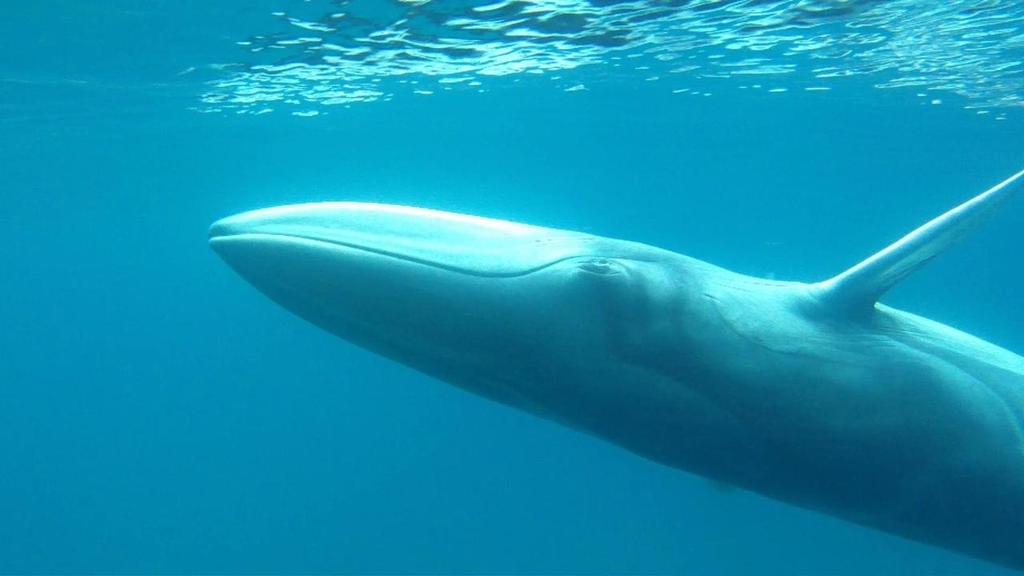
Omura's Whale
Balaenoptera omurai
Omura's whale or the dwarf fin whale (Balaenoptera omurai) is a species of rorqual about which very little is known. Before its formal description, it was referred to as a small, dwarf or pygmy form of Bryde's whale by various sources. The common name and specific epithet commemorate Japanese cetologist Hideo Omura.
The scientific description of this whale was made in Nature in 2003 by three Japanese scientists. They determined the existence of the species by analysing the morphology and mitochondrial DNA of nine individuals – eight caught by Japanese research vessels in the late 1970s in the Indo-Pacific and an adult female collected in 1998 from Tsunoshima, an island in the Sea of Japan. Later, abundant genetic evidence confirmed Omura's whale as a valid species and revealed it to be an early offshoot from the rorqual lineage, diverging much earlier than Bryde's and sei whales. It is perhaps more closely related to its larger relative, the blue whale.
From the article Omura's whale on Wikipedia (CC BY-SA), quoted section by section
Range & habitat
Omura's whale are found in the Indo-Pacific and the Atlantic Oceans, primarily in shelf waters between 35° N and 35° S, with the majority of records in the tropics (between 23° 26' N and 23° 26' S). Their range includes southern Japan (with strandings and entanglements recorded in March and from May to October; including the prefectures of Yamaguchi, Miyazaki, Kagawa, Mie, Shizuoka, and Chiba), South Korea (December to January, from the provinces of South Jeolla and South Gyeongsang), China (with strandings from November to February and in August; including the provinces of Zhejiang, Fujian, Guangdong, and Guangxi), Taiwan (with strandings from November to March and in May; there are also sightings from April to May and July to August), Hong Kong (March), the Philippines (Manila Bay, Busuanga, and the Bohol Sea), Vietnam (Quảng Ngãi Province), Malaysia (Pahang), Thailand (with sightings and strandings from February, May to June, and November to December; including the provinces of Phang Nga, Phuket, Prachuap Khiri Khan, and Songkhla), Indonesia (with sightings and strandings from February, April to June, and from September to November; with records from West Sumatra, the southern Java Sea, Bali, Komodo, the Solor Archipelago, Seram, Raja Ampat Islands, and East Kalimantan), the Cocos (Keeling) Islands, the Andaman Islands (April), Australia (Western Australia from Exmouth to no …
Wikipedia: “Range”
What it does
Little is known of the behavior and diet of Omura's whale. Their blow is low and diffuse. After surfacing, the dorsal fin is usually not visible until after the head and splashguard have disappeared and they do not fluke when diving. They have been seen lunge feeding, defecating, and breaching off both Komodo National Park and northwestern Madagascar; they've also been seen rolling at the surface in apparent mating (the last of which allowed the identification of a male) off the former area. Off Madagascar, average group size was only 1.1 individuals (272 individuals in 247 groups), but loose aggregations of as many as a dozen whales could be seen. A total of thirteen cow-calf pairs were observed between 2011 and 2016, including a female first seen in an aggregation in 2012, then with a calf in 2013, and alone again in 2015 and 2017, showing that individuals can exhibit strong site fidelity. The six paratypes taken in the Solomon Sea in 1976 reportedly only had krill (Euphausia diomedeae) in their stomachs, while crustaceans and fish were found in a 7 m (23 ft) female from Japan. Individuals in Madagascar have been observed lunge feeding on the krill Pseudeuphausia latifrons.
Song. Omura's whale produce amplitude-modulated songs of 15-50 Hz with a peak frequency of 36.1 Hz and an average duration of 9.2 seconds. …
Wikipedia: “Behavior and diet”
Listen
Looking for field recordings…
Where it lives
Recorded sightings
—
geo-referenced records in GBIF, from museums, herbaria and field observers.
Drag the globe to turn it. Dots are where records exist, not a range map; darker means more records.
In the stacks
Searching the stacks…
Every page naming Balaenoptera omurai in the Biodiversity Heritage Library →
This page is assembled live from iNaturalist, GBIF, Wikipedia, the Source Library and the Internet Archive. It is not yet part of the hand-edited codex. iNaturalist taxon 74104.