- Animals
- ›Chordates
- ›Vertebrates
- ›Mammals
- ›Therians
- ›Placental Mammals
- ›Ungulates, Carnivorans, and Allies
- ›Even-toed Ungulates and Cetaceans
- ›Ruminants
- ›Bovids
- ›Antelopes, Goats, and Sheep
- ›Goats and Sheep
- ›Capra
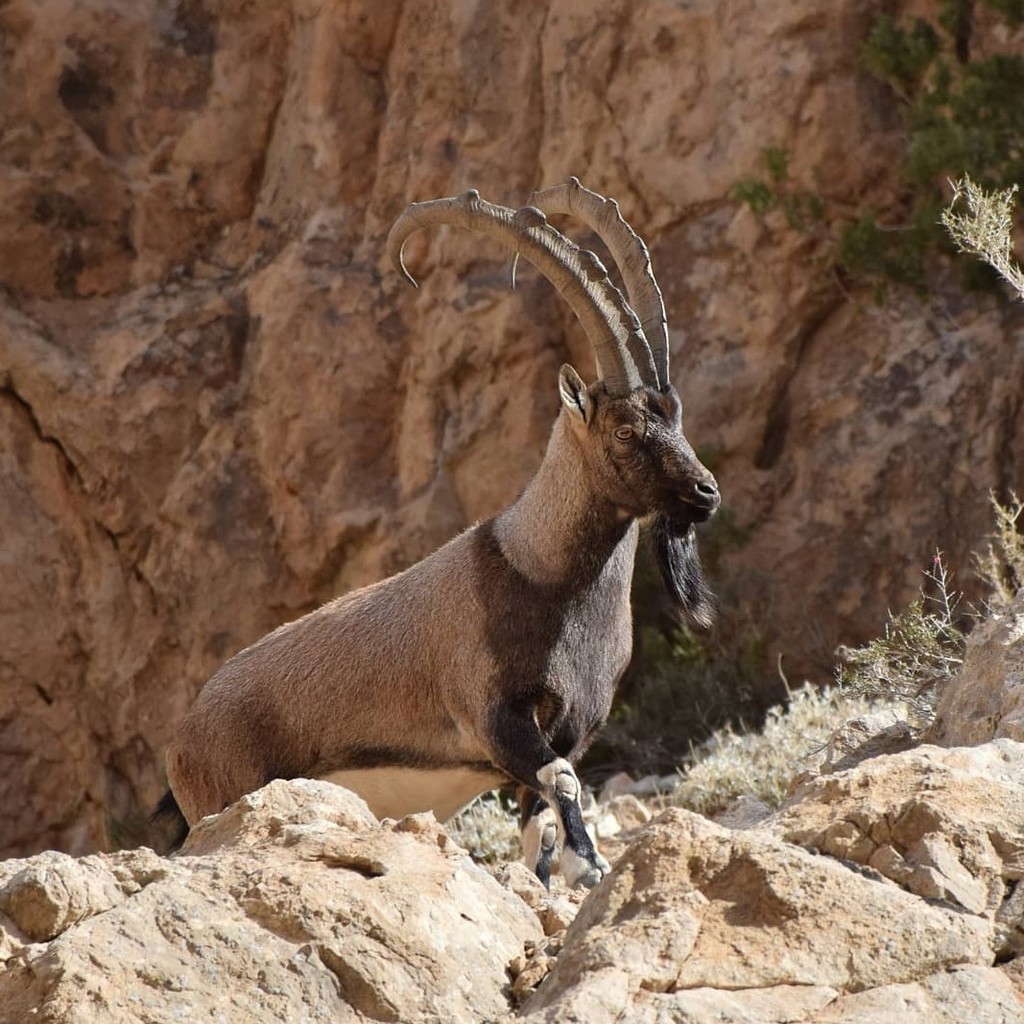
Wild Goat
Capra aegagrus
The wild goat (Capra aegagrus) is a goat species, inhabiting forests, shrublands and rocky areas ranging from Turkey and the Caucasus in the west to Iran, Turkmenistan, Afghanistan, and Pakistan in the east. It has been listed as near threatened on the IUCN Red List and is threatened by habitat destruction and degradation.
It is thought to be the ancestor of the domestic goat (C. hircus).
From the article Wild goat on Wikipedia (CC BY-SA), quoted section by section
Range & habitat
In Turkey, the wild goat occurs in the Aegean, Mediterranean, Black Sea, Southeastern and the Eastern Anatolia regions up to 3,250 m (10,660 ft) in the Taurus and Anti-Taurus Mountains. In the Caucasus, it inhabits montane forests in the river basins of Andi Koysu and its tributaries in Dagestan, Chechnya and Georgia up to 2,700 m (8,900 ft). In Armenia, wild goats were recorded in the Zangezur Mountains, in Khosrov State Reserve, and in highlands of the Syunik Province during field surveys from 2006 to 2007. In Azerbaijan, wild goats occur in Ordubad National Park, Daralayaz and Murovdag mountain areas in Nakhchivan Autonomous Republic. In Iran's Haftad Gholleh Protected Area, wild goat herds live foremost in west-facing areas with rocky substrates, water sources and steep slopes that are far from roads. In Turkmenistan, wild goat populations inhabit the mountain ranges of Uly Balkan and Kopet Dag. In Pakistan, wild goat herds occur in Kirthar National Park.
Wikipedia: “Distribution and habitat”
What it does
In Kirthar National Park, 283 wild goat groups were observed for 10 months in 1986. The group sizes ranged from two to 131 individuals but varied seasonally, with a mean ratio of two females per male. In Dagestan, male wild goats start courting females in mid December. The rutting season lasts until the third week of January. Females give birth to between one and three kids in late June to mid July. Older males drive younger males from the maternal herds. The gestation period averages 170 days. Kids are mobile almost immediately after birth. Kids are weaned after 6 months. Female goats reach sexual maturity at 1½–2½ years, males at 3½–4 years. The lifespan of a goat can be from 12 to 22 years.
Wikipedia: “Behaviour and ecology”
Listen
Looking for field recordings…
Where it lives
Recorded sightings
—
geo-referenced records in GBIF, from museums, herbaria and field observers.
Drag the globe to turn it. Dots are where records exist, not a range map; darker means more records.
In the old herbals & bestiaries

Ortus sanitatis
1491 · p.532

Sancai Tuhui, Juan 92 — Birds & Beasts (NCL Original)
王圻、王思義 · 1609 · p.107

Sancai Tuhui, Juan 92 — Birds & Beasts (NCL Original)
王圻、王思義 · 1609 · p.108

History of All Cloven-Hoofed Quadrupeds
Ulisse Aldrovandi · 1621 · p.755

Sancai Tuhui (Vol. 92)
王圻, 王思義 · 1609 · p.80

History of All Cloven-Hoofed Quadrupeds
Ulisse Aldrovandi · 1621 · p.750
In the stacks
Searching the stacks…
Every page naming Capra aegagrus in the Biodiversity Heritage Library →
This page is assembled live from iNaturalist, GBIF, Wikipedia, the Source Library and the Internet Archive. It is not yet part of the hand-edited codex. iNaturalist taxon 74139.