- Animals
- ›Chordates
- ›Vertebrates
- ›Mammals
- ›Therians
- ›Placental Mammals
- ›Ungulates, Carnivorans, and Allies
- ›Even-toed Ungulates and Cetaceans
- ›Ruminants
- ›Bovids
- ›Antelopes, Goats, and Sheep
- ›Goats and Sheep
- ›Capricornis
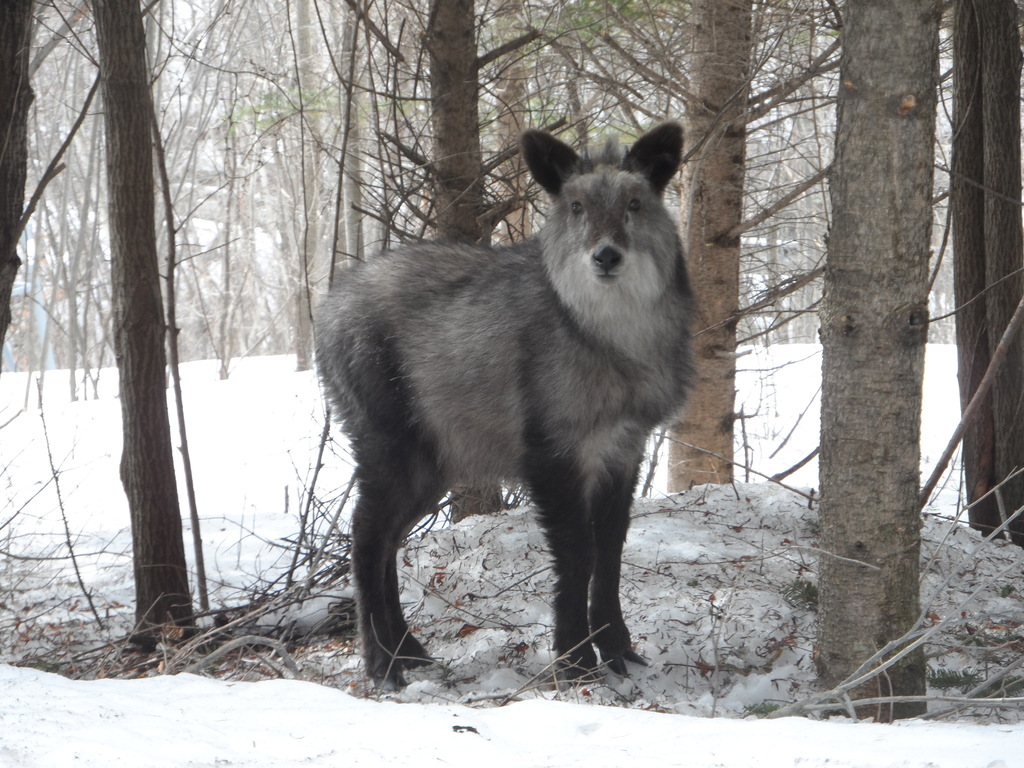
Japanese Serow
Capricornis crispus
The Japanese serow (氈鹿, kamoshika; lit. "coarse pelt deer") (Capricornis crispus) (羚羊) is a Japanese goat-antelope, an even-toed ungulate. It is found in dense woodland in Japan, primarily in northern and central Honshu. The serow is seen as a national symbol of Japan, and is subject to protection in conservation areas.
Adult Japanese serow stand about 81 centimetres (32 in) tall and weigh 30–45 kg (66–99 lb). They are black to whitish, and colouring lightens in summer. The fur is very bushy, especially the tail. Both sexes have short, backwards-curving horns, and are difficult to distinguish by sight. Japanese serow are found in dense mountain forests where they eat leaves, shoots, and acorns. They are diurnal and feed in early mornings and late afternoons. Serows are solitary, or gather in couples or small family groups. The animal marks its territory with sweet-and-sour-smelling preorbital gland secretions, and males and females have separate territories that may overlap.
From the article Japanese serow on Wikipedia (CC BY-SA), quoted section by section
Description
The Japanese serow is a small bovid whose displayed morphology is primitive in relation to other bovids. It has a stocky body whose size varies little between sexes or geographic location; it stands about 70–85 cm (28–33 in) tall (70–75 cm (28–30 in) at the shoulder) and weighs 30–50 kg (66–110 lb). The hoof is cloven. Compared to mainland serow, the ears are shorter and the coat is typically longer and woollier—about 10 cm (3.9 in) on the body. It has a bushy tail of 6–6.5 cm (2.4–2.6 in) and no mane. Its fur is whitish around the neck, and fur on the body may be black, black with a dorsal white spot, dark brown, or whitish. The coat lightens in summer. There are three well-developed skin glands: large preorbital glands in both sexes, which increase in size as the animal ages; poorly developed interdigital glands in all four legs; and preputial glands. The adult's 32 permanent teeth form by 30 months, and have a dental formula of 0.0.3.33.1.3.3. The inner sides of the teeth become blackened with a hard-to-remove substance, likely tree resin. The tongue has a V-shaped apex.
Differentiation between the sexes is not well developed; body size, growth, survival, and feeding habits show negligible difference. Both sexes have short, backwards-curving horns measuring 12–16 cm (4.7–6.3 in); the sheaths have a series of transverse rings. …
Wikipedia: “Appearance and anatomy”
Range & habitat
Capricornis crispus is the only wild bovine ruminant in Japan, and is endemic to three of the four main islands of Japan: primarily northern and central Honshu, and small areas in Shikoku and Kyushu. It can tolerate colder, snowier climates better than mainland serows. The animal is found solitary, in pairs, or in small family groups in open grassland and forests at an elevation of about 1 km (0.62 mi), and uses caves to rest in. It prefers temperate deciduous forest, but also lives in broad-leaved or subalpine coniferous forest made up of Japanese beech, Japanese oak, alpine meadow, and coniferous plantations. Population density is low, at an average of 2.6 per square kilometre (6.7/sq mi), and no greater than 20 per square kilometre (52/sq mi).
C. crispus is philopatric and territorial, and marks trees with sweet-sour-smelling preorbital gland secretions to indicate its territory. Males and females establish separate, overlapping ranges, typically 10–15 ha (25–37 acres), but the male's is typically larger than the female's. Aggression is rare, but the serow may react with hostility to territorial breaches. Due to the extinction of its once-primary predator, the Japanese wolf, the Japanese black bear is its only predator. It flees with a whistling snort when it detects danger. …
Wikipedia: “Distribution, ecology, and behaviour”
In human culture
Labelled a "living national treasure of the forest", the Japanese serow has achieved emblematic status in Japan with national associations. It is seen as a relic species harking back to the formation of the Japanese archipelago as distinct from mainland Asia. In a symbolic gesture in 1973, the Chinese government gifted Japan a giant panda, to which the Japanese government returned two Japanese serow. Municipalities and other regions of Japan have adopted the serow as a local symbol. In Japan, the Japanese serow is most commonly known as kamoshika or kamoshishi. It has historically been given a variety of names, often based on its appearance, some of which translate as "mountain sheep", "wool deer", "nine tail cow", and "cow demon". Regional names abound, some of which translate as "dancing beast", "foolish beast", or "idiot". Japanese people often characterize the serow as "weird" or "abnormal", and it is seen as a "phantom animal" as it tends to live alone in the depths of distant forests, and appears to observe forest workers from areas high in the mountains. The serow has a reputation in Japan for its speed and agility. Superior athletes are compared to the serow, as it is known not only for its agility, but also its sprinting ability. The Yamaha Motor Company has marketed the XT 225 sport motorcycle as the Yamaha Serow. …
Wikipedia: “Cultural significance”
Listen
Looking for field recordings…
Where it lives
Recorded sightings
—
geo-referenced records in GBIF, from museums, herbaria and field observers.
Drag the globe to turn it. Dots are where records exist, not a range map; darker means more records.
In the stacks
Searching the stacks…
Every page naming Capricornis crispus in the Biodiversity Heritage Library →
This page is assembled live from iNaturalist, GBIF, Wikipedia, the Source Library and the Internet Archive. It is not yet part of the hand-edited codex. iNaturalist taxon 74140.