- Animals
- ›Chordates
- ›Vertebrates
- ›Mammals
- ›Therians
- ›Placental Mammals
- ›Primates, Rodents, and Allies
- ›Primates
- ›Monkeys, Apes, and Tarsiers
- ›Monkeys and Apes
- ›Apes and Old World Monkeys
- ›Old World Monkeys
- ›Cercopithecines
- ›Guenons, Vervet Monkeys, and Talapoins
- ›Chlorocebus
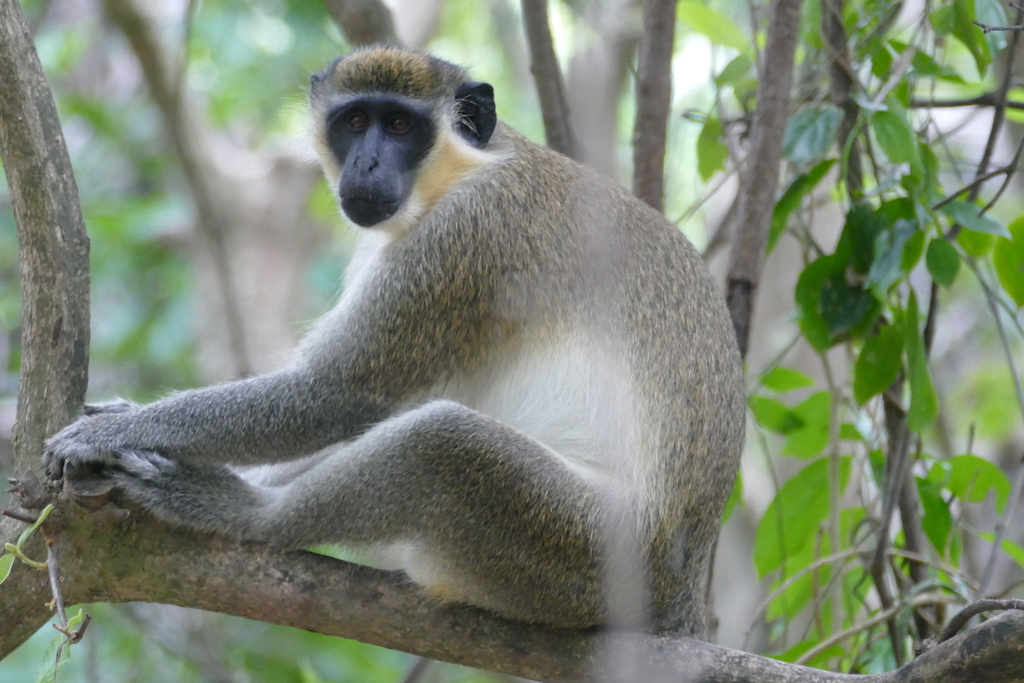
Green Monkey
Chlorocebus sabaeus
The green monkey (Chlorocebus sabaeus), also known as the sabaeus monkey, is an Old World monkey with golden-green fur and pale hands and feet. The tip of the tail is golden yellow as are the backs of the thighs and cheek whiskers. It does not have a distinguishing band of fur on the brow, like other Chlorocebus species, and males have a pale blue scrotum. Some authorities consider this and all of the members of the genus Chlorocebus to be a single widespread species, C. aethiops.
From the article Green monkey on Wikipedia (CC BY-SA), quoted section by section
Range & habitat
The green monkey can be found in a wide range of wooded habitats, ranging from very dry Sahel woodland to the edge of rainforests. It is also commonly seen in coastal regions, where known to feed on seashore foods such as crabs. It also takes a wide variety of other foods, including fruits and invertebrates. The green monkey is found in West Africa from Senegal and The Gambia to the Volta River. An insular population can be found on the Bijagós Islands in Guinea-Bissau. It has been introduced to the Cape Verde islands off north-western Africa (islands of Santiago and Brava only) as early as the second half of the 16th century, and the West Indian islands of Saint Kitts, Nevis, Saint Martin, and Barbados, having been introduced in the late 17th century by slave ships coming from West Africa. A small colony descended from 20th century zoo escapees exists in Broward County, Florida.
Wikipedia: “Habitat and distribution”
What it does
As other members of the genus Chlorocebus, the green monkey is highly social and usually seen in groups. They usually live in groups of 7 up to 80 individuals. Within these groups, there is distinct social hierarchy evidenced by grooming behaviors and gender relationships. Green monkeys are known to communicate both verbally and non-verbally. They have distinct calls which they use to warn others in the group of predators, and even have specific calls for specific predators. Body language, such as the display of brightly colored genitalia, is also used to communicate danger, but can also be used as a way of establishing dominance. It has also been documented that green monkeys may use facial expressions to express their emotional state.
Reproduction. Green monkeys live in a polygynous society, revolving around the alpha males. The alpha males have control over social interactions and mating between other males and females in the group. These monkeys are seasonal breeders, breeding during the April to June months (October and November in the Nyes area North West of Thies), during which rainfall is the heaviest. It is during these rainy seasons that fruit is most abundant, so it is speculated that green monkeys schedule their breeding around this time, when resources are most abundant. …
Wikipedia: “Behavior”
Listen
Looking for field recordings…
Where it lives
Recorded sightings
—
geo-referenced records in GBIF, from museums, herbaria and field observers.
Drag the globe to turn it. Dots are where records exist, not a range map; darker means more records.
In the old herbals & bestiaries


In the stacks
Searching the stacks…
Every page naming Chlorocebus sabaeus in the Biodiversity Heritage Library →
This page is assembled live from iNaturalist, GBIF, Wikipedia, the Source Library and the Internet Archive. It is not yet part of the hand-edited codex. iNaturalist taxon 74190.