- Animals
- ›Chordates
- ›Vertebrates
- ›Mammals
- ›Therians
- ›Placental Mammals
- ›Ungulates, Carnivorans, and Allies
- ›Carnivorans
- ›Mongooses
- ›Social Mongooses
- ›Crossarchus
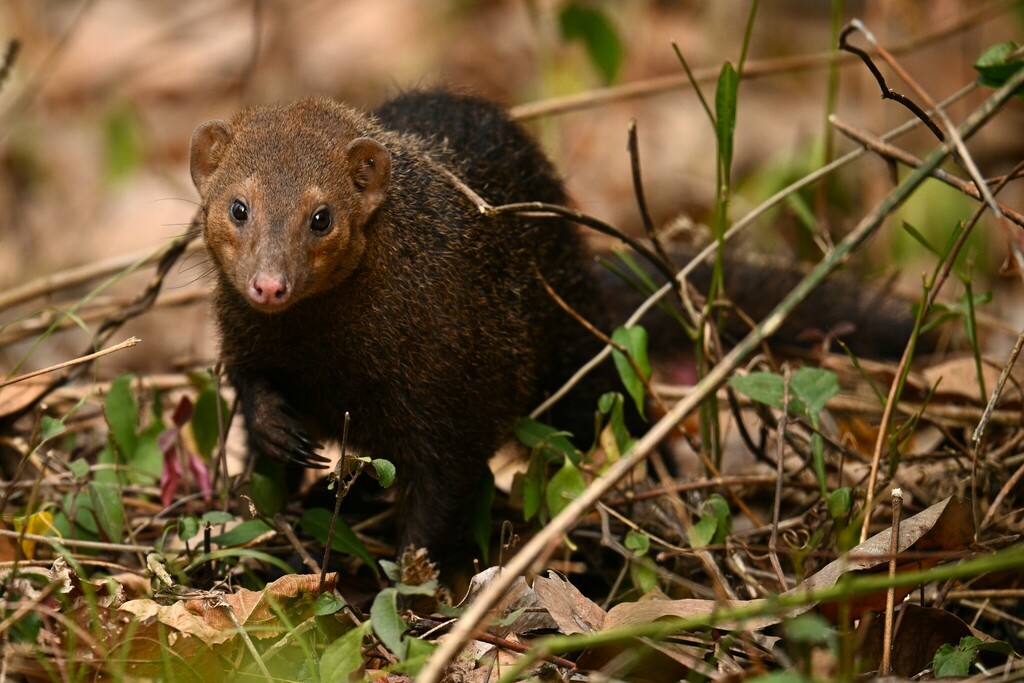
Flat-headed Kusimanse
Crossarchus platycephalus
The flat-headed kusimanse (Crossarchus platycephalus) is a dwarf mongoose endemic to Benin, Cameroon and Nigeria. This species was once regarded as a subspecies of the common kusimanse (Crossarchus obscurus).
From the article Flat-headed kusimanse on Wikipedia (CC BY-SA), quoted section by section
Description
The flat-headed kusimanse has a head to body length of 30 to 36 cm (12 to 14 in) with a long tail measuring 16 to 21 cm (6.3 to 8.3 in). The body is slender and elongated with dark brown or black fur and a mane on the neck. There are five toes in front and rear paws with the front paws have strong claws. The males are slightly larger than the females. An average male weighs about 1 to 1.5 kg (2.2 to 3.3 lb), while an average female weighs between 0.5 to 0.9 kg (1.1 to 2.0 lb). Both sexes have a pair of anal scent glands located in the hind part of the body.
Range & habitat
The flat-headed kusimanse is native to Central Africa, with a range extending from southern Benin and southern Nigeria via Cameroon and Equatorial Guinea to the Central African Republic and the northwest of the Republic of the Congo up to an elevation of 1,600 m (5,200 ft). It inhabits dense lowland rainforests and damp savannah landscapes.
Wikipedia: “Distribution and habitat”
What it does
The flat headed kusimanse is mostly terrestrial, and often forages on rocks, and burrows for termite mounds. It can climb trees, and has a particular affinity towards the fruits of African oil palm trees. Its arboreal skills serve as a refuge from predators, and for other activities. It can be tamed and is cooperative with humans. It is probably diurnal and lives in groups that roam around its territory without a fixed structure. It is generally carnivorous and looks for invertebrates and small vertebrates on the forest floor or in rotted tree trunks.
== References ==
Wikipedia: “Behavior”
Listen
Looking for field recordings…
Where it lives
Recorded sightings
—
geo-referenced records in GBIF, from museums, herbaria and field observers.
Drag the globe to turn it. Dots are where records exist, not a range map; darker means more records.
In the stacks
Searching the stacks…
Every page naming Crossarchus platycephalus in the Biodiversity Heritage Library →
This page is assembled live from iNaturalist, GBIF, Wikipedia, the Source Library and the Internet Archive. It is not yet part of the hand-edited codex. iNaturalist taxon 74221.