On eBird ↗
Palmchat
Live sightings near you, the range map, bar charts of when it is seen, and Macaulay Library photos and recordings.
Palmchat
Dulus dominicus
The palmchat (Dulus dominicus) is a medium-sized passerine bird endemic to the Caribbean island of Hispaniola (split between the Dominican Republic and Haiti). It is the only species in the genus Dulus and the family Dulidae, and is related to the waxwing family Bombycillidae and the silky-flycatchers in Ptiliogonatidae. Its name reflects its strong association with palms for feeding, roosting, and nesting.
From the article Palmchat on Wikipedia (CC BY-SA), quoted section by section
Description
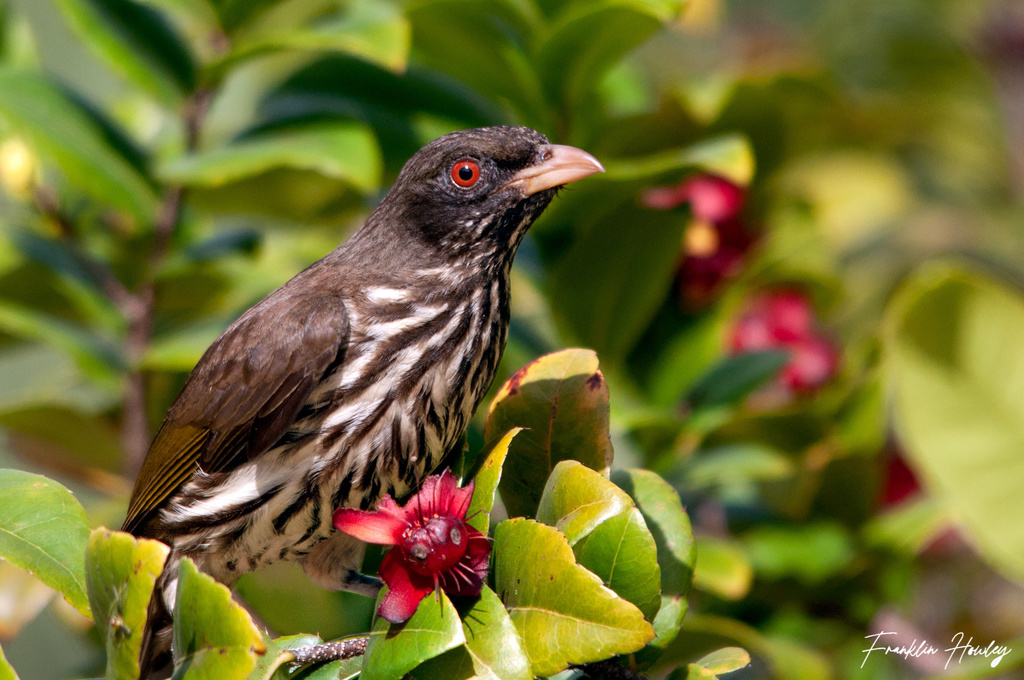
Palmchats are medium-sized passerines, about 18–20 cm (7–8 in) in length and weighing 41–52 g (1.4–1.8 oz). Their appearance has been described as "moderately odd" by the Handbook of the Birds of the World, having relatively small heads, short yet deeply-curved yellow-horn bills and long necks. The wings are long and rounded, and the feet are large and strongly-clawed. The plumage is olive-brown above, and heavily streaked with brown below. Their rumps, as well as the uppertail-coverts, are dark greenish-olive, and the tail is brown. The primary feathers are yellow-green. They lack the soft silky plumage of the waxwings or silky-flycatchers. Adults show no sexual dimorphism in plumage, but the males have slightly larger wings. Immature birds resemble the adults but have darker throats and forenecks and buff-coloured rumps.
Range & habitat
The species is endemic to the island of Hispaniola (in both Haiti and the Dominican Republic), and the adjacent Saona and Gonâve Islands, where it is common and widespread. It inhabits areas from sea level to 1,800 m (5,900 ft). The species occupies a wide range of habitats, most commonly open savanna where royal palms are most common, but also other open, semi-open or even broadleaf and pine forest. They are only absent from the highest mountains and dense closed forest. Where its food trees are present, it has adapted well to human-modified habitat such as farmland city parks and gardens. The species is not thought to be migratory. Some have suggested that it may undertake localised movements after the breeding season, but the only evidence is a slight reduction in observed birds during this period in some areas. The species is a poor disperser and is not found on islands close to Hispaniola, although there is one uncorroborated report of a palmchat from Jamaica.
Wikipedia: “Distribution and habitat”
What it does
Palmchats are very sociable birds, often seen in small flocks containing several pairs, which will roost closely together with their bodies in contact.
Breeding. Palmchats build large, conspicuous, communal nests of twigs which may be up to 2 m (6.6 ft) across, with each pair of palmchat having adjoining nests with their own separate chambers and entrances. These nests are typically occupied by four to ten pairs of palmchats, but nests containing up to 50 have been recorded. The Puerto Rico royal palm, (Roystonea borinquena) and Hispaniolan silver thatch palms (Coccothrinax argentea) are the preferred tree for nesting in, but they will also less frequently nest in cana (Sabal domingensis) and coconut palms (Cocos nucifera), or other trees and even telephone poles may be used. In general, trees selected for nesting tend to be larger (in circumference and height) than those not, and trees with other trees nearby are also seemingly preferred. There has even been one unusual report of a palmchat nest on a rock islet off the coast. An important aspect of nest site selection is that the branches of the selected tree do not touch those of other trees, and therefore nesting rarely occurs in dense forest. These nests are also used for roosting even outside the breeding season, and are maintained throughout the year. …
Wikipedia: “Behaviour”
Listen
Looking for field recordings…
Where it lives
Recorded sightings
—
geo-referenced records in GBIF, from museums, herbaria and field observers.
Drag the globe to turn it. Dots are where records exist, not a range map; darker means more records.
In the stacks
Searching the stacks…
Every page naming Dulus dominicus in the Biodiversity Heritage Library →
This page is assembled live from iNaturalist, GBIF, Wikipedia, the Source Library and the Internet Archive. It is not yet part of the hand-edited codex. iNaturalist taxon 7434.