- Animals
- ›Chordates
- ›Vertebrates
- ›Mammals
- ›Therians
- ›Placental Mammals
- ›Primates, Rodents, and Allies
- ›Primates
- ›Lemurs, Lorises, and Allies
- ›Lemurs
- ›Lemurs
- ›Typical Lemurs
- ›Hapalemur
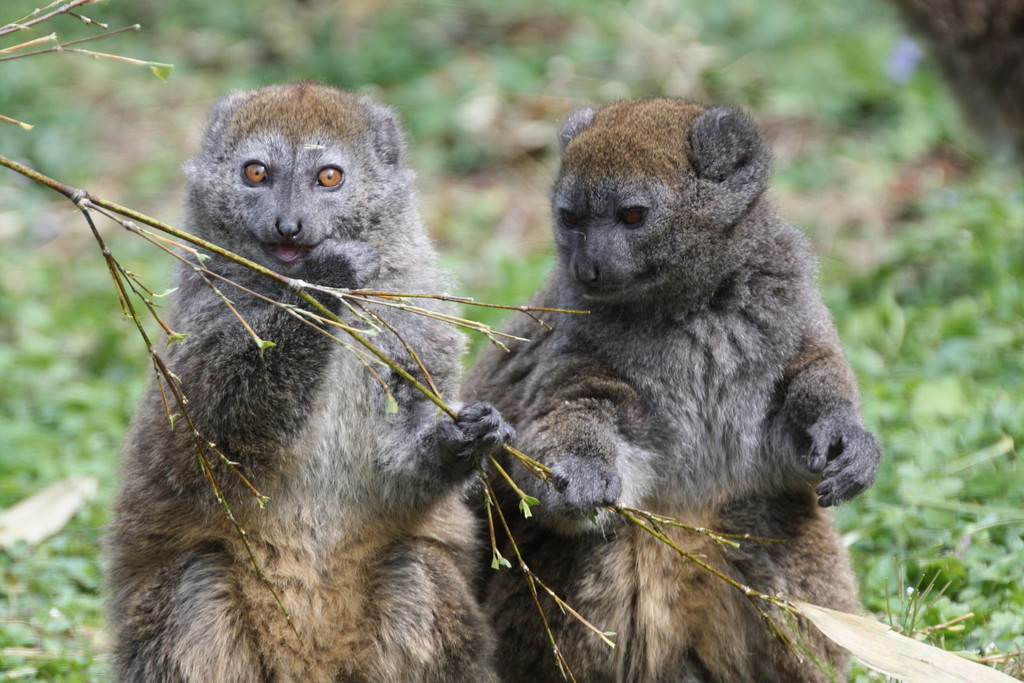
Alaotran Bamboo Lemur
Hapalemur alaotrensis
The Lac Alaotra bamboo lemur (Hapalemur alaotrensis), also known as the Lac Alaotra gentle lemur, Alaotran bamboo lemur, Alaotran gentle lemur, Alaotra reed lemur, or locally as the bandro, is a bamboo lemur. It is endemic to the reed beds in and around Lac Alaotra, in northeast Madagascar. It is about 40 cm (16 in) long, with a similar length tail, and is a brownish-gray colour. It is the only bamboo lemur to live in and feed on papyrus reeds, and other reeds and grasses, and some authorities argue that it should be regarded as a subspecies of the eastern lesser bamboo lemur (Hapalemur griseus). The population of this lemur has been declining because of habitat destruction and the International Union for Conservation of Nature has rated it as being "critically endangered".
From the article Lac Alaotra bamboo lemur on Wikipedia (CC BY-SA), quoted section by section
Description
The tail and body of the Lac Alaotra bamboo lemur are both 40 cm (16 in) on average, and it weighs 1.1–1.4 kg (2.4–3.1 lb), with males slightly larger than females. Its dense, woolly fur is a gray-brown on the back, lighter gray on the face and chest, and chestnut brown on the head and neck.
What it does
This lemur is the only primate specifically adapted to living in papyrus reeds. Unlike other bamboo lemurs, the Lac Alaotra bamboo lemur does not eat bamboo; instead, it feeds on the stems of papyrus reeds, shoots of the grass Phragmites communis, and two other species of grasses (Echinochloa crus-galli and Leersia hexandra).
Wikipedia: “Ecology”
Listen
Looking for field recordings…
Where it lives
Recorded sightings
—
geo-referenced records in GBIF, from museums, herbaria and field observers.
Drag the globe to turn it. Dots are where records exist, not a range map; darker means more records.
In the stacks
Searching the stacks…
Every page naming Hapalemur alaotrensis in the Biodiversity Heritage Library →
This page is assembled live from iNaturalist, GBIF, Wikipedia, the Source Library and the Internet Archive. It is not yet part of the hand-edited codex. iNaturalist taxon 74404.