- Animals
- ›Chordates
- ›Vertebrates
- ›Mammals
- ›Therians
- ›Placental Mammals
- ›Ungulates, Carnivorans, and Allies
- ›Bats
- ›Yinpterochiroptera
- ›Rhinolophoid Bats
- ›Old World Leaf-nosed Bats
- ›Hipposideros
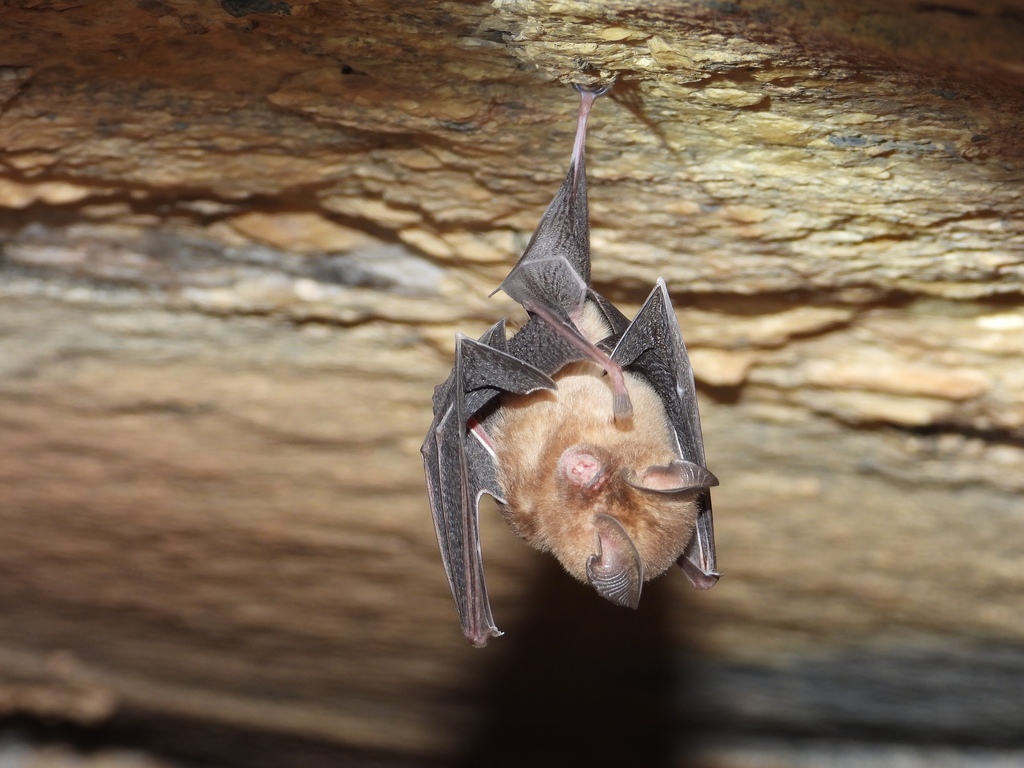
Durga Das's Roundleaf Bat
Hipposideros durgadasi
Khajuria's leaf-nosed bat (Hipposideros durgadasi), also known as Durga Das's leaf-nosed bat, is a species of bat in the family Hipposideridae. It is endemic to India. Its natural habitat is caves. It is threatened by habitat loss.
From the article Khajuria's leaf-nosed bat on Wikipedia (CC BY-SA), quoted section by section
Description
The fur is soft and brown to reddish-brown on the dorsal surface and whitish on the ventral surface. The bat, like other species in the bicolor group, lacks supplementary leaflets. The anterior leaf possesses a median emargination and is covered everywhere with short, stiff black hair. The internarial septum is well-developed and has a short base and a bulbous apex. The nostrils are oval in shape and they possess narial lappets on the outer margin. The tail of the bat projects beyond the interfemoral membrane, and the baculum is 1.3mm long, with a C- shape. The presence of a well-developed internarial septum of peculiar shape (with a short base and a bulbous apex), the fact that the tail projects beyond the interfemoral membrane, and the conspicuous C-shape of the baculum are some of the characters of H. durgadasi which render this species distinct from its sister species.
Range & habitat
The bat is endemic to India and known from the villages of Katangi, Katanga and Richhai in the district of Jabalpur in Madhya Pradesh and the villages of Hanumanahalli and Therahalli in the Kolar district of Karnataka. In 1998, a team from the Zoological Survey of India also found 9 individuals in a roost site in Loyudhan Falls in the Mirzapur district of Uttar Pradesh. However, specimens of H. durgadasi have not been spotted in the original type locality for almost 30 years. The bat's known range extends over 114,335 km2, however, the bat only occupies around 2,000 km2 of that. It inhabits areas from 347 to 900 m above sea level. The bat roosts in colonies of several individuals in cave systems and is also found roosting below large granite boulders and in caves. It has been observed roosting with other species of bat, but has also been found to roost purely with members of its own species in a cave. The bat mainly forages in dry tropical deciduous forest and tropical thorn forest.
Wikipedia: “Habitat and distribution”
Listen
Looking for field recordings…
Where it lives
Recorded sightings
—
geo-referenced records in GBIF, from museums, herbaria and field observers.
Drag the globe to turn it. Dots are where records exist, not a range map; darker means more records.
In the stacks
Searching the stacks…
Every page naming Hipposideros durgadasi in the Biodiversity Heritage Library →
This page is assembled live from iNaturalist, GBIF, Wikipedia, the Source Library and the Internet Archive. It is not yet part of the hand-edited codex. iNaturalist taxon 74420.