- Animals
- ›Chordates
- ›Vertebrates
- ›Mammals
- ›Therians
- ›Placental Mammals
- ›Primates, Rodents, and Allies
- ›Primates
- ›Lemurs, Lorises, and Allies
- ›Lemurs
- ›Lemurs
- ›Sportive Lemurs
- ›Lepilemur
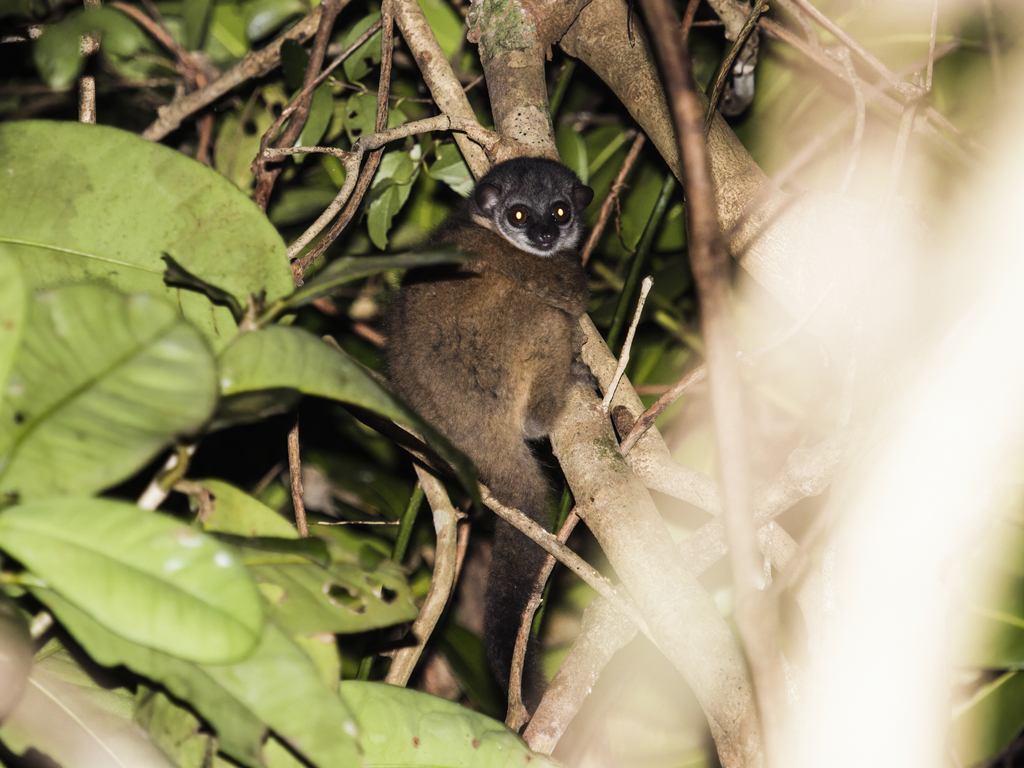
Seal's Sportive Lemur
Lepilemur seali
Seal's sportive lemur (Lepilemur seali), or the Anjanaharibe-Sud sportive lemur, is a sportive lemur endemic to Madagascar. Previous to a 2006 genetic analysis showing the species to be distinct, it was thought to be a population of weasel sportive lemur (Lepilemur mustelinus). Like all members of its genus, it is nocturnal and largely folivorous. It is threatened by habitat loss, hunting, and climate change.
From the article Seal's sportive lemur on Wikipedia (CC BY-SA), quoted section by section
Description
Seal's sportive lemur has long, thick fur that is uniformly light chocolate-brown to reddish-brown above and lighter brownish grey below with cream-tipped hairs on the sides of the belly. The face is light brownish grey, with a yellow to white collar on the neck. The hands and feet are light, greyish brown. The tail is brownish grey, and sometimes possesses white-tipped hairs. It is a medium-sized Lepilemur, with a total length of 53 cm (21 in), of which 27 cm (11 in) is the body and 26 cm (10 in) is the tail. It weighs approximately 950 g (34 oz).
Range & habitat
Seal's sportive lemur is found in northeastern Madagascar, where it is known at least as far south as the Fananehana River and no farther north than the Bernarivo River. However, the exact boundaries of the species' range are not clear. Within its distribution, Seal's Sportive Lemur occupies mid to high altitude humid rainforests, preferring undisturbed low-canopy forests that have good availability of sleeping holes in old trees.
Wikipedia: “Distribution and habitat”
Listen
Looking for field recordings…
Where it lives
Recorded sightings
—
geo-referenced records in GBIF, from museums, herbaria and field observers.
Drag the globe to turn it. Dots are where records exist, not a range map; darker means more records.
In the stacks
Searching the stacks…
Every page naming Lepilemur seali in the Biodiversity Heritage Library →
This page is assembled live from iNaturalist, GBIF, Wikipedia, the Source Library and the Internet Archive. It is not yet part of the hand-edited codex. iNaturalist taxon 74500.