- Animals
- ›Chordates
- ›Vertebrates
- ›Mammals
- ›Therians
- ›Placental Mammals
- ›Ungulates, Carnivorans, and Allies
- ›Bats
- ›Yangochiroptera
- ›Noctilionoid Bats
- ›New World Leaf-nosed Bats
- ›Nectar Bats and Allies
- ›Lonchophyllini
- ›Lonchophylla
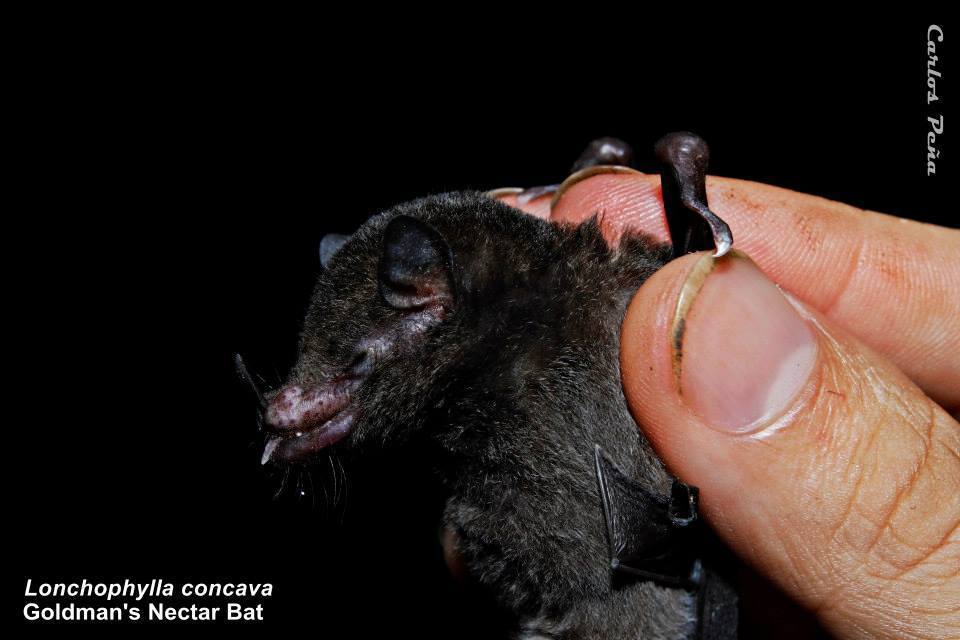
Goldman's Nectar Bat
Lonchophylla concava
Lonchophylla concava is a species of leaf-nosed bat found in Central and South America. It was long considered a synonym of Goldman's nectar bat, though is now recognized as distinct. It consumes nectar and pollen.
From the article Lonchophylla concava on Wikipedia (CC BY-SA), quoted section by section
Description
Lonchophylla concava has a forearm length of 32.0–34.6 mm (1.26–1.36 in). Females weight 7.0–8.0 g (0.25–0.28 oz) while males weigh 7.0–9.0 g (0.25–0.32 oz).
Range & habitat
Lonchophylla concava is found in Central American and South America, including Costa Rica, Panama, Colombia, and Ecuador. It has been documented at a range of elevations from 0–1,000 m (0–3,281 ft) above sea level.
== References ==
Wikipedia: “Range and habitat”
What it does
Lonchophylla concava is nectarivorous and palynivorous, consuming the nectar and pollen of Mucuna and banana plants. It also consumes some butterflies and moths. During the day, it roosts in caves.
Wikipedia: “Biology and ecology”
Listen
Looking for field recordings…
Where it lives
Recorded sightings
—
geo-referenced records in GBIF, from museums, herbaria and field observers.
Drag the globe to turn it. Dots are where records exist, not a range map; darker means more records.
In the stacks
Searching the stacks…
Every page naming Lonchophylla concava in the Biodiversity Heritage Library →
This page is assembled live from iNaturalist, GBIF, Wikipedia, the Source Library and the Internet Archive. It is not yet part of the hand-edited codex. iNaturalist taxon 74509.